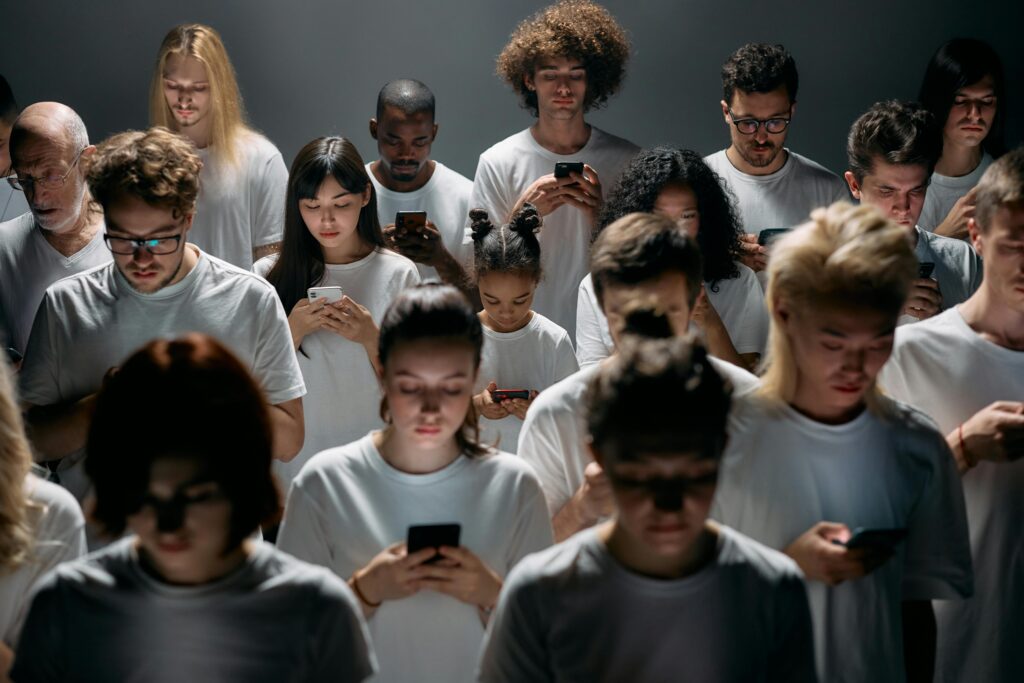


People born since the emergence of technology and its incorporation into various aspects of daily life have been called digital natives. They are considered experts in digital knowledge and are distinguished by how they understand and use technology compared to previous generations. Despite limited empirical studies, the term has gained widespread acceptance over time, leading to negative repercussions for people already facing social inequality.
The concept of “digital native” gained traction in 2001 when technologist Marc Prensky coined it. He defined digitally native people as those born after 1980 who came to a world influenced by the internet rather than newspapers or television, so they have a natural understanding and operation of digital tools, unlike digital immigrants who do not master them.
Prensky said at the time of writing this article that young people had been immersed in technology from birth, which gave them characteristics such as high levels of digital skills, the ability to multitask, media literacy, constant connectivity, the need for fast delivery of information, the culture of sharing data, and a unique attitude towards education. In addition, he argued that the rapid arrival and spread of technology had transformed how students think and process information, making it difficult for them to succeed academically under pedagogical methods of the time that they considered “obsolete.”
However, no scientific or sociological studies backed these statements. Most individuals born before 1980 accepted its veracity, feeling it made sense. While it is true that the generation of 1940, for example, has found it challenging to deal with digital resources, it does not mean that those who started with these tools have an innate understanding of them.
History of the Theory and its Transcendence
A study by the National Library of Medicine of the United States explains that generational theory was developed in sociology to clarify the differences between population groups. The German sociologist Mannheim established that the analysis of generations provides a means to understand society, and these groups were formed through experiences and events shared throughout history. In addition, later specialists concluded that this classification provides flexibility and new perspectives to address social problems and promote solutions.
In 1998, a business strategy expert, Don Tapscott, defined the “Net Generation” as a force for social transformation that, through digital media, would develop and superimpose its culture on the rest of society. Several years later, Prensky published his text, and after this, other authors called youth with these attributes “millennials” (Howe & Strauss, 2009), “digital orphans” (Susana Lluna, 2017), and “digital cretins” (Michel Desmurget, 2019).
In turn, the British pedagogue specializing in the sociology of education, Rebecca Eynon, highlighted that some believe that new technologies have forged forceful characteristics in the lives of young people, affecting how they communicate, socialize, create, and learn. She adds that Prensky sees them as digital native speakers in the languages of computers, video games, and the internet, warning that education must change to support them: the digital immigrants guide and teach the young students.
For her, the idea of the digital native has both positive and negative connotations. On the favorable side is the understanding of young people and their use of technology. The scientific community did not consider the experiences and perspectives of young people until the 1960s when they became a research focus. Any initiative encouraging researchers, policymakers, teachers, and other actors to pay attention to young people’s use of digital resources is valuable.
Eynon believes there is some truth in the premise because more young people use the Internet than the generations preceding them. Age is usually a crucial factor in models that explain who benefits more from technology. Likewise, some theories are related to this reasoning; for example, new media connect generations, which unites them in a common culture (Jenkins, 2009), and technology serves as a way to experience autonomy and personal control over different aspects of life (Buckingham, 2008; Davies & Eynon, 2013).
However, Eynon warns that conceptualizing young people in this way is delicate. If we consider everyone born after 1980 a digital native, then a broad range of individuals of all ages and stages of life are covered, i.e., a significant proportion of the population. Thus, the term is meaningless since, technically, many caregivers and teachers are now as competent as their young counterparts.
Similarly, she observes that this discourse frames the relationship of youth with technology in a dystopian way. Promoting a utopian vision where young people have innate digital abilities ignores the fact that vulnerable children can be exploited by technology or exposed to undesirable content. She even insinuates that the experts and teachers are novices and that young people should teach them how to use these tools.
Eynon stresses that these issues are visible in the popular and political discourse on young people, perpetuating this theory and gaining ground in debates about the future of education. Prensky observed that his proposal gained acceptance; however, although these statements aroused interest and became part of the cultural and academic lexicon, they remained unfounded. The technologist tried to support his approach with other publications but was unsuccessful.
On the other hand, some studies analyzing the role of technology and youth have determined that:
- The frequency of using digital platforms is confused with a skill.
- Technologies for “living” are mixed with those for “learning.” Devices such as mobile phones used in everyday life are employed for learning, but their purposes differ.
- The wide technological diversity and differences lead to digital divides, raising concerns about equity and justice in education.
Various studies have refuted the myth of the digital native and questioned the discourse. Authors like Diego Levis have criticized the term, arguing that a date of birth is not a factor of inclusion or exclusion in society. He points out that “it is a propaganda slogan of a reactionary nature that hides, among other things, the inability we have to understand the behavior of young people, their motivations, and their needs.” Likewise, he maintains that being young does not translate into mastering technology because some young people are almost digitally illiterate even when they have the means at their fingertips.
The French newspaper Le Monde published a report that questioned the youth’s digital skills, not including the use of social networks or blogs, with testimonies from teachers who detailed the difficulties of incorporating computers into their teaching of young people. They emphasized how complicated it is for adolescents to search and select information online. Similarly, research at Stanford University revealed that several students who could be categorized as digital natives lacked critical competencies to evaluate the information found virtually.
Prensky recognized that this notion has been disproportionately misunderstood and simplified, ignoring the need for education and digital skills training. Professor Edwin Ortiz Herazo declared that these skills are not due to the birth era but to learning and continuing education.
Problematic Implications and Better Understanding
Enrique Dans, a professor who teaches innovation, shows that it is a mistake to assume that young people are better prepared to deal with technology because it has been a regular part of their environment. Because of technology’s omnipresence, it is not a foreign concept to them, but they are not instructed at all to use it. He points out that young people do not have any genetic modification that prepares them differently; if they are skilled in technology, it is because it’s within their reach, especially because today’s devices are manufactured and programmed increasingly intuitively.
“Let’s consider that technology, like any other environment, requires responsible accompaniment, a dedication of time and resources, didactics, and a series of rules,” adds Dans.
Sue Benett, Karl Maton, and Lisa Kervin detail in their text The “Digital Natives” Debate: A Critical Review of the Evidence that no study shows that people called digital natives are more apt with technology. They suggest that the notion that these individuals have sophisticated knowledge and high abilities should be relativized at the very least.
Having the facility for basic hardware and software operation does not mean that young people better understand the digital framework of today’s society; i.e., it is difficult for them to comprehend the activity of the social ecosystem like previous generations. To this end, the philosopher and expert in technology and society, Ferran Adell, explains that it is essential that someone provides young people with the relevant resources to understand the digital framework in which they operate today, generating a context that promotes citizens’ criticality and engagement in social transformation.
This is imperative because the current debates on educational policy and best practices are rooted in the mentality that contemplates that students born in an era of digital media are different from previous ones. This results in teachers, educational administrators, and policy and media managers assessing that a different approach is necessary for them. Perhaps a different technique in education is needed, but not from unsubstantiated conjectures.
Because Prensky was unable to prove his theory, uncertainty about the applicability of his concepts permeated, especially in countries with various educational contexts, limited access to technology, and economic and social circumstances that restrict the benefits of the virtual environment; this is the digital divide (Van Dijk, 2006).
Prensky’s concept also evoked other concerns. If this idea were accurate, the pedagogue Paul Kirschner and the researcher Pedro De Bruyckere suggested it could be interpreted that teachers of digital natives, being digital immigrants, impede the learning of young people and that then when these young people become teachers, the problem will resolve itself.
Therefore, the non-existence of this notion would help teachers avoid assuming that their students have talents and competencies that they lack. Thus, like any other skill, digital abilities must be taught, accompanied, and acquired correctly.
“Digital skills are not binary. It’s not that you have them or you don’t. There’s a huge spectrum. We say, ‘Oh, well, they have a smartphone; they must have skills.’ But that’s really not the reality of how skills are acquired,” mentions Amanda Bergson-Shilcock, a senior fellow at the National Skills Coalition.
Another concern Kirschner and De Bruyckere highlight is promoting the widespread myth that people can multitask. This attributes alleged capabilities of human cognitive architecture and information processing capacities when several studies have shown that multitasking harms cognitive, productivity, and mental health processes.
Similarly, Inmaculada Jauregui, a clinical psychology and research doctor, declares that excessive digital sensory stimulation produces attention, concentration, memory, and learning disorders. She highlights studies on how sleep interferes with memory after watching videos or playing video games.
Considering all of the above, Rebecca Eynon identifies three compelling problems as risks when discussing the digital native:
1. Supporting children in an age of networking—People use technology differently for different reasons and in different ways, which has more to do with their stage of life, their social context, or their interests than with their ability or inability to use digital resources.
- The “digital natives” rhetoric actively disempowers many people (educators) who could help youth.
- Schools, parents, and guardians play a leading role in young people’s digital experiences, helping them access technology, develop digital skills, and provide support networks addressing technology and dealing with online threats, safeguarding their privacy.
- It is essential to create educational systems that support a joint vision as a society on how young people relate to technology. The lack of conscious debate can hurt individuals who already experience social exclusion.
2. Digital inequalities—Some research has proven the differences between how young people interact with technology and the advantages they gain from it based on socioeconomic factors. For example, people with limited economic resources tend to have lower-quality access to these tools, and fewer individuals can support them; therefore, they are usually less skilled.
- The inability to access the online platform to perform the assigned task disfavors their development.
- Not having the skills required to make the most of technology excludes and segregates them.
- It is necessary to design policies that address digital inequalities by committing to systemic changes and rethinking the structures that condition them. Having a laptop does not eradicate complex family problems such as not having daily food, heating, medical care, or job opportunities.
- For Ortiz Herazo, assuming that youth have uniform access ignores the significant variations in each person’s context according to their environment.
- The digital gap involves the lack of access to technologies of people such as rural residents, low-income households, people with low levels of education, and those in developing countries.
3. Acceptance of the status quo—The “Digital native” speech stimulates the idea that all use of technology is exciting and advances the notion that it will empower future society. This thinking leads to a widespread acceptance of the status quo, contemplating that these resources are beneficial and that young people must be able to leverage them.
- Other cases that cause concern are related to commercial companies benefitting from digitally monitoring young people’s data. For this, it is imperative to observe the role of corporate actors and third parties using educational technology to collect, store, and process information.
So, in reality, if many children and teenagers manage applications properly, it has more to do with the developer’s capacity to generate attractive tools. However, this does not mean young people can safely leverage their digital potential or browse online.
Likewise, an additional problem concerns teachers’ training and digital competencies. Some teachers are not confident enough to lead activities requiring virtual media literacy. Therefore, it is essential that educational institutions and public policymakers invest in training programs that make them active participants in these latent needs. In this way, it is possible to provide new citizens with sufficient resources to conceptualize the social impact of technology.
“We need more than a tech center that tells people how to connect to the WiFi — we need drop-in centers where people who do need help don’t feel bad asking for it,” states Clay Shirky, the Vice-Provost for Educational Technologies at New York University.
In 2009, Prensky transformed the terminology of “digital native” into digital wisdom. He stated that as generations progress in the 21st century, they will all have grown up with technological resources, which blurs the distinction between digital natives and immigrants. He also discerned that digital literacy and critical competencies are essential and asked educators to rethink their teaching approaches to the new generations.
The premise of digital natives minimizes the intention of understanding youth’s connection with technology. Reframing the discourse to find answers, backed by research, is essential to building an innovative and fair education system. Even though what is meant by “digital native” has altered over time, defining students as “digital learners” places them at the center of education rather than pigeonholing them into predefined properties and standardizing learning.
Translated by Daniel Wetta