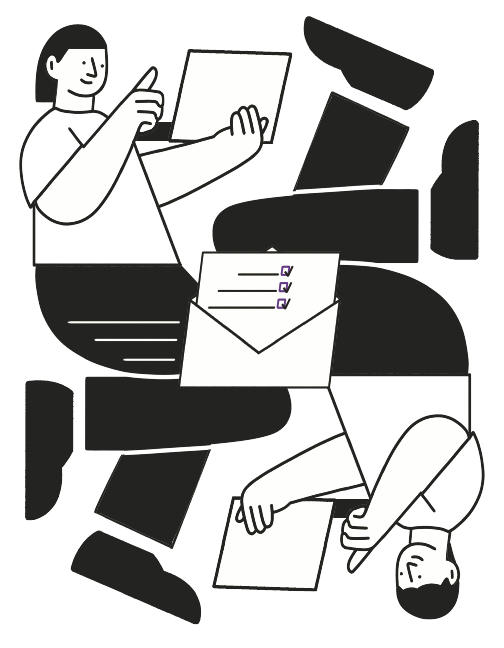


In a previous article, I wondered how much we could reduce our social lives to purely virtual exchanges without them becoming unsatisfactory. I started from the extreme idea (perhaps fictitious, though one no longer knows) of someone who had no face-to-face relationships but could continue to live only through online relationships. From there (and how empty such an existence would sound, if it were really possible), I questioned what things would constitute the minimum to achieve a certain plenitude. My deep reflections led me to three obvious conclusions: that we should maintain “live” relationships with our closest loved ones, limit online sexual experiences (privileging the shared and the face-to-face), and leave our locality from time to time to get to know other human and natural environments to determine if what we see on our electronic devices has anything to do with reality.
I knew that all my speculation, although amusing, was just a game because it omitted the obligation of billions of people to leave home to go to work. Even so, there was some seriousness to it because I am almost certain that, if it were ever possible to do without face-to-face jobs, most people would give them up and gladly lean towards the virtual, even beyond the obvious limits I find in it.
Not all of us experience face-to-face interactions as the best. So, I return to the question of how much we can do without it in our social life.
In my view, we will be able to answer this question —fundamental in our day— if we first inquire into the essentials of our relationships with other people, and from there try to discover which parts of it could pass into the virtual world without detriment.
For me, the answer goes back to the day of our birth, to our arrival in the world. At that moment, and in the life experiences closest to it, we can already see everything that we will later seek in our relationships with others. If we understand what those first days reveal, perhaps we can glimpse what human beings expect from each other, not superficially but essentially, which is what really matters when calculating the risk our lives run when moving to the virtual.
I do believe that human beings are born, in some way, already equipped to establish transcendent relationships with others. We discover this if we reflect on, according to my philosophical fantasy, the two main propensities already present in our first contact with the world: that of giving ourselves to others and that of receiving those who want to give themselves to us. This double movement describes our social being more than anything else.
We give ourselves wholeheartedly and immediately to others as soon as we are born, as bearers of a treasure for those around us: “We bring cake to the party,” as the saying goes, and we only need someone to take it and enjoy it. The treasure is us, of course.
As for receiving, we do it, yes, for survival, but not in the selfish sense of being centered on ourselves, but as beings completely open to the world to receiving the gifts, treasures that they are, that others want to give us.
The notion that babies are born deprived of everything, even meaning, does not seem to me superior to the idea that they arrive already with the capacity to give themselves to others and to receive them; to be received and to find another who wants to give to them. Nursing our mother’s breast, for example, is not extracting something from her but opening our body to her, who also wants to give herself to us. Perhaps this image is clearer if we compare giving and receiving to a pitcher pouring while the glass is filling, as a single event occurring simultaneously in two bodies. In fact, in the mother’s womb, our bodies prepare to seek the world: sheltered in darkness, the eye, for example, develops in anticipation of light.
Being received and receiving is like the flow of air and breathing: two natural movements, one centrifugal, outward, and the other centripetal, inward. If we are well received and if we are trusted to give of ourselves, we will flourish as soon as we are born; we will be fulfilled just by arriving. But we must be clear that this purpose can be lost, just as the natural function of breathing can, and then we will have to find a way to restore it.
Few things are as painful as a person refusing to enter with us into this kind of circle of the soul. The frustration can be great, to the point of forcing us to degrade ourselves before our own eyes, giving ourselves to the outside world even when there is no one there to receive us; to submit to a non-existent being to flee from our own history. This is precisely the tragedy of the contemporary world: generations and generations of us giving everything without knowing to whom, working without knowing who will receive what we do, giving ourselves regardless of who receives what we do, and receiving from those we would prefer not to give us. Producing, producing, producing… giving the best of us… to no one: in the best of cases, this self-exploitation (as Byung-Chul Han calls it), this producing and producing only for ourselves, leaves us sad, empty of meaning; at worst, if we succeed, egomania turns us into monsters.
I feel that it is now becoming clear to me what I understand as the magic of our arrival into the world, as well as the risk of its non-fulfillment. We can now investigate to what extent and in what aspects virtual life manages to recover and make this cycle of mutual surrender and mutual reception flourish. The non-presencial: does it allow others to receive me and for me to receive them? In a word: is virtual hospitality possible? Everything revolves around that.
Let’s begin again with the baby’s life. The first thing that comes to mind is those two types of union that are as important as they are indisputably presential: breastfeeding and holding. Since there is no “non-presencial” version of them, we can skip them and go to the next thing. Thus, I arrive at a third form of encounter, which now points to the possibility of the virtual: looking, seeing one another. We know its importance, how the baby and the mother meet in each other’s gaze; experiencing the feeling of carrying themselves within. The same happens with the father, and the siblings… and with all who approach with trust and love. This extends to all of us, regardless of age: when two human beings really look at each other, they are welcoming, even if the situation announces a challenge or a debate, a confrontation “in a fair fight,” as they say. (On the other hand, suspicious, “out of the corner of the eye,” scrutinizing, or analytical looks are never mutual; they are neither welcoming nor are they well received).
Is it possible to look at each other in the virtual world? In remote conferences, we certainly see each other’s eyes. But is that a seeing look? Do the eyes on screen meet, embrace, give and receive each other?
For now, technology has not reached the point where we can lock our gazes in virtual space and time. The “live” intertwining of the eyes, which, as we know, can delve as deep as the soul itself, is one of the things we miss most in our videoconference chats. If one day we manage to make the gazes engage (with something like nano cameras embedded in our pupils), then we will see if that give-and-receive also flows at a distance, through the technological network.
I would love to continue with the infinite list of receiving/being received from the moment we are born (sharing smiles, caressing each other, kissing, bumping noses), things that we don’t know if they can migrate entirely to the virtual. (Will there be remote touching at some point?). But the reader’s time is running out (we will talk, one day, too, about the supposed law of brevity in today’s virtual life). So, I will give just a couple more examples, concentrating on two fundamental types of encounters that, I imagine, we all know are possible virtually: crying and laughing.
Crying is possible live or on the phone, watching a movie, or on someone’s shoulder (or both). In our grief, we may feel comforted by a friend or by a character in a series, and likewise we may experience their sorrow. Compassion is a feeling that does flow through virtuality and, for many people, flows better through it. I insist that I do not believe the hug of someone close to me can be replaced, but I do know that a sincere, deep hug is not easy to give, and that sometimes distance helps one feel the presence of the other.
Laughter is another primary sensation that can be shared virtually; in virtuality, it can be a means of expression and extraordinary flourishing. Since the beginning of cinema, movie screens have been populated with comedic geniuses, as if they were a natural environment for them, almost to the point of excluding any other access. A good example is Charlie Chaplin.
Why is humor, one of the most vital forms of human communication, extraordinarily compatible with the virtual? Important thinkers—such as Henri Bergson and Edward de Bono—believe that laughing and making people laugh are among the highest expressions of human intelligence. We know well that comedy is transmitted, not so much through physical proximity as through oral and body languages, which, like all languages, are composed of intelligible symbols: Symbols are words, conscious gestures, and mannerisms, and all those kinds of behaviors that comedians intentionally use to trick and stimulate our intelligence. Symbols need only the textual, visual, or auditory streams to be shared. Virtuality is a perfect medium for laughing together.
Before I close, I want to return to the subject of giving and receiving and confessing an idea that comes to me suddenly, in the light of all that I have said above. In its first version, this article discussed the act of writing and the possibilities one has to express oneself and communicate with one’s readers through this medium. I decided to remove that when the subsequent approach apparently took a different direction, but now I understand why I thought about it that way. My real question, when reflecting on my work as a writer, comes down to the same thing I have been saying: for whom do I write? It’s as simple as that. Does this medium, undoubtedly virtual (not only because it is on the internet but also because it is made of symbols that “represent me”), justify my feeling such deep emotion and my gratitude for the contact I have with you, dear reader? Or am I a person writing alone, at best like someone casting a bottle with a message into the ocean waves, probably without any intended recipient?
Is anyone there?
Knock-knock.
Translation by Daniel Wetta