
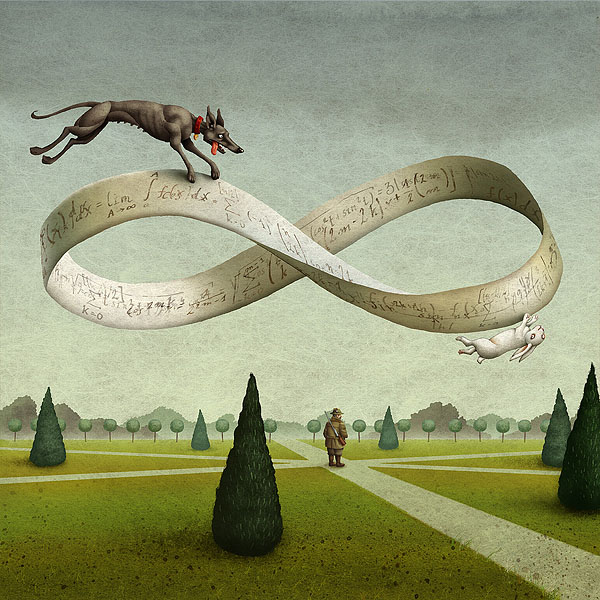
Towards the middle of the nineteenth century, the mathematician August Ferdinand Möbius discovered something interesting and funny. If you take a strip of paper (about forty centimeters, say) and glue its ends together, you will obviously get a circular band, which, for example, you can put on your head like a crown. Now, if you take another strip of the same paper, but before joining its ends, you give one of them a half-twist, what you will have is a second, poorly made crown, twisted, worthy of a jester with a crooked mouth. This second band is called a Möbius Strip or Möbius Band.
Unlike the first crown, which has two sides (one facing your hair and the other visible to others), the Möbius strip has only one side: if you run your finger along it, after eighty centimeters you will return to the same point. By a kind of mathematical spell, with that one little twist, you can now move to the “other side” without lifting your finger, and then return to the “first” side, also without lifting it. The Möbius strip has only one side.
I tell you this because I want to explain how my family and I once performed a prank that, unintentionally, turned out to be very similar to the above. We entered a place through a door, we went out through that same door to a different place, and we returned to the starting point just by repeating the sequence in reverse. And it wasn’t that hard. You see, we took a suitcase of clothes and stayed at a hotel in the historic center of Mexico City, where we lived at the time. We spent the night and, when we went for a walk the next morning, the city looked different. Or, rather, we felt that we were seeing it for the first time. With this small twist in our daily lives, we became tourists in a place we had never seen, even though we had been there a thousand times. Everything surprised us: our city’s radiant palaces, its spectacular shops, its magnificent spaces. Even the flag that flew in the great square seemed to belong to another country.
We spent the day enjoying novel food—which we had tasted a thousand times—watching hundreds of passers-by, many of them tourists like us, and finally, in the evening, we returned to the hotel. We slept, and the next morning, as planned, we checked out and went back home. As soon as we left the hotel, the historic center looked to us the same as always. We had returned to our place of departure.
One of the strangest things about that walk, when things seemed new to us, was that we could feel we were another person. Suddenly, I was a tourist from another country; I seemed imbued with the spirit of someone else visiting Mexico City for the first time. On the one hand, I saw “another side” of the same thing; on the other, and this was the funny part, I seemed to be experiencing things as if from another side of me.
I baptized this marvelous experience (I can’t call it anything else) as Moebius Tourism. (I feel sure that if we had returned home without first going back to the hotel, leaving our clothes and car there, today we would still be living in that twilight zone, that unknown dimension).
Interested in pedagogy, I can’t help but think that the novel sensation I forged with the simple, but disruptive, act of staying in a hotel in my own city can be revived in a teaching-learning strategy.
It all starts, of course, with the unusual decision to go on a family trip to “our own home.” This daring in how we discern and decide things, this twist in everyday inertia, is called lateral thinking by the psychologist and philosopher Edward de Bono. Lateral thinking describes moments of originality (that is, a return to the origin, a real “reset”) when human beings can see, as if for the first time, things that have always been there. Such a thing allows us to see attributes we had not noticed before, or, in the case of problems, solutions we had not considered.
In a beautiful old movie called The Gods Must Be Mad, a young Bushman named Xi, who has never had contact with anyone outside his small town, suddenly finds himself walking through the desert and fleeing from civilized men who want to kill him. Xi, who at this point in the film has already made friends among the “good” whites, knows how to start an open-top Jeep in drive and move forward. Thus, when chased by the thugs, he can jump into the Jeep and start to flee. But (oh, misfortune!) his friends, who were not with him, had left the shift in reverse, and the car started to go backwards. As anyone would be, Xi is surprised by this unexpected motion. But is it really a disgrace? Surely it would have been for us, accustomed to unidirectional ways of thinking. However, for the “savage” and multilateral Xi, the situation soon ceases to be a problem: moving to the other side of the world, he stops, sits on the hood with his legs towards the steering wheel, and, controlling it, drives the car in reverse as if he were facing forward.
It is one of cinema’s great moments. It makes us see how a response that, for our apparently naïve character, is the most natural, is, for us, a real turn of the screw, a confrontation with a new world: not only a different way of seeing the one we inhabit, but an immersion in a true new reality.
Lateral thinking is not just an occurrence, or even a brilliant idea: it means, I say, moving to the other side of reality and putting ourselves in a different place: another world, practically.
That is what I would like to bring to the classroom: a watershed that can, suddenly (like hope falling from the sky), infuse the world of students (and, of course, teachers), suddenly erasing everything they know and providing them a new learning opportunity. In a world like ours, increasingly unidirectional and narrow, the arrival of something unexpected can open us to new knowledge.
That twist of the screw might be no more than a detail. Humor, for example, can function this way: as we all know, a good joke in the middle of class is capable of completely renewing the willingness to teach and learn. And if it is not just a good joke but a whole way of being, that is, a teacher who is sympathetic by nature (and who uses humor not as a distraction but as a continuous didactic, intelligent, and sensitive turn of the screw), then we can speak of a true case of lateral pedagogy.
The only bad thing about this is that one cannot advise teachers to be nice, because it would be like suggesting they be tall or short, or have a different eye color. The ability to use humor is very personal (so it’s better not to advise those who don’t have it to tell a joke, much less their students!).
Perhaps the easiest thing is to suggest to teachers that they try to introduce a playful environment in class. Playing is more widespread than comedy and may be within most teachers’ abilities. We could almost say that “it’s a matter of letting go,” and, of course, of inventing or collecting good games. A great example of how far this can go is in the film “Radical,” where, going out of his usual box, the actor Eugenio Derbez portrays a primary school teacher capable of leading his students, ordinary kids, in the desolate landscape of education in Mexico, to become a model group at the national level – all through the seriousness of the game (seriousness that he, moreover, applies in all aspects of his life). The film begins when the children enter the first class and find the teacher crawling on the floor, urging them to climb onto their benches to prevent the ground/sea in which he is “swimming” from devouring them. Immediately, the game sets in motion a mathematical exercise that consists of… But I won’t tell you more: watch it!
Inventing games – and, above all, proposing an unusual way of learning – would be, very well, part of a lateral pedagogy, in which many other examples would fit. Years ago, I was invited by the Ministry of Public Education to create a show — “preferably interactive” — to be presented in public elementary schools in the country. I came up with the following: I summoned an actor who, because of his physical appearance, could very well give the appearance of a young judge, and I took him to present himself to the children as if he really were: “I am Judge ‘Salomón’… and I invite you to do an activity together about ethical values and their importance when applying the laws.” Divided into teams, the students then set about constructing a small ship that would represent society, including its flag, captain, crew, and a list of shipping criteria and purposes.
They were working on it – and everything was going well – when the good Balderón de la Charca burst onto the stage, a clown with a red nose and shoes, saying that the SEP had scheduled a lecture for those students at that same time. Judge Solomon tried to conciliate, but the clown’s disruptive nature made it impossible. Half an hour later, the good conciliatory judge had become a madman, making it clear that his ability to apply the rules in peace – that is, aligned with the values that he himself proposed – was collapsing as he collided with this reality that was suddenly imposed on him. Thus, he ended up subduing Balderón by force and improvising an arbitrary children’s court to punish him.
The key to the success of that show was the actor playing the judge sustaining his role, convincing girls and boys from beginning to end that he really was. That way, the “audience” would “live” the event as a real event and would experience firsthand the drama that values suffer when they have to be applied in judicial reality. I don’t know if we achieved the objective, but that was the intention.
Experiments like this were undertaken in the seventies by the Brazilian director Augusto Boal through a series of practices he called invisible theater. Boal had an actress and an actor pretend to be a married couple and enter a supermarket, she leading him by a dog leash around his neck. To spark discussion among the customers, a third actor reproached the couple for their behavior, and another actress came to their defense, pointing out their right to relate as they chose. Thus encouraged, all those present engaged in a lively debate, which other actors and actresses sought to lead, to provoke an outbreak of social consciousness (those were times when the art of protest was at its peak). In the end, the cast revealed their true identity, but I’m sure that if they hadn’t, at least some of the attendees would have wondered one day whether they had dreamed it or whether it had come true.
Could something similar be done in the classroom? Could someone interrupt, playing a character to provoke opinions or even question the teacher’s approach to some crucial concept? What if, while the teacher was talking about Christopher Columbus’ discovery of America, an actress, pretending to be a cleaning clerk —circumstantially present in the room—interrupted to comment that the real “discoverers” had been nomads who arrived many centuries before, giving rise, with her comment, to an argument against Eurocentrism (and teaching, also, that in school not only can the usual “knowledge” be questioned and also that there is no single way of learning)?
Invisibility could become extreme. Let’s imagine a mathematics course in which, on the first day of classes, the arriving students (who would be of different ages: let’s say, young people but also older adults) find, not a teacher crawling on the floor, but a note written on the blackboard, which says: “Dear students, welcome. I am your teacher. I am invisible—hidden—among you. You see, in this game, you have two challenges: one, to cover the entire textbook for the final exam, and the other, to discover who I am. To achieve both, you can ask each other all the questions you want, about mathematics, of course, but also about your personal lives. The only question not allowed is: “Are you the teacher?“
The note would end with the remaining game instructions, possible scenarios, and rewards for those who guess correctly.
The idea of such a dynamic – perhaps it is already clear – is that, motivated by the presence of a hidden teacher, the students would look to each other for answers to the problems in the book, and find and share solutions, yes, with the help of the undercover teacher, but also on their own. Surely, with a good book, they would discover the methods sooner or later.
But the height of invisibility, Moebius’s real twist, would be that, in the end, there were no teachers in that class. Thus, the students would truly enter an alternate world and, in addition to learning mathematics, they would, to their surprise, discover that they had unintentionally developed new skills, “as if by magic”.
I’m almost finished.
The School of Moebius invites, of course, the development of many more dynamics than those I mention, inspired by the tactic of the invisible. However, the truth is that I don’t know how far an educational model based on this kind of transmuting alchemy can be developed (which, I confess, is starting to give me a bit of vertigo).
Such experiences may help manage new levels of learning by breaking through, even if only slightly, the limits of teaching. Looking at common things in a new way could provide unprecedented insights. Perhaps experiences that are a little risky would bring sensations, emotions, and even discarded ideas to the surface, capable of renewing the meaning behind why human beings continue to go to school.
But we must not rule out that, when it comes to evaluating their didactic value, our ingenious and innovative dynamic activities reveal themselves to be insubstantial; i.e., isolated experiences, incapable of coupling with other cognitive links: fun and idle adventures, as delightful as wetting your feet on the beach and enjoying the moment. I myself, if I am frank, could describe my experience in the historic center of Mexico City as an extraordinary event, but unrelated to any other fact and, therefore, incapable of becoming true knowledge.
And yet (a new twist) we might not fail to wonder if that pure fun, that volatile surprise, like a game of sleight of hand, is, in the end, a living part of the spirit of teaching, a spirit capable of uniting the appropriation of knowledge with joyful immersion in the pure instant.
Could they, in reality and in unreality, have only one face? As the old TV show said, “Anything can happen in the Twilight Zone.”
Translation by Daniel Wetta