)
)
)
)

The answer to this article’s title question may seem obvious. Often, listening complements reading—listening to a classmate, reading aloud and following the reading, writing a dictation, or even reading messages from our cell phones with background music. It clearly seems like an ally.
However, when it comes to books versus audiobooks, many people erect barriers separating the value of both alternatives, either due to misconceptions such as that one is more complex than the other or that the same human senses used to comprehend or imagine the background of a text are not the same. However, the two have a few differences; each has its benefits, and it is necessary to learn to accept these paths to achieve the same goal.
Let us remember that in the past, stories from Greek mythology were told by word of mouth, and people who could read and write were the minority. Likewise, not even that long ago, radio was the primary means of communication; entire families gathered to listen to the latest news or entertainment programs. Listening to an audible story is nothing new, so why do audiobooks “don’t count” for some?
Some people believe that comprehension is deeper when reading than listening because the former requires more concentration. It should be noted that listening does not yield reading comprehension; instead, it provides listening comprehension. Studies show that listening and reading stimulate the same cognitive parts of the brain. Our imagination functions similarly through both mediums: we have to imagine scenarios, characters, and situations. A difference is that in audiobooks, we hear tones of voices, which can bestow additional value to what we take in if there is a good narrator; in addition, we can learn the correct pronunciation of words.
Reading improves our reading skills, just as listening improves our listening skills. Therefore, the more we do of either of them, the more we understand the information received through reading or listening. Both modalities expand our cognitive skills.
Reading is also “more difficult than listening,” but “difficulty” does not prove that one option is better. Listening to books is passive consumption for some people who think reading is more challenging. However, as mentioned above, the same parts of our brains are used; moreover, emotionally, both have the same effect when immersing ourselves in a literary experience. Studies have found that the impact of feeling captivated or trapped by the story is the same in our brains, regardless of whether we listen or read.
Audiobooks as a means of accessibility and continuous improvement
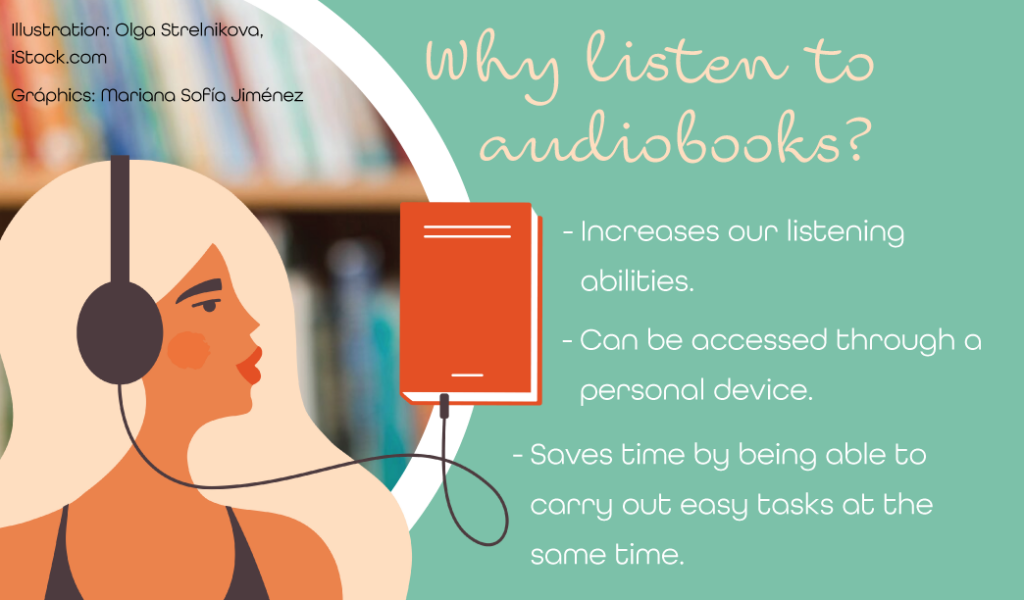
For many, there’s nothing like the feeling of our eyes falling on the text of a page and turning them with our fingers. However, it is tedious for others to carry a book everywhere, either because it is heavy or because of the fear of mistreating it. Here is where the nature of the audiobook facilitates accessing any text: not only one but many books can be accessed through the convenience of our mobile device, which never leaves us without a book when we are away (or not) from home.
When we read, our eyes stare at the words on a page or screen, so all our attention must be directed to reading to understand it as much as possible; the ideal requires stillness. However, an advantage of audiobooks is that they save time from our day since they allow performing other simple tasks while listening is more manageable. We can listen to an audiobook during a walk in the park while folding laundry, washing dishes, or being stuck in traffic. However, it’s essential to notice that performing more complex tasks will mean the information we hear will not be processed entirely. We must avoid multitasking, which will only result in our activities not having optimal quality and comprehension.
Access to printed or published texts on the Internet is limited for people with visual impairments or conditions such as dyslexia or hyperactivity. However, audiobooks offer them an excellent alternative. Although not all books have audio versions, the outlook is increasingly bright as this medium is increasing its popularity: it is estimated that by 2030, the global market for audiobooks will reach 35.04 billion dollars.
Since they are allies, why not combine both options? Reading and listening to the same text could be incredibly helpful for maintaining concentration and expanding vocabulary by listening to the correct pronunciations of uncommon words. If you are currently learning a new language, doing so can accelerate your learning. Whether your language is native or not, you will have a broader overview of text structure, improving your grammar.
No matter the medium, immersing ourselves in new worlds to which different authors invite us through their books, in their different formats, drives us to learn and become familiar with new teachings, cultures, and ideals. Regardless of how we enter a new universe, what’s important is that we create a habit of reading or listening to books and enjoying their contents, incidentally opening ourselves to the many benefits they give us.
Translation by: Daniel Wetta

)
)
This article from Observatory of the Institute for the Future of Education may be shared under the terms of the license CC BY-NC-SA 4.0