)
)
)
)

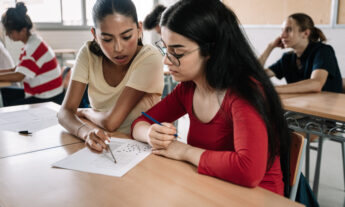
As the teaching-learning process evolves towards active practice, the teacher ceases to be a mere transmitter of information and becomes a facilitator. In this environment, where the student assumes a participatory role rather than merely receiving messages, peer learning is positioned as a key strategy and an effective process. This method demonstrates the ability to generate and consolidate knowledge through teaching others.
According to Jake Hansen, peer-to-peer tutoring in a supervised environment improves data retention because teaching a concept to another person requires understanding it beforehand. Thus, the exchange of knowledge benefits both the learner and the teacher, as the latter reinforces and deepens their own learning.
Various learning strategies support this theory; however, Lev Vygotsky coined the term scaffolding, which refers to the process in which an adult helps a child carry out a task. One of his most significant contributions was the sociocultural theory of development, which explains how social and cultural interactions influence cognitive development and learning in childhood. As Andrea Álvarez details, Vygotsky established that children do not acquire knowledge in isolation; rather, they build knowledge through connections with others, especially adults or more competent peers.
Specifically, the concept of peer instruction was developed in the 90s by Harvard University Physics Professor Eric Mazur. Mazur describes this interactive teaching method as a dialogue between students on the same subject to achieve a deep understanding. After noticing that his students struggled to grasp certain concepts, he transformed the classroom into a space for debate and reasoning through guiding questions.
In this scenario, as the magazine UNIR puts it, the teacher abandons the role of speaker and the learner ceases to be a passive listener who only memorizes. The teacher serves as a facilitator or mentor, rather than simply rating answers as correct or incorrect, moderating the discussion to encourage reflection, debate, and critical thinking.
Thus, Mazur establishes four stages of the peer learning method:
- Outside the classroom, students become familiar with the material that the teacher has provided through readings and questioning.
- At class time, a debate on a particular topic is promoted, based on the answers to the questions previously presented by the teacher.
- Each student gives their personal stance after exchanging their ideas and thoughts with other classmates.
- After sharing as a group, students answer the initial question again, giving either the same answer or a modified one after introspection.
Other theories that support peer-to-peer learning include constructivist and connectivist theories. The first is linked to the experience, beliefs, and knowledge each student has already acquired; in its social aspect, also derived from Vygotsky, it states that learning is an active, social process. The connectivist theory, introduced in 2005 by George Siemens, argues that technology is closely linked to learning. From this perspective, discerning what information is relevant is essential, especially in a context where many students are online and exposed to large volumes of information. Understanding these social and digital environments contributes to more effective learning interactions.
Likewise, cooperative learning encourages students to talk and bond without fixed roles; all members of a group work toward a shared learning goal. This approach often takes the form of Problem-Based Learning (PBL) and involves solving real-world problems.
In short, peer tutoring is based on the interaction between a mentor, usually a student with a stronger command of a particular topic, and a classmate who needs their support. Under this methodology, the roles are dynamic and interchangeable depending on the topic. Learning becomes bidirectional: the tutor reinforces their knowledge by explaining concepts and understanding others’ perspectives, while the supported student consolidates their learning by processing information and articulating their own ideas, thereby clarifying them.
Benefits of Classroom Collaboration
There are several advantages to implementing peer-to-peer learning to gain a deeper understanding of a particular topic. Mazur asserts that education should not be reduced to the transfer of knowledge, but should focus on students and require them to assume some responsibility for their learning.
Below are some benefits of incorporating this methodology as a learning tool in the classroom. This compilation brings together the recommendations of authors such as Eric Mazur, Jake Hansen, Nailah Herbert, Nell Derick Debevoise Dewey, and Ceri Jones.
- Peer-to-peer tutoring promotes greater interaction and dynamism in the classroom, increasing student engagement. In addition, more time is spent in this space.
- In-depth conceptual learning is possible, so the student can apply what they have learned.
- There is a strengthening of argumentation and communication skills for their interpersonal relationships.
- It reinforces teamwork, cooperation, and patience.
- It improves feedback for recognizing areas of opportunity and developing new solutions.
- It provides greater confidence in their knowledge and interactions with people, which can translate into lower rates of student absenteeism and dropout.
- It favors the diversity of opinions and thoughts. Knowing different contexts and situations allows students to enrich the panorama and, therefore, the learning process.
- It reinforces real-time learning.
- It creates a space of mutual respect and shared goals that are achieved faster and more efficiently, which helps educational programs reduce costs.
- It lets students hear real experiences of others and discover better ways of doing things, not merely taking an established path.
- It is a realistic and achievable model that motivates peers, even within the same class.
Beyond the academic context, peer-to-peer knowledge construction contributes to learners’ future professional lives. Students will be able to innovate, adapt, and collaborate effectively in multidisciplinary teams.
Critical Implementation Challenges
On the other hand, Hansen describes some possible limitations to adopting this methodology. For some people, especially younger students, learning from their peers can be as distracting as it is stimulating. If they are peers with a strong emotional bond, they are more likely to stray from the topic.
Likewise, others may not respect their peers’ feedback or comments. In general, when a teacher makes recommendations, students tend to listen carefully because the teacher is an authority figure. However, it’s easier to ignore an idea or advice from a peer.
The journal UNIR also reflects on obstacles that education experts observe with this method, such as the difficulty students sometimes have committing to working through the materials before taking the class. Even for teachers, the time spent planning and preparing a subject is greater.
Peer-to-peer learning models
Far from being rigid, peer-to-peer learning offers a range of strategies and modalities to facilitate its implementation in the classroom. For example, Hansen proposes the following:
Proctor model: A more experienced student teaches a younger or less experienced student. This can happen between students of different academic grades or even between students in the same class.
Discussion seminars: Debating manifests different perspectives and deepens understanding. These seminars are usually more common in college.
Peer support groups: These meetings are led by students, usually outside the classroom and without teacher accompaniment. Thus, classmates study for their exams or work on group projects.
Peer evaluation: Informal peer feedback is common in writing courses.
Collaborative projects: Students work in groups to deliver a project within a specified timeframe. Their interactions lead to collaboration and the development of various interpersonal skills.
Cascading groups: Student teams increase or decrease progressively. For example, a student may learn a topic individually, then discuss it in pairs, and finally share it with others.
Mentoring: Someone with expertise in a certain area guides and supports a mentee. This can include peer mentoring or, in other cases, a student who requires additional support and has a mentor work with them one-on-one.
Reciprocal teaching: Learners teach each other and develop skills in questioning, predicting, summarizing, and clarifying.
Jigsaw method: Students are divided into groups, and each group studies a different topic. Then, one member of each group joins a new group to discuss other topics, allowing discussion of multiple concepts.
Five steps to successful execution
Several decades ago, Topping and Ehly proposed a model for successfully implementing peer-to-peer learning in five steps.
- Organization and commitment: First, establish a structure for interaction; the key is to give immediate feedback. While it takes time for the teacher to grade, classmates can correct themselves on the spot as long as the environment allows for a continuous flow of comments.
- Provocation of cognitive conflict: Real learning entails a challenge. The “cognitive conflict” makes the student notice a discrepancy between what he believes and his peer’s information. Thus, students question their own ideas, there is greater participation, and knowledge is co-constructed.
- Scaffolding and error management: The most advanced students act as a “scaffolding,” supporting others to solve problems they may not be able to do without help. In this case, the tutor monitors his classmate and detects errors to reinforce his mental agility.
- Active communication: To explain a concept, the student must first process and organize it in their mind. This facilitates communication skills that are transferable to their professional life.
- Affectation management and motivation: Emotional factors such as trust, mutual responsibility, and a sense of belonging will be vital to admit doubts. In a trustworthy, shared leadership environment, motivation will increase.
Finally, the methodology prepares learners for future work and professional environments that are multi- and transdisciplinary. These environments will require adaptation and critical thinking, so recognizing how to solve problems and work together will be essential regardless of the branch of the profession they choose.
Peer learning is strengthened in an environment of collaboration, dialogue, and acceptance of others as legitimate sources of knowledge. Sharing experiences not only enriches individual trajectories but also creates meaningful learning communities.
What models would you apply in your approach to peer-to-peer learning?

)
)
This article from Observatory of the Institute for the Future of Education may be shared under the terms of the license CC BY-NC-SA 4.0