

Children’s increasing access to digital devices has sparked widespread debate about the potential impact of screens on language development during early childhood. However, screen use and its relationship with the development of children’s language is a more complex issue than normally portrayed.
The risks of screens in early childhood development
Various studies, such as those by Madigan et al. (2020) and Nwachukwu et al. (2025), have found correlations between prolonged screen use during early childhood and increased risks of language development difficulties. On average, children with more exposure to electronic devices tend to have a later onset of their first spoken words, a more limited vocabulary, and greater difficulties in understanding and using language effectively. In addition, studies such as that of Massaroni et al. (2023) have indicated that these children may face challenges in social communication, such as conversing, responding to others, carrying out age-appropriate communicative exchanges, and alternating conversational turns.
However, evidence indicates that these effects do not depend solely on the use of screens, but also on how they are used. The correlation between screen time and language difficulties is most significant when exposure begins before the age of two, a particularly sensitive stage for brain development and the acquisition of communication skills. During this period, children learn language primarily through direct interactions with the people around them.
Moreover, the risk seems to increase with high exposure time and passive content consumption, for example, by spending long periods watching videos instead of participating in activities that stimulate communication. In these circumstances, the opportunities to listen, answer, ask questions, or share experiences with others are greatly diminished, reducing the experiences that favor language development.
Language Development in Early Childhood
Language development in early childhood is a progressive process that begins in the first months of life and builds through constant interactions between the child and the people around them. Although children are born with biological capacities that allow them to acquire language, this development depends largely on exposure to sounds, words, gestures, and meaningful conversations. During the first years, they go from producing sounds and babbling to understanding words, expanding their vocabulary, forming sentences, and using language to express needs, emotions, and ideas.
Family interaction is essential in this process, since language is learned in social contexts. Everyday conversations with parents and caregivers (such as responding to the baby’s sounds, naming objects, reading stories, singing, asking questions, and waiting for answers) provide opportunities for the baby to listen to language structures, practice new sounds, and learn the meaning of words. These shared communication experiences, known as serve and return interactions, favor the development of brain connections associated with language and communication.
In addition, the quality of the interaction is as important as the number of words that the child hears. An adult who follows the child’s lead, responds to their interests, and adapts to their way of speaking facilitates deeper learning by turning daily activities into communicative opportunities. Conversely, when opportunities for conversation and shared play decrease, infants have less experience practicing essential language skills.
Screens, by themselves, are not the cause of language delay; rather, their influence depends on how, how much, and in what context they are used, especially in relation to the opportunities for communicative interaction that adults provide.
Are all screens the same?
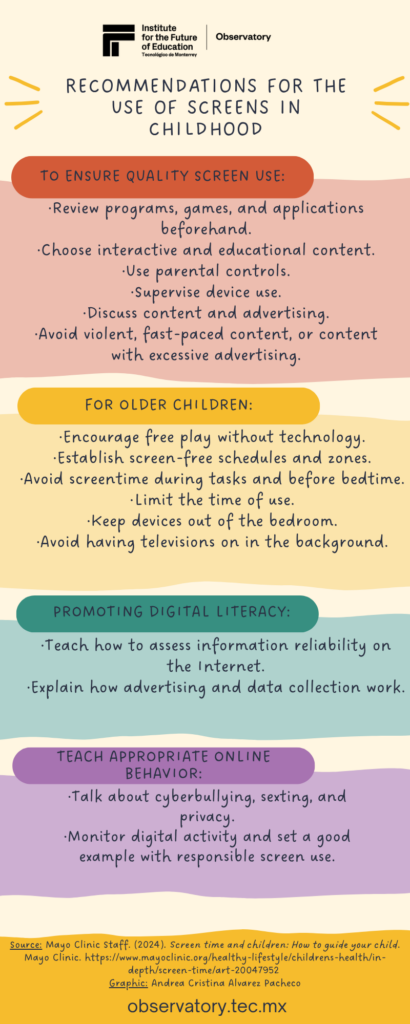
The impact of screens on language development will depend largely on several aspects, such as exposure time, the quality of interactions, and the child’s family context. Previously, the American Academy of Pediatrics (AAP) recommended screen time limits that changed based on the child’s age: it recommended limited use by the youngest children, while prioritizing quality content and a healthy balance in older children and adolescents.
However, in its latest updates, the AAP warns that there is no precise amount of screen time that can be considered universally safe or appropriate for all children and adolescents. Instead of focusing solely on time counts, it recommends looking at the quality of digital media consumed, the type of content, how children and adolescents interact with technology, and the perceived impact on their development, relationships, learning, and emotional well-being. In addition, to promote healthy habits, it recommends establishing screen-free spaces and times, especially during family meals, and removing electronic devices from bedrooms between 30 and 60 minutes before bedtime to promote rest.
Language Difficulties and Higher Education
Various studies indicate that problems in language development can persist into adulthood and affect important areas such as education, employment, and social participation. A study by Conti-Ramsden et al. (2018) found that young adults with these problems, compared to their peers without this condition, had, on average, lower levels of academic and professional training and a greater need for educational support. In addition, the results showed great variability, with some people managing to complete their studies and obtain good work results, especially when they had adequate support strategies.
On the other hand, a systematic review by Gillespie et al. (2020) confirmed that young people with problems in language development may face greater difficulties during the transition to adult life, especially in areas related to education, employment, and independence. These difficulties do not affect all people in the same way, as factors such as the level of support received, educational opportunities, and the development of compensatory strategies can significantly influence results. Specifically in the university context, these difficulties are reflected in tasks that require advanced use of language, such as understanding classes with specialized vocabulary, participating in debates, organizing written assignments, or communicating confidently in academic and social situations.
Meaningful Screens
The impact of screens on the development of children’s language does not depend only on their presence, but also on the place they occupy in everyday life. Technology can become a tool for learning and communication when it is used intentionally, with appropriate content, with the accompaniment of an adult, and with opportunities to talk, play, and reflect on what is observed.
Rather than asking how much time children spend in front of a screen, we should ask ourselves what experiences the screen contents are replacing and what new opportunities they can offer. Human interactions, shared play, and conversations are still the primary drivers of language development. Therefore, the objective is to integrate screens purposefully, ensuring that they complement, not replace, the experiences that allow them to communicate, learn, and build relationships with those around them.
Translation by Daniel Wetta