

In January of this year, the Digital Education Council (DEC), in collaboration with Tecnológico de Monterrey’s Institute for the Future of Education, published a study it conducted with the participation of professors and students from 29 Latin American universities on the use of Artificial Intelligence (AI) in education. Universities from the AI Global Education Network (AIGEN), led by Tecnológico de Monterrey and six other universities in the region, participated in the study. The results of this AI in Higher Education Latin America Survey 2026, available free of charge on the DEC website, constitute essential knowledge for understanding teachers’ and students’expectations and needs regarding AI in education. Its findings are relevant not only to higher education institutions in the region, but also to governments and decision-makers at all levels.
The results confirm a growing student adoption of AI, rising from 86% to 92%, while among teachers the growth was much greater: from 61% to 79%, an increase of 18 percentage points, compared to the 2025 global survey.
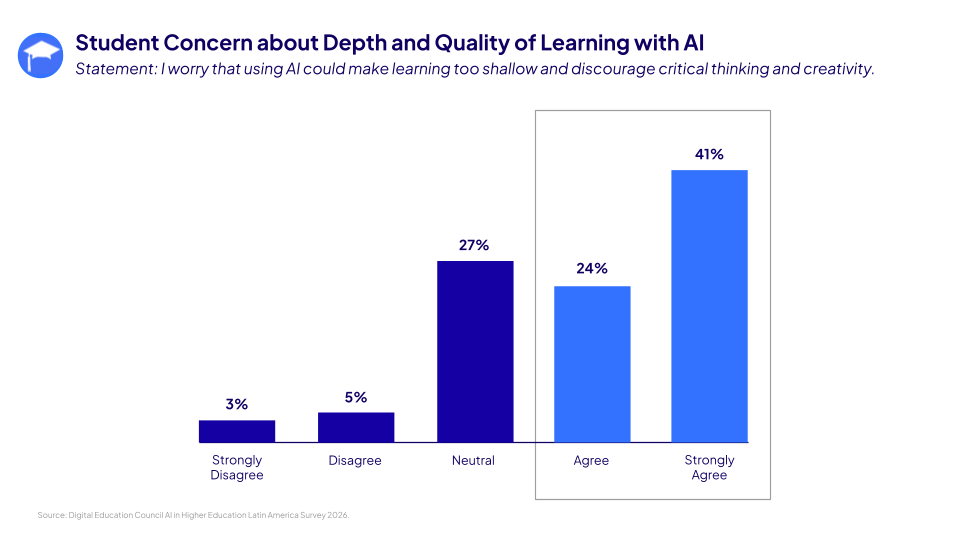
Students express mature opinions on the use of AI. Although two-thirds of the students surveyed view it positively, 65% fear that its use will lead to superficial learning and discourage both critical thinking and creativity. The study indicates that students also understand the impact of this technology in the workplace: 73% expect to continue using AI in their future jobs, and their mastery of it makes them confident in their performance after graduation.
For their part, teachers also show more confidence in using artificial intelligence in education. Their positive opinion increased from 57% to 72% in 2026, although 88% of teachers report using it moderately. 76% use AI to create teaching materials, but only 36% of teachers teach their students how to use it. This may be related to their concern that students will develop an overreliance on this technology, or to their perception that students cannot critically evaluate AI-generated results. And while 76% of teachers anticipate significant changes in their practice, only 12% perceive AI as a threat to their employment. The survey also debunks the belief that the longest-tenured teachers are the most resistant to adopting AI, showing similar adoption and perception rates across different age ranges.
However, clearly, teaching practice is evolving in the age of AI: 48% of teachers believe that task redesign is necessary to ensure their effectiveness and preserve learning outcomes. Half of the teaching staff feel that these changes must be significant and short-term, if not urgent. Facilitating critical thinking is perceived as the most important teaching skill for future educators, and the responsible and ethical use of AI and technology is the second most relevant.
The survey also sheds light on AI literacy. Using the five dimensions proposed by the DEC for AI literacy as a reference, teachers and students were asked about their level of AI mastery. Students report a low level of proficiency (1.5/4.0 on average), indicating that they lack sufficient criteria for evaluating AI-generated content or recognizing its biases. However, the majority recognize current trends, and 53% can use AI tools in their future career field.
Teachers’ AI literacy levels (1.6/4.0 on average) are only slightly higher than those of students. 53% of teachers report being able to promote responsible, ethical, and inclusive use in AI-assisted, human-centered environments. The results also show that teachers with greater AI literacy are more aware of the changes caused by the rise of artificial intelligence, the transformations ahead, the role this technology can play in improving the quality of teaching, and the need to prepare students to use AI in the future labor market.
The survey also provides valuable information for institutions. Students report that the key factors for developing AI skills are access to tools and resources (66%), clear guidelines for using AI appropriately (47%), and opportunities to interact with and learn from AI in the classroom (43%). For their part, teachers identify the lack of knowledge on how to start using AI as the main barrier to adoption, with key enablers: teacher training in AI knowledge and skills (68%), access to tools and resources (63%), and the collection of good practices and use cases for AI integration (51%). Finally, 77% of students with high AI literacy demand institutional training in this subject; however, 51% with lower AI literacy show little interest in training, suggesting a potential gap that could widen if not addressed.
Ultimately, this report will help institutions prioritize strategic actions to promote the responsible and effective use of AI in education. It presents a pressing call to establish transparent governance of the use of this technology. We invite you to learn more about the survey and the actions undertaken by AIGEN universities to promote the responsible use of AI in Higher Education.
Reference
Digital Education Council, AI in Higher Education LATAM Survey 2026. https://www.digitaleducationcouncil.com/post/ai-in-higher-education-latam-survey-2026