)
)
)
)

Perspectives come and go, but the truth is that those of us dedicated to education have not been able to stop thinking lately about the risk that the teaching profession runs in the face of artificial intelligence and other electronic means. Recently, my thoughts on this matter have led me to imagine what it was like in the past, rather than conjecturing what awaits education in the future. Although these are only fantasies, a clear image has come to me that the educator position has been threatened continuously throughout history.
In my fanciful ruminations, some arts always accompanying the teaching profession are intertwined. One is the theater, historically considered a source of social education, and today almost cast into oblivion, but related to the educator’s work, notably because of the histrionics required when standing in front of a class of students – and even earlier, at home, because of the acting performance that parents undertake when raising their children: Fathers and mothers are daily actors (comic and dramatic), storytellers, minstrels, jugglers, singers, magicians, acrobats… How limited a mom or dad would seem if they lacked even a dozen of these resources!
Another art related to education is the preservation of knowledge and human expressions in general (preservation by mnemonic, material, or electronic means). It is an art with its own history, nurturing the work of educators similarly to how writers have nourished the performing arts with their works. Thanks to this, the so-called “universal” knowledge passes from one generation to another; of course, it always intertwines (and often competes) with what we call “personal experience,” which is intimate and spontaneous. In this respect, teaching is like the interpreter’s improvisation of the playwright’s texts throughout the history of theater.
Well, the point of all this weaving is that I have composed a kind of caricature about how, historically, certain types of educators (starting with parents) have been displaced by others and intrusive technologies that execute their functions. (As I say, this recounting is intertwined with several details of the performing arts.) Hopefully, my presentation will generate a rapidly changing panorama that is amusing.
Here goes. I begin by imagining a small ancient village where parents are solely responsible for educating their children, telling them edifying stories that shape their personality, transmitting to them and monitoring their compliance with the group norms, and training them in a trade. How will these parents feel when suddenly a new character appears in the community – one with the title of “teacher” – authorized to share in that hitherto exclusive parental responsibility? Right off the bat, he gathers all the village children to explain the general rules of coexistence, teaches them trades different from those their ancestors had always exercised, and, to top it off, tells them stories their parents had never heard!
What would that same teacher feel centuries later when a new character appears in her classroom, authorized to record – with a new technique called “writing” – everything she explains to the children, i.e., all the knowledge and fables that for centuries had only been kept in memory? This new character explains that he will take what he has written to other places to train new teachers.
Then, what will this scribe feel, who with the passage of time has become accustomed to selecting rigorously those masters who can use his texts, when a horde of vulgar acrobats appears in all the towns propagating the ideas and stories that he has collected so carefully, recreating them to their liking to please their audiences? And worse, what would he feel in the fifteenth century when a goldsmith named Gutenberg popularized the reproduction of his texts, which can now be replicated everywhere? How will the few teachers he authorized to teach his contents feel as the centuries go by and the avalanche of books invades the world, when now not only can anyone be a teacher but anyone can learn things in a solitary reading? And finally, what will the skilled and well-paid acrobats (some of whom form large theater companies) feel now that their audiences can read the stories they tell in books?
At that point, teachers had to learn to be somewhat of an acrobat, a performer to give their classes a unique appeal, adding a personal touch and some imagination (or a lot, as I do). The good thing is that, as they are in the sixteenth and seventeenth centuries, the beginnings of modernity, they can leverage the growing and fashionable individualism to include their personal perspectives in their lessons and thus add value to themselves. Sure, they must specialize, study hard, and read many books to stay ahead of ordinary readers and remain useful (fortunately, the ideas of wise men are always complicated, and someone prepared to explain them is always welcome).
Likewise, theater (since we are also talking about it) has to become unique and specialised. It is no longer enough to tell good stories; you have to turn them into a spectacle, to do something on the stage that no one can do. The great stages, the renowned plays, the clever authors, and the sophisticated paraphernalia that allows the actors to fly, to immerse themselves in rivers disguised as nymphs, to have real thunder and lightning bolts flash across the stage (remember, we are still talking about the seventeenth century). Dramatic art achieves ecstasy… and success!
For all this, one wonders again what that wave of new teachers, original, informed, and uniquely capable of interpreting the masters, will feel when in the middle of the following century (the eighteenth), a group of them – adhering to the new democratic furor – decides to bring together all human knowledge in a single collection of pedagogical texts called The Encyclopedia (which means complete education or something similar) and makes accessible explanations available to the general population. Of course, the teaching and academic guild shouts to the sky (I insist, this is still my imagination):
With such monstrosity, knowledge will be vulgarized, and information will spread without control!
Now, no one will know what is true and what is not!
The teaching profession is at risk more than ever!
By the way, around the same time, the theater also shouts to the sky in the form of opera (well, this already existed, but now, with the triumph of the French Revolution, it becomes more “popular”). On stage, you sing, you dance, and the scenery is magnificent… And yet, such a majestic atmosphere only serves for the great heroes of yesteryear (exceptional individuals) to mourn their defeats and sing arias of forbidden and funereal love before a society that mourns its pain as it runs singing in chorus for democracy.
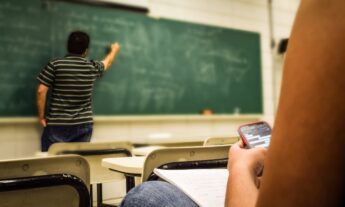
The nineteenth century, the Age of Progress, arrives. No matter how much they jump, sing, and dance, the teachers can no longer attract the attention of their over-informed students, who, in the middle of class, and with total indiscretion, take out and consult their mobile phones…oops!…sorry, their encyclopedias, while the teacher talks to himself. To make matters worse, more people come to class: children and members of the nascent proletariat? I don’t think so, but the bourgeois classes, without a doubt, want to be up to date with the new knowledge (they not only fill the opera halls but also send their children to schools).
Teachers realize that to maintain discipline, they must resort to force. The classroom is filled with rigor. The script is filled with blood. Otherwise, studying becomes tedious and annoying. The only interesting thing is science, which the church rejects. The teachers, mere instruments for the transmission of knowledge, must coldly explain and impose exams and evaluations, and the fact is that the bourgeoisie, beginners in knowing about school but skilled in accounts, are eager to measure how much their children are learning and if they are getting their money’s worth.
Theater has also entered into decline. No one pays attention there either, except when the diva appears on stage and everyone applauds. Except for that, the audience looks around and assesses – they evaluate the attendees’ clothes, faces, and attitudes. They take attendance: no one from a good society should be missing. The best part of the play is the intermission, like recess in school. And no one cares about the morals of double standards being propagated from the stage.
Luckily, the play (and all types of theater) is about to end.
The cinema is going to appear.
The twentieth century arrives. The world of electricity and images begins – the current world. (And current pedagogy: even today, in 2025, the differences between theater and cinema serve as a metaphor for what happens in the classroom; for example, how theater, as a storyteller, quickly replaced by the big screen is comparable to how the teacher who only knows how to transmit information gets replaced by documentary videos, pre-recorded virtual courses, historical series, ChatGPT, and other virtual media).
Images expand as a means of information (a single picture is worth a thousand words, especially those from a dull actor or a bored teacher). The printed newspaper proliferates; everyone listens to the radio. A revolution takes place in Russian theater: as it cannot compete with cinema as a spectacle and storyteller, it ceases to give importance to those two things. It concentrates on something long forgotten: what the actor and the spectator feel. Theater becomes increasingly separated from the narrative and focuses on the person of the actor, on the fact that he is there, alive, on stage. As I say, the important thing is the exchange, the vibe between actor and audience, that vital encounter that is absent in cinema, the radio, and the new prodigy they call television.
The soulmate of the theater, the school, also begins to privilege feelings. Gradually, it is less important what the teacher (and the actor) say, and more how they say it; less critical what the student (and the audience) learns, and more important the experience they have in the time they spend together.
The sixties arrive. At times, the theater and school become a party. The former leaves the stage and goes out into the streets; more than ever, it is a means for education and a part of social pedagogy, almost as much as it was once in ancient Greece. The school also celebrates the dissolution of educational spaces and formalities. The line between teachers and students blurs, as well as between classroom and reality: they do fieldwork together, learn by doing, attend workshops, and create their own. They perform music and dance, i.e., theater.
But all this almost immediately falls apart.
The joy wanes. It seems that everything was a bad trip. Arts, teachers, and artists are silent. Some consider the downturn positive because it allows for reconsidering excesses and achievements. Others – like gurus – believe that the vital energy has only been hidden, knowing it is not the right time. Meanwhile, increasingly powerful, the audiovisual media have continued their march, becoming the river’s driving current, sucking everything into its flow. Cable television, cell phones, and the internet have arrived. The planet becomes a brain network (Each head is a world, it was said before, but now the world comprises a single head, a single mind). Everything live, including theater, is becoming increasingly expensive and rarer, as are schools promoting experiential exchanges between teachers and students. For the public and the ordinary student, knowledge equals digital information, and life experiences are concentrated in electronic media: social networks, networks…
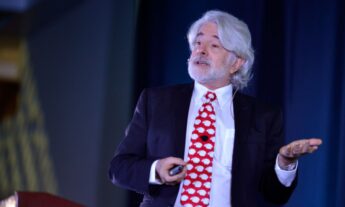
Suddenly, under the zenithal light of the stage, the solitary figure of a new teacher emerges, the ideal teacher of today, played by the most contemporary and authentic theatrical actor: the so-called stand-upper. (For those who do not know the term, it is a type of comic actress/actor [comedian] who stands alone before the audience and amuses them with personal confessions full of jokes about his or her life; of course, they mix in additional stories and loose jokes, but it’s mainly a personal testimony.) As I say, this solitary character appears on the stage – a new teacher who comes to recuperate the vocation’s prominence – immediately displaying his style: He does not come to make us laugh, but he is funny, certainly, and gives us vital information. However, the crucial, truly essential thing is that he first gives his own testimony, his unique vision. His performance is something of a personal confession about learning. He vibrates; he makes us vibrate. He feels; he makes us feel his unmistakable presence. He exposes knowledge as a person experiences it- a natural, not artificial, intelligence. Suddenly, we find ourselves engaging with our testimony, amused, with questions arising from real needs and endearing intuitions. The experience has become a unique moment, impossible to be replaced by any electronic means (by the way, although we can see standuppers in videos or by streaming, it is an essential requirement of the genre that their performance is recorded with a live audience so that it retains its theatrical character of face-to-face exchange).
We leave the theater with a conviction: we want a teacher like that. What we have just witnessed was indeed a performance, an ideal representation, but we want a teacher like that – for our good and that of all the guild representatives. It has become clear: if the teacher is not unique or authentic, his presence will not matter. In the end, when the one who educates is not genuine, it does not matter to us if another teacher replaces him, or a video, an audio or a book, or a lot of books, or a lot of videos, or even a machine (in fact, some of these teach interesting things and even tell good jokes).
We return home. Thus, we end our history of teaching and the theater and how they survive all threats time and again. We feel that nothing can stand against them because they are the living presence of humanity that makes us one (that unites us), the face-to-face we have with ourselves and others, who receive and represent us.
Yes…
Sweet dreams.
Translation by: Daniel Wetta

)
)
This article from Observatory of the Institute for the Future of Education may be shared under the terms of the license CC BY-NC-SA 4.0