

What does this theory say?
The Dead Internet Theory (DIT) originated more than 10 years ago in response to changes in the internet, especially the arrival of social networks, though at that time it had a conspiratorial tone. Currently, the arrival of artificial intelligence (AI) has rebooted the theory, driven by the use of bots to generate content and the obsession with “likes.” Now, platforms prioritize participation and income metrics over authenticity, and they privilege monetization. This affects the authenticity of connections for which networks originally existed.
The dead internet theory suggests that the internet today:
- Is full of content generated by artificial intelligence, relegating human activity to the background (Walter, 2025).
- Particularly, social media is dominated by non-human activity, AI-generated content, and corporate agendas, which impede authentic human interaction (Muzumdar et al., 2025).
- It is no longer powered by humans, but driven by AI agents, bots, and algorithm-generated content (Cheemalapati et al., 2026).
Thus, the dead internet theory posits that the non-human is prioritized over the organic and real, and the goal is to generate more revenue. Moreover, the use of bots, which has significantly increased content, likes, and artificial engagement, raises another worry: the nature of bots.
Bots everywhere
Today, the number of bots has increased exponentially due to the use of AI, as bots are easy to develop and scale. However, what is a bot? It is defined as an automated software application that executes tasks on the internet, which can be beneficial or malicious. The former refers to improving the functionality and performance of web, mobile, and API pages, among other services. However, malicious bots are designed to engage in illegal activities; they are difficult to detect because they can mimic human behavior. Some bad bots include web scrapers (data extraction), credential-stuffing bots (to commit fraud, espionage, theft, reputational damage, and account takeover), spam bots, and DDoS bots (used to disrupt normal traffic through a saturation attack).
However, according to the “Bad Bot Report 2025“, automated traffic on the Internet surpassed human activity for the first time in 2024, when automated traffic accounted for 51% and human activity for 49%. The report also indicated that malicious bot traffic increased significantly, with 37% of automated traffic malicious and 14% good.
Moreover, the report indicates that Mexico was among the countries with the most bot attacks in the Americas, behind Brazil and Canada. Another interesting fact is that the education sector was the third most attacked by bots, behind the travel and retail sectors.
Implications of this theory
While AI can help perform many previously heavy and overwhelming processes, it has also led to a significant increase in automated traffic, controlled by algorithms and bots, for the benefit of the machine and not people. Here are some of the implications of the Dead Internet Theory:
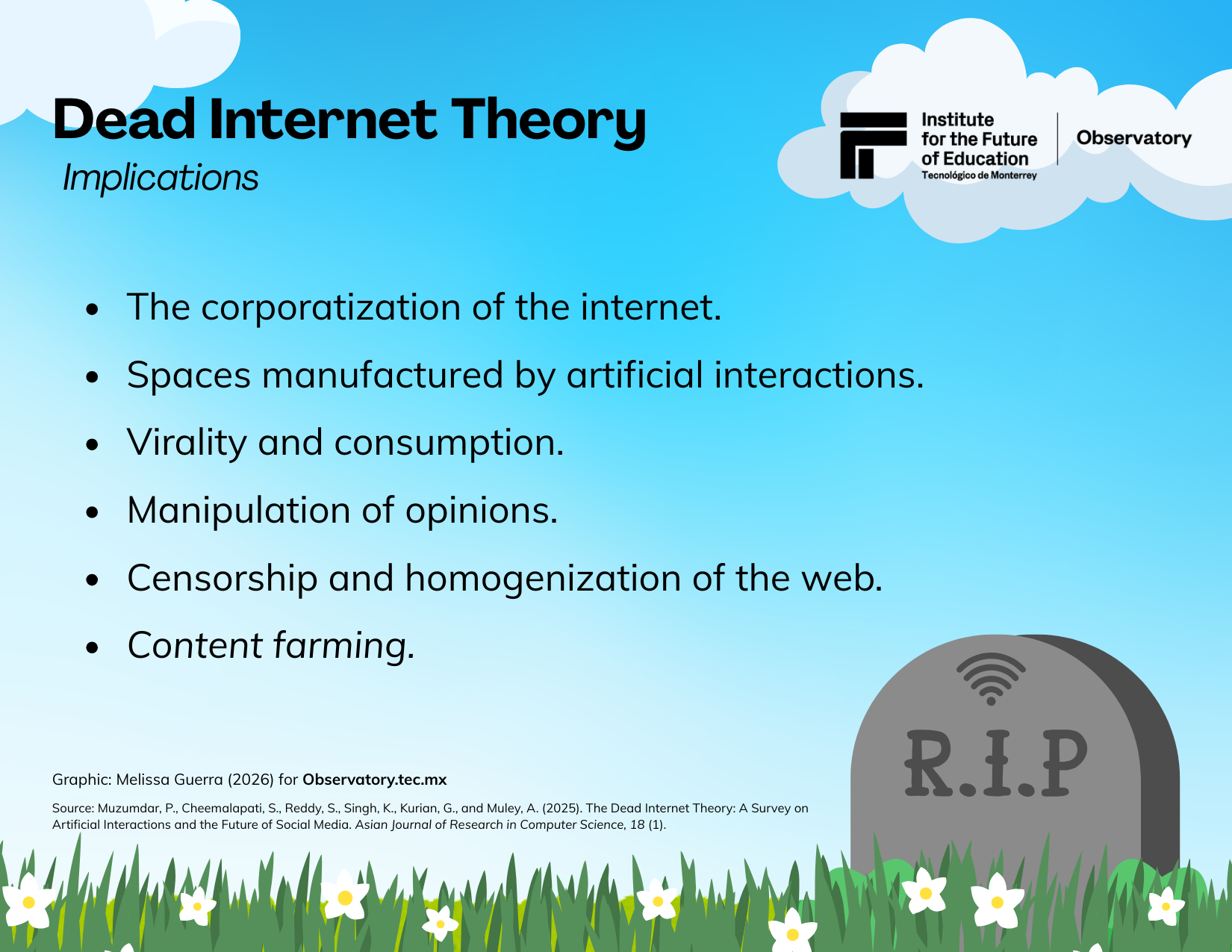
The corporatization of the internet refers to cyberspace being controlled by companies. This causes users’ attention and data to be used to develop and sell products, as well as for surveillance, espionage, and the sale of personal data, among other purposes.
Spaces shaped by artificial interactions not only promote automated accounts, algorithms, and AI-generated content but also encourage the manipulation of metrics, creating the illusion that there is widespread activity to continue generating revenue from artificial engagement (Veale and Cook, 2018, as cited in Muzumdar et al., 2025). So, thanks to the rise of artificial interactions, virality and consumption have been prioritized over real and meaningful connections, so algorithms favor artificial, polarizing, or sensationalist content.
Likewise, thanks to artificial interactions powered by bots, opinions can be manipulated more easily and efficiently, since much of the content that exists today is generated by AI (which also responds to economic models), which is exacerbated, according to Muzumdar et al. (2025), by censorship and the homogenization of the web (everything now looks the same, same narrative, etc.).
Finally, content farming is the practice of creating web pages that publish large amounts of content, usually repetitive and low quality, to generate traffic on the internet and attract visitors. Content farms are optimized to prioritize content that the algorithm likes (i.e., the user’s perceived interests to capture their attention); they prioritize quantity over quality. These practices cause homogenization and suppress the authenticity and originality of human content.
All this leads not only to the loss of the Internet’s initial vision: to be a decentralized and human-driven structure for information exchange regardless of geographical or cultural barriers. Now it has become a portal of disinformation and a battle for attention and clicks, where platforms and algorithms reign, and artificial content is rewarded over authenticity.
How can this be mitigated?
Time and time again, the answer lies in what we least expect: ethics. Models built on ethical AI frameworks must be created; principles such as transparency, accountability, non-maleficence, fairness, and human oversight, among others, are vital to prevent misuse and address the challenges of AI in society. Other authors point out that algorithmic mediation and platform governance also need to be reviewed; this refers to how algorithms decide to organize, filter, and display information to users.
AI has changed how we search for information. It is mistakenly used as if it were a search engine like Google. It has transformed the way we listen to music, for example, as AI ghost artists perform on platforms like Spotify, and how we interact on social networks. It has relegated human activity to a minimum, since AI can do everything, including writing (academic work, blogs, emails, SEO in marketing, copying, etc.), generating ads (homogenization), creating online interactions, among others.
It is crucial that human agency, the ability to make decisions and to act with intention and purpose, is not lost. It is also important that LLM and AI systems are designed with safe, human-centered, and ethical guidelines that do not solely promote economic interests, as this directly violates the ethical principles of non-maleficence and beneficence, as well as those of governance (AI control) and accountability. As users, we have no choice but to stay informed about changes in AI regulations and to be familiar with the applications or software we use and the data we authorize to support these systems.
Today, more than ever, it is difficult to discern between human and artificial content; thus, it is important to take a break from technology and focus on things that bring us happiness and purpose. In a hyperconnected world, we must give ourselves time to disconnect online so we can connect with what really matters.
Translation by Daniel Wetta