


What is gamification?
Gamification refers to the application of game mechanics in non-gaming contexts. In education, Zampeta et al. (2020) note that gamification, or the use of game elements, is a method of designing systems and activities to create experiences and motivations similar to those experienced when playing video games to influence user behavior.
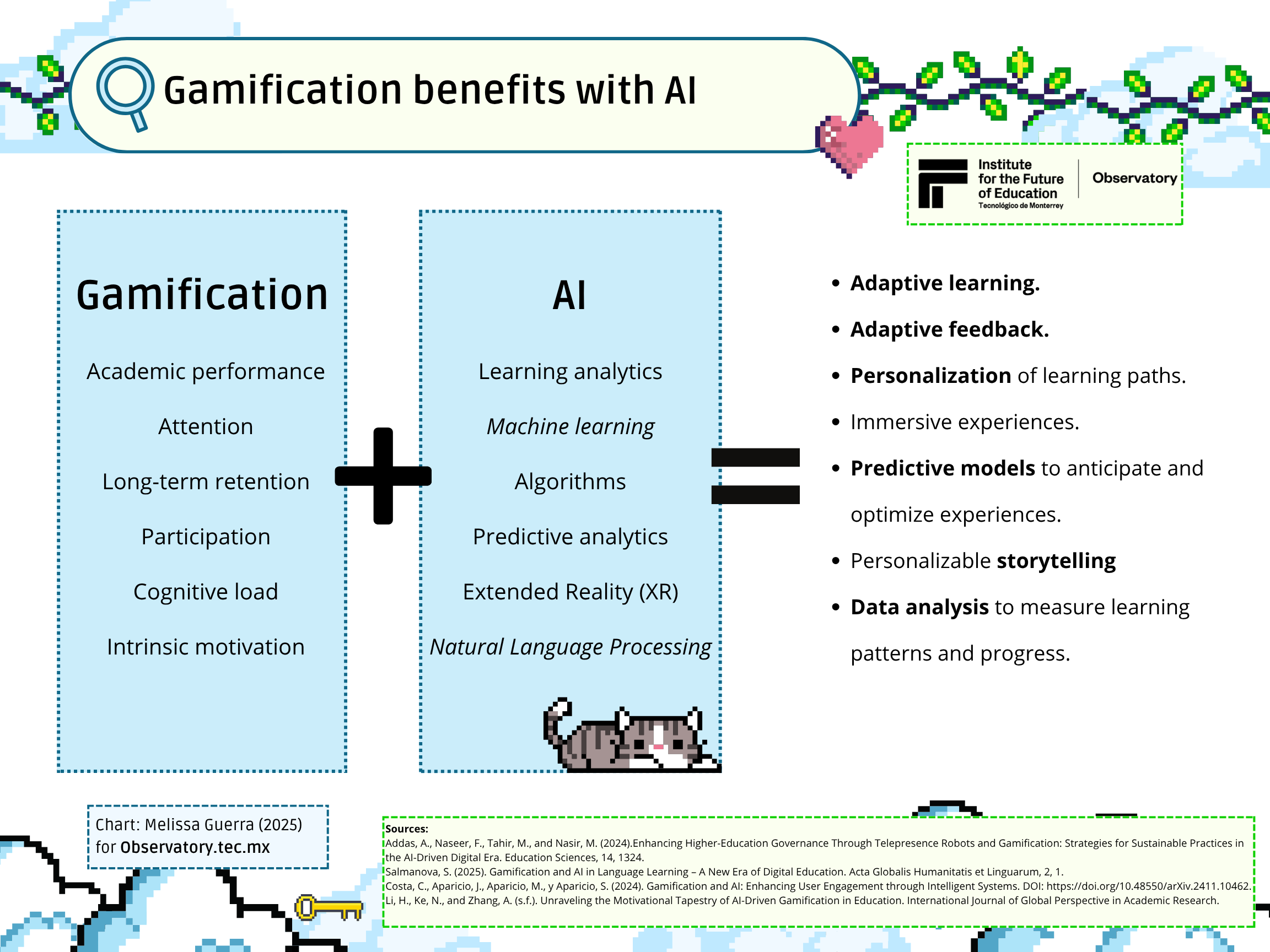
Therefore, in educational contexts, gamification integrates aspects of gaming into structured learning environments, increasing students’ motivation, participation, and academic performance while enhancing intrinsic motivation, reducing cognitive load, and improving retention.
How do I know if I’m gamifying?
It is essential to distinguish between gamification, game-based learning, and serious games to understand how each concept is applied in education to enhance results.
Gamification
- Its objective is to incorporate elements of game mechanics (such as badges and points) into non-playful activities, such as implementing a badge system on the platform every time a student completes an assignment.
- The playful part is adjusted to the content.
- The activity can be collaborative.
Game-based learning
- Its purpose is for the game to serve as a vehicle for learning (games that already exist, adapted, or designed for educational environments).
- The content is tailored to the game.
- It is usually competitive.
Serious Games
- Have a formative purpose.
- They are designed for specific purposes (education, engineering, health, etc.).
- Their purpose is to develop skills.
Key elements of gamification
According to Costa et al. (n.d.), the fundamental elements that must be considered to implement gamification successfully are below.
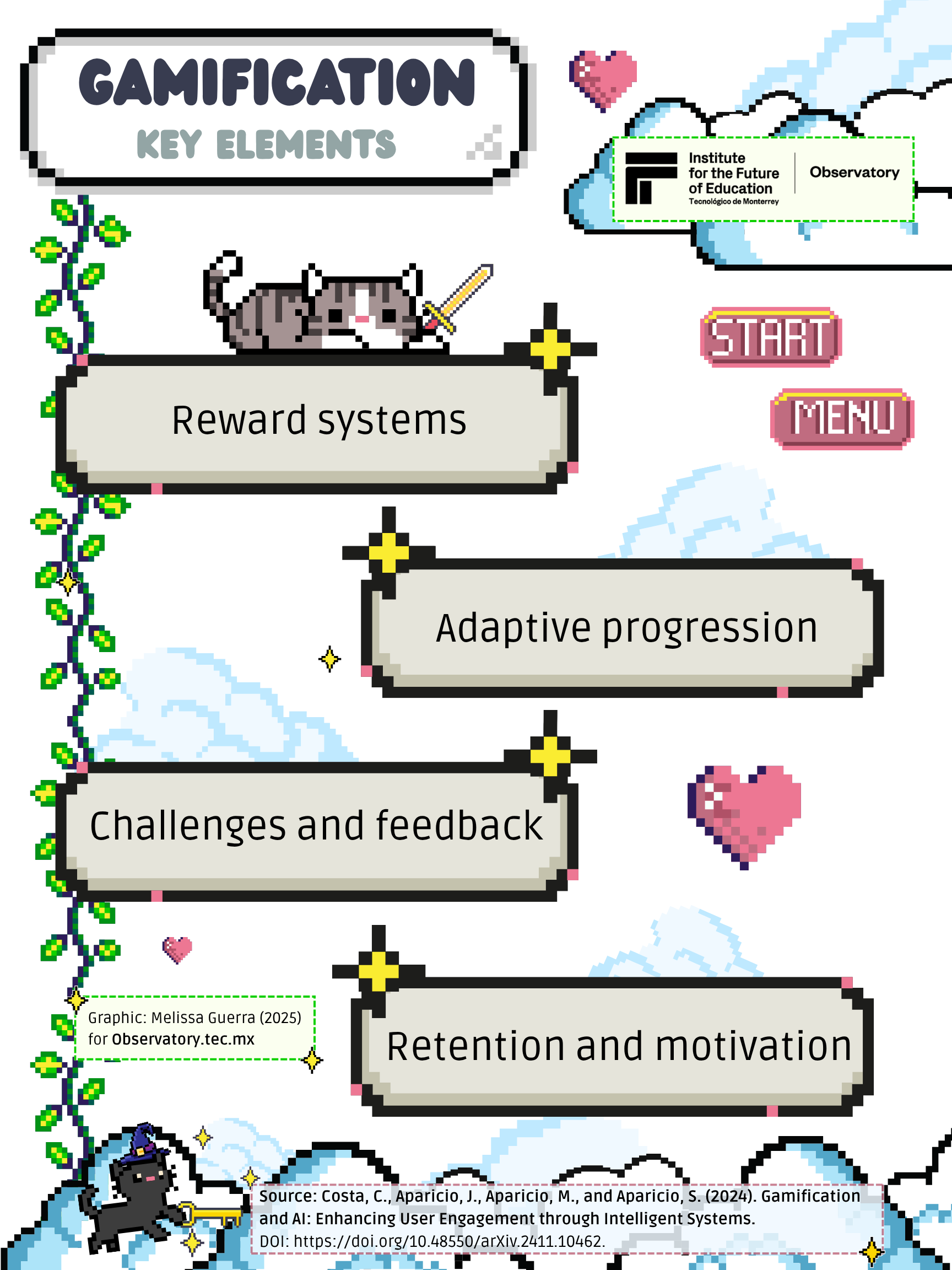
- Reward system: It is necessary to motivate students, maintain motivation, and maximize participation.
- Adaptive progression: Refers to the levels of difficulty, which can be adjusted according to the students’ abilities to maintain their attention and progress.
- Challenges and feedback: Game challenges are customized, and feedback is provided in real-time. It is imperative to generate a sense of accomplishment.
- Retention and motivation: Student participation, retention, and motivation depend on balancing rewards and challenges.
How is Artificial Intelligence (AI) integrated into gamification?
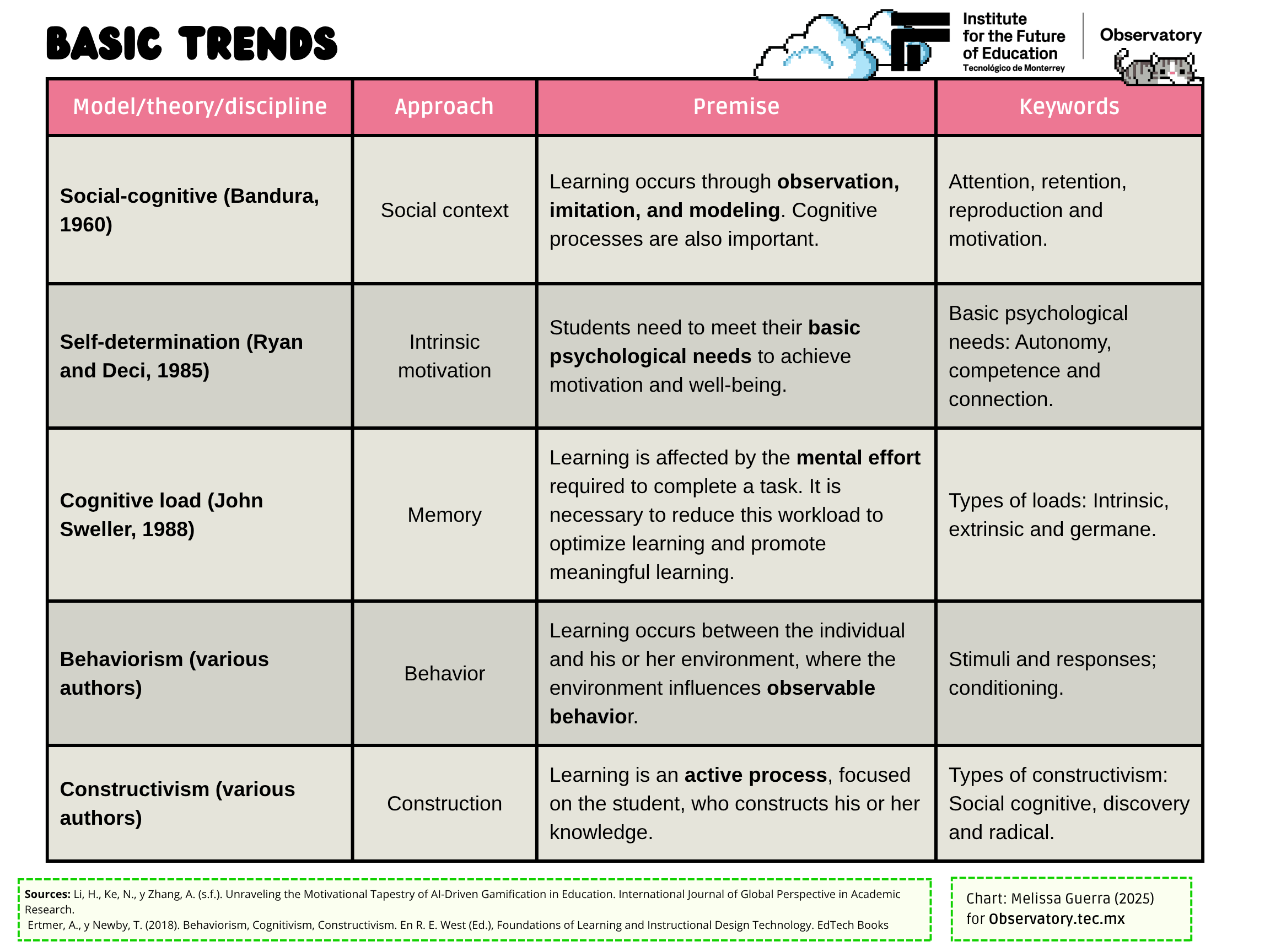
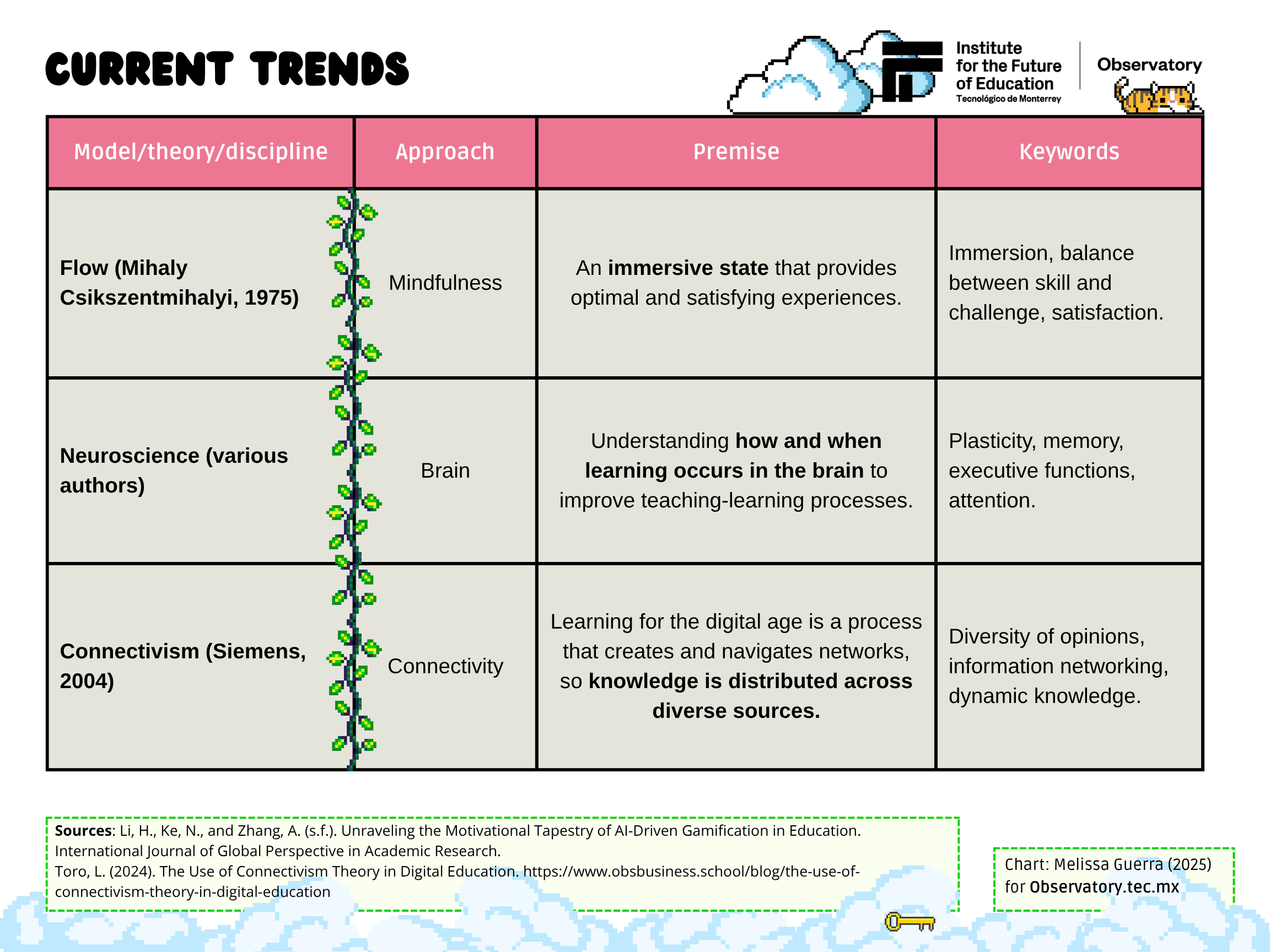
Before delving into this point, it is necessary to understand the learning and motivation theories underpinning gamification and the new trends of the digital age and AI (See the IFE summary of gamification theories below).
Basic Trends
Current Trends
AI Trends
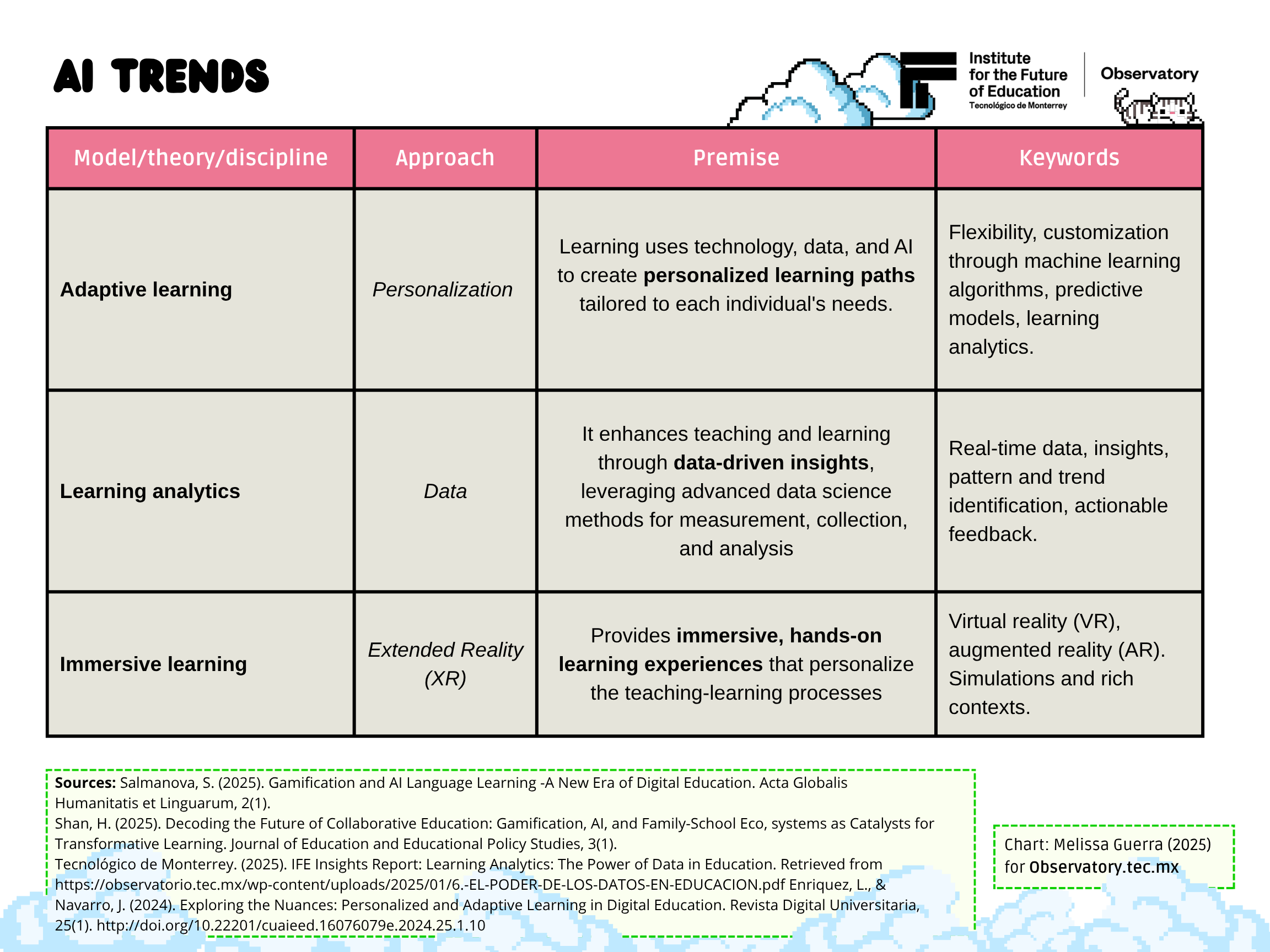
All these theories, models, and frameworks are applicable when implementing gamification, as various elements and mechanics can be combined to create gamified environments and develop a meaningful learning experience. Gamification does not entail playing for the sake of playing alone; it must have a purpose.
Integrating AI requires understanding that AI utilizes machine learning algorithms, neural networks, and deep learning to personalize educational experiences, optimize teaching and learning processes, and increase dynamism and efficiency. Thus, this integration is intended to transform education into something more attention-grabbing, interactive, and adaptive.
Key elements of gamification with AI
The following are essential to provide more enriching and engaging learning experiences:
- Personalization with machine learning: User data is analyzed to create personalized experiences, adjusting the difficulty, challenges, rewards, and other elements to meet the student’s needs.
- Predictive analytics involves examining information to anticipate behaviors and trigger specific interventions to prevent attention loss and boost engagement.
- Adaptive game mechanics refers to systems that adapt mechanics in real time, encourage desired behaviors (through reinforcement learning), and ensure that students feel challenged at all times to optimize their participation.
- Learning analytics: Collecting and analyzing data is essential, as it can help us understand complex patterns and facilitate effective teaching and learning processes.
- Natural language processing enables the creation of interactive and immersive learning environments, thanks to its ability to understand and comprehend human language.
- Computer vision refers to using extended reality (XR) to enhance visual and interactive aspects of learning experiences.
Benefits of AI-powered gamification
The benefits of AI in enhancing gamification are varied and depend on the degree of implementation, which often depends on operating costs, the educational context, an appropriate instructional design for successful integration, and teacher preparation, among other factors.
Ethical issues and future challenges
It is utopian to think that AI will solve everything. On the contrary, its ethical implications and future challenges must be considered. Algorithmic biases, AI hallucinations, security risks (related to data management), reduced human interaction, etc., are restrictive and disturbing factors.
Therefore, these aspects must be considered when designing gamified learning experiences. Notably, a bias in an algorithm can produce undesired results. For example, if the AI is not trained with sufficiently diverse datasets to mitigate prejudices, biases related to ethnicity, cultural context, skin color, etc., can arise, which can disadvantage student users.
Additionally, artificial intelligence “hallucinations” come to light when AI invents unsubstantiated information or produces false or non-existent information. Therefore, the information received by AI-integrated systems should continuously be reviewed to avoid this type of error. Also, security risks will always be a concern with AI, as data increasingly governs today’s world. Reviewing and controlling how data is used on platforms and who has access to sensitive information (e.g., biometric data, personal information) is necessary.
Challenges
Salmanova (2025) and Vrabie (2023) warn about the challenges of AI-powered gamification:

- Implementation costs: Infrastructure, maintenance, and subscription costs must be considered.
- Scalability issues: When not considered, these can lead to a more expensive implementation.
- Limitations to customization: The degree of customization will depend a lot on the AI being used.
- Accessibility: Not all institutions can offer adequate access. Some still face internet connectivity problems and lack the necessary infrastructure, etc.
- Excessive gamification can make learning superficial, especially when it is designed more for entertainment purposes than learning. Likewise, an exaggerated emphasis on game mechanics can hinder critical thinking and problem-solving skills as students become overly reliant on AI.
- Cognitive overload can occur due to excess game elements/mechanics, i.e., too much unnecessary information or stimulation.
- Excessive rewards can result in undesired results in students’ academic performance and motivation.
- Cultural context problems: AI lacks the experience of complex human contexts, resulting in an authenticity issue.
- Reduced human interaction: Overuse of AI can lead to learner dependency, which can impede the development of social skills.
- Potential for distractions: Distractions occur when tools are not adequately designed, detracting from the educational purpose.
Although AI offers numerous opportunities to optimize and enhance educational processes, the potential ethical implications and risks to teaching-learning processes must be considered. One noteworthy risk that continues to be a topic of debate is that student reliance on AI can hinder their development of critical thinking.
Although there are ways to promote this and other types of thinking through AI, its excessive use, familiarity, convenience, and practicality can be a trap for those who do not pay sufficient attention to its dangers. Therefore, teachers must remain vigilant when selecting or designing their tools. (They already have too many things on their plate, which adds to the immense range of extra-classroom activities).
Remember that one meaningful gamification is worth a thousand AI applications.
Translation by: Daniel Wetta