)
)
)
)
Since its inception, academia, teachers, students, and parents have witnessed significant educational transformations. From traditional approaches to inclusive and innovative proposals, education has evolved indisputably.
Thanks to this, teaching-learning processes and training quality have improved. However, it should not be forgotten that this has resulted from technological and industrial revolutions responding to societal needs. Moreover, the arrival of Artificial Intelligence (AI) has created new challenges and opportunities that loom for “Education 6.0,” which will again revolutionize future educational environments.
A long road from education 1.0
Teaching transformation has been a long and continuous process of examining the strengths and weaknesses of various methodologies and modalities for improvements. These educational reinventions are described as follows:

Remember that each educational revolution has decisively accelerated new and better initiatives that promote comprehensive and quality education and respond to society’s needs in an increasingly volatile world.
Where are we today?
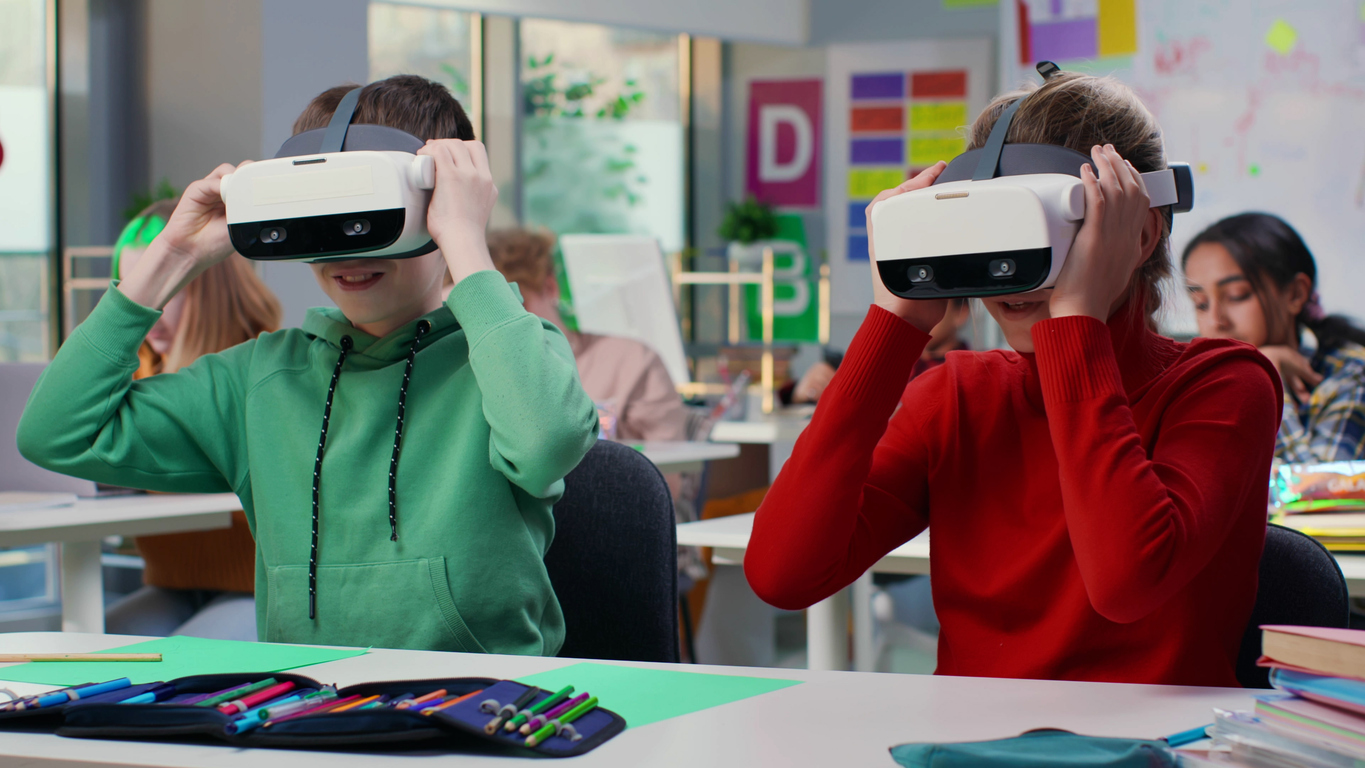
The current panorama of Education 5.0 emphasizes personalized learning, collaboration, and well-being. Likewise, this paradigm promotes the development of 21st-century skills, such as critical thinking, creativity, and problem-solving through technology such as AI, the metaverse, virtual/augmented reality, and the IoT(Internet of Things), among others.
Characteristics of education 5.0
The characteristics of Education 5.0 include the following:

This paradigm focuses on personalization, technology, academic development, flexibility, accessibility, and physical, mental, and emotional well-being.
Education 5.0 also stands out for including AI in the educational process through personalized or collaborative learning. It also emphasizes gamification and remote learning (a trend enforced by the COVID-19 pandemic). Social values and environmental responsibility are also highlighted, comprising a more humanistic approach to education.
The role of the teacher
The educator in this model must have a wide range of skills apart from being a facilitator of knowledge and a promoter of the competencies necessary for the twenty-first century, with a perspective to include generative AI tools in the classroom. Therefore, the faculty must be trained to use AI tools as resources to carry out teaching tasks (planning, evaluations, etc.), detect plagiarism, and consider other ethical issues involving students.
Challenges
Some of the areas of opportunity of Education 5.0, which must be considered for the following educational revolution, include the cost of implementing tools and technology, dealing with teachers’ lack of training, data security and privacy (especially from the use of AI), and ethical issues.
Where are we going?
Although generative AI transforms education, this process requires management, evaluation, and reflection on current needs inside and outside the classroom. It also involves teacher training and reformulation of analytical and study programs, as well as the capacity of institutions to act and react in the face of these changes.
Although Education 6.0 is still being defined, specific markers outline its possible path.
Education 6.0
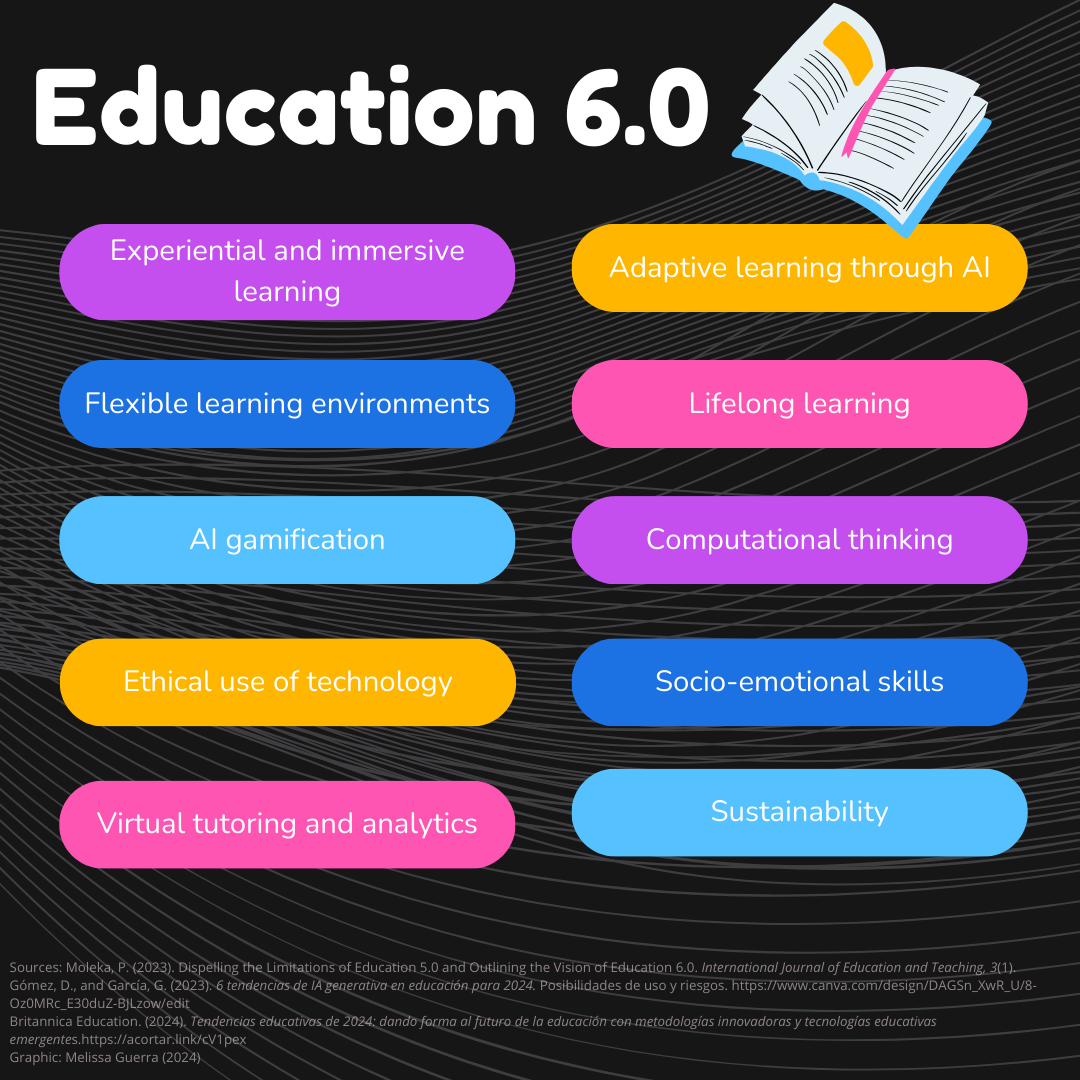
This concept is still in development. However, some authors describe the paradigm of Education 6.0 as having the following potential characteristics.
Future challenges
Although these may be some trends of Education 6.0, it should be noted that each revolution marks the turning point of its predecessor. Therefore, it is likely that critical characteristics of Education 6.0 include data security and privacy, learning analytics, feedback, and personalized education.
Ethics will be a central axis due to AI integration into EdTech. Therefore, promoting ethical values and humanism will permeate Education 6.0 to achieve a more marked balance between technology and human beings.
Another point of reflection on Education 5.0 is how well-being and mental health are integrated into the classroom and how the arrival of AI in education affects this. Moreover, the digital divide that continues to permeate education can worsen if programs or public policies that guarantee access and inclusion of technology for all are not carried out.
The disruptive presence of large-scale generative AI, impacting 21st-century skills (for example, critical thinking), automates many processes that do not require the student to “make an effort,” so developing particular skills and competencies may be limited. This represents one of the teachers’ challenges for both the present and future.
Lifelong learning, viewed as relevant and essential in Education 5.0, will most likely (and fortunately) continue to be promoted in the future. Due to the accelerating technological changes, companies need employees to undergo upskilling and reskilling. In addition, lifelong learning will be necessary for the holistic well-being required in the digital society, as current and future busy lifestyles can aggravate problems related to stress and mental health.
Experiential learning is necessary for current students to prepare them for a natural, technological world now and in the future. On the other hand, personalized learning in Education 5.0 may tend towards hyper-personalization. Therefore, reflecting on the education task, we must consider innovations, including integrating AI into education, thinking about and being aware of realistic needs and things that can be improved.
Translated by Daniel Wetta

)
)
This article from Observatory of the Institute for the Future of Education may be shared under the terms of the license CC BY-NC-SA 4.0