

Universality signifies the generalized application of something or its totality without exception. Universality infers equity, inclusion, quality, and universal access to education.
However, the educational reality is that universality does not exist. We seek it starting with school furniture, the signage (so that visually impaired people can see them clearly), the spaces intended for learning, other spatial designs (access to ramps, path signage, walkways, etc.), and inclusive curriculum development, among other aspects.
In this sense, Universal Design for Learning (UDL) is an aid when designing learning experiences aiming for the universality of education, offering flexibility and inclusion to ensure that all students obtain quality education.
What is Universal Design for Learning?
Universal Design for Learning (UDL) is a framework for developing intentional and proactive planning, which considers the broad diversity of needs and preferences of every student in the classroom.
It is defined as a model for improving teaching-learning processes, combining knowledge of neuroscience, architecture, and technology to create optimal instruction design and proactive and meaningful learning environments. Its objective is to reduce barriers within learning, whether physical, cognitive, affective, or institutional, and to create flexible and accessible learning experiences so that all students have the same opportunities.
Origins
To understand how UDL originated, it is essential to know the core concept: universal design (UD). Marc Harrison, a professor of industrial design at the Rhode Island School of Design, developed intriguing insights into design and architecture. After suffering a brain injury, Harrison discovered new ways to visualize physical space.
His ideas were later adopted by Ronald Mace, who coined the term universal design in the 1970s.
The seven principles of DU are:
- Equal use
- Flexible use
- Simple and functional use
- Comprehensible information
- Tolerance of error
- Low physical exertion
- Appropriate dimensions
In addition, several educational initiatives propose educational inclusion and provide frameworks for this purpose, such as the “World Declaration on Education for All” and UNESCO’s “Guide to Ensuring Inclusion and Equity.”
These benchmarks set out fundamental principles that must be addressed, including recognizing universal access to education and considering equity in educational rights and opportunities. Therefore, UDL arises from the principles of universal design (UD) and education policies, considering the scientific evidence of neuroscience to understand how the brain learns and the research and development of the CAST organization (Center for Applied Special Technology).
Therefore, this model, considering the principles of UD beyond physical spaces, focuses on designing teaching and learning opportunities that are varied, accessible, meaningful, and highly involved for everyone, including those with specific needs or disabilities.
UDL Principles
Because it is based on neuroscience, this model identifies three neurological networks that impact learning: the what, how, and why.
- Recognition Network (What): This recognizes voices, faces, letters, and words. It allows a person to understand information, ideas, and concepts and identify and interpret patterns of sounds and light, which also involve the senses (taste, touch, and smell). In addition, it is responsible for collecting information and interpreting it, so it requires attention, memory, and perception processes.
- Strategic network (how): This network helps the students construct meanings. It is responsible for receiving and cataloging information, thus promoting connections, sequencing, analysis, and information research.
- Affective network (why): This network controls the emotional parts of learning (e.g., motivation). It evaluates patterns by attaching emotional meaning to them. It regulates attitudes and emotions according to the input received.
The principles of UDL are based on these networks and their learning impact. There are three fundamental axes:

Principles characteristics
Each universal learning design principle has several qualities:
Representation: Provide information in more than one format.
- It shows flexibility in presenting, receiving, and interpreting information.
- It adjusts to different languages, learning styles, cognitive development, sensory and social needs, and perceptual differences.
- It adapts the materials according to the required complexity and environmental conditions.
Action and expression: There is more than one way to interact with materials.
- It offers flexibility in how learners respond to information.
- It provides an output that is easily adjusted to the different control means (perceptual, sensory, motor).
- It uses a variety of methods to identify strengths and needs.
- It assesses knowledge and employs follow-up processes.
Participation: There are many ways to motivate students.
- Flexible personalization of the affective network increases participation.
- The design adapts to students’ interests and cultural backgrounds.
- It organizes learning environments in different ways (teamwork, individual, peers, etc.) and manages access to technology and materials. It considers human resources, such as in the classroom or school.
Application in K-12
UDL was initially implemented in primary education, and more research has been done on its scope, impact, and opportunities. Some studies indicate that teaching and curriculum design with this approach support child development (e.g., gross motor skills), circle time, and instruction in science, engineering, math, and STEM education.
In addition, the implementation of this model is mentioned in conjunction with other approaches and models, such as embedded learning or Multi-Tiered Systems of Support (MTSS), that promote inclusion in the classroom.
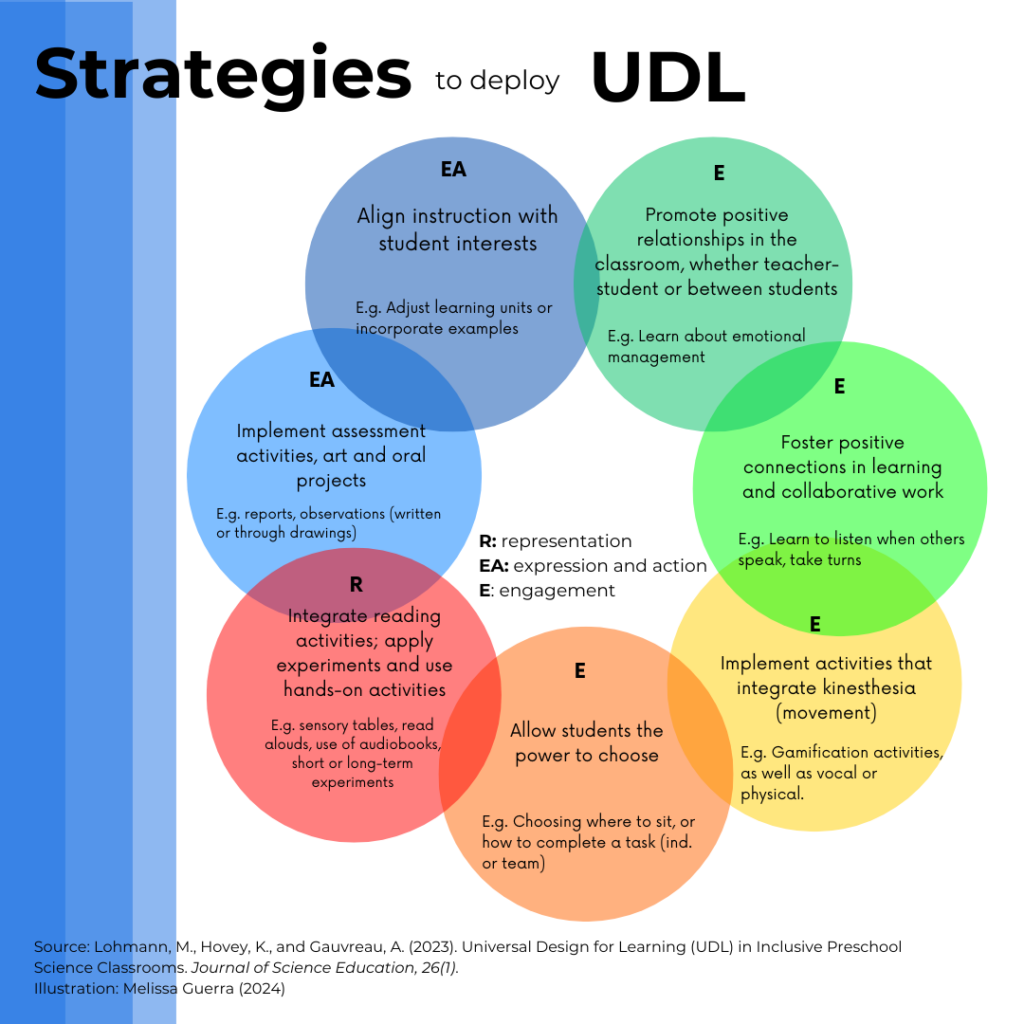
Regarding participation, other studies indicate that aligning learning with students’ interests increases motivation, concentration, participation, and achievement.
Additionally, some research shows that allowing students to have learning options supports self-determination and autonomy, decreases unwanted behaviors in the classroom, and increases concentration on tasks.
Here are some strategies that can be implemented within the UDL framework:
Implementations in Higher Education
This approach began with primary education, so there is little research on it at higher education levels. However, some institutions have implemented it to eliminate discriminatory practices and promote diversity.
Although this model aligns with the policies of “Disability Studies in Education” (DSE), it should not be perceived exclusively as a specialized approach to special education or for people with disabilities because it is oriented towards diversity and inclusion.
The implementation of UDL in higher education institutions has been increasing. Studies of its impact have been carried out in several universities in the United States and South Africa, finding strengths but also weaknesses that should be worked on, such as curriculum design from a universal perspective, the lack of training in inclusive education, and the lack of commitment on the part of the community and some institutions.
Here are some considerations for applying universal design for learning in higher education:
- Focus on the functional needs of both students and collaborators.
- Make inclusion and accessibility a dialogue in institutions. Everyone must be included to identify needs and provide solutions; it is not an exclusive effort of specific departments or teaching staff.
- Build a systemic foundation through inclusive models for educational design, which can be used in facilities management, faculty, support services, etc.
- Leverage technology to support inclusion.
- Look for universities or people who will help understand and address the challenges.
- Consult resources that support the principles of inclusive education.
Using technology with UDL
Applying digital technologies in UDL benefits students by allowing them to narrow their differences. Likewise, thanks to support technology (assistive technology), educational quality can be accessible to more students, which is an element of educational inclusion.
In addition, technology allows for the effective personalization of curricula and learning experiences for diverse learners. With the advent of artificial intelligence (AI), these processes are now easier to perform.
Considerations
UDL is an approach based on inclusion and universal design. Its application is gradual through stages because training and openness are required for the curricular design of optimal learning units for deployment.
It is necessary to consider what works best in practice. Therefore, when creating a UDL environment, various approaches can be integrated to complement what works within the classroom with the flexibility that UDL provides.
Applying such robust approaches requires time because the work involves trial-and-error processes and needs acceptance at all institutional levels. Additionally, it is necessary to have the support of internal or external resources so that the development and implementation of UDL can have a higher probability of success, remembering that it is joint work and in phases.
Translation by Daniel Wetta