)
)
)
)
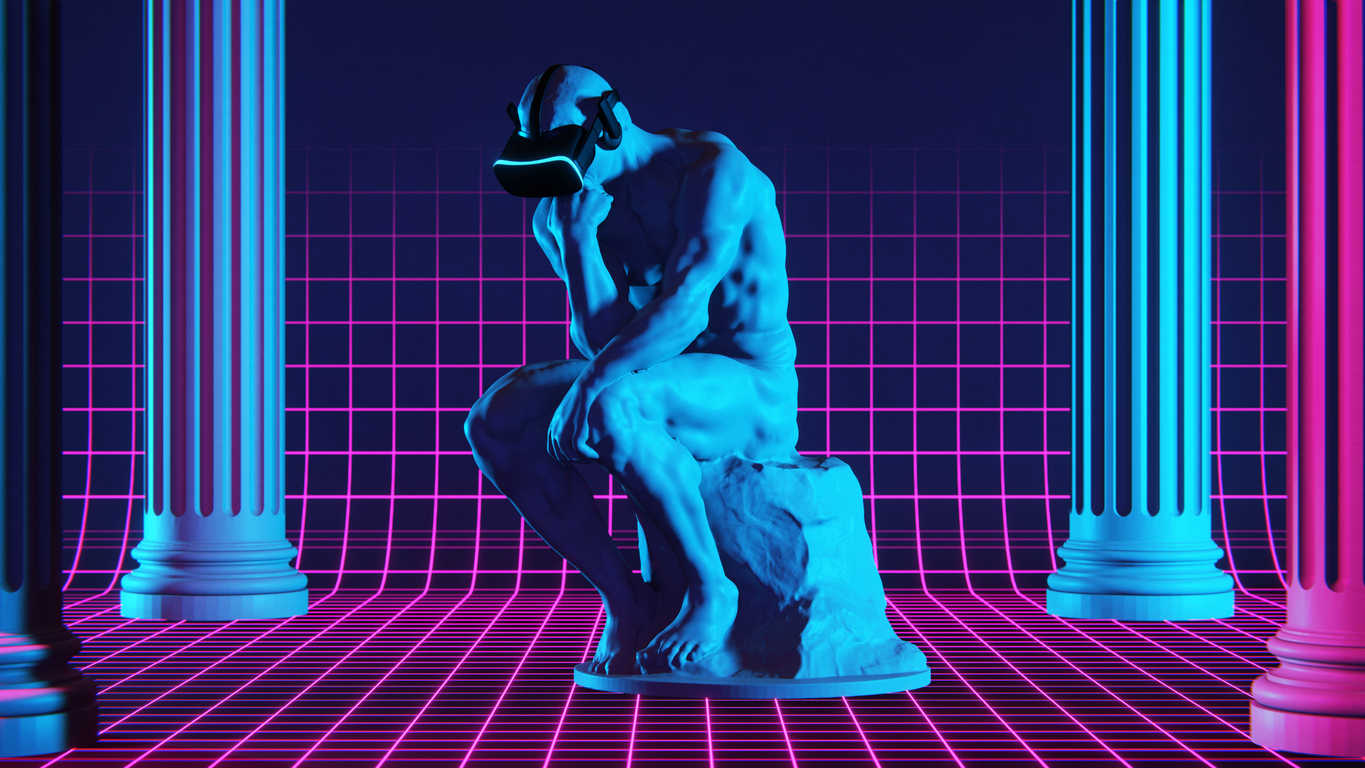
What if school trips to visit local museums were extended to see anywhere on the other side of the globe, such as the Sydney Opera House or the Sahara Desert, or you could even delve into a disease-fighting DNA sequence? Digital travel allows you to zip to different destinations from a classroom and immerse yourself in various cultures worldwide. This way of learning shortens distances and also permits navigating complex topics, such as human body anatomy.
Virtual resources dissolve limits; digital trips offer the capacity to go back 250 million years and walk among dinosaurs. Roving on distant planets that have never seen human footprints is also possible. These learning experiences are the riches of extended reality.
Sometimes, offering student excursions designed for discovering new concepts in authentic environments is challenging for multifactorial reasons. However, apps, websites, and games that help teachers incorporate creative learning activities exist, and while they are not a replacement for authentic experiences, they facilitate the delivery of relevant lessons.
Many virtual explorations are online versions of a real experience, with site scenes captured in 360 degrees at different angles, presented as a holistic or immersive virtual involvement. So, strolling historic streets, attending renowned museums, admiring picturesque landscapes, climbing to the tops of various mountains, and even touching the bottom of unexplored oceans are feasible through technological devices.
Beyond resources for Geography class teaching, these trips cover various topics and can be applied to many other subjects. With the help of virtuality, the students can transport themselves to different historical periods, living the past uniquely, such as touring medieval castles or witnessing historical events that changed the world.
In addition, digital tourism provides opportunities to plan visits to specific places with defined educational objectives. The tools allow immersion in new environments, with a spectator sense of involvement, acquiring cultural awareness and education. Thus, it is feasible for students to develop a profound understanding of the world near and far.
Virtual excursions vary according to course goals and instructors’ teaching styles. Some passages guided by a teacher figure include basic informational content, compasses, and maps, while others are self-guided experiences with pop-up texts, tags, or videos.
These educational resources have great social value, providing inexhaustible knowledge, competencies, and skills. The purpose of digital travel is learning. For teachers, their learners must gain experience and return with information, like in a traditional visit. Still, the extensive scope of virtuality offers presentations, sounds, and images.
Moreover, the complexity of school travel, the time required to organize and manage it, and sometimes the lack of support from administrators negatively affect educators’ willingness to attempt it. Therefore, this alternative reduces teachers’ concerns and ensures the student body’s safety and learning.
This pedagogical focus gives students a first-hand experience of where the physical and virtual worlds overlap. To do this, it is helpful to understand the categories in the “virtuality spectrum”: Augmented reality adds graphic information to a physical environment; virtual reality has a real-looking space where digital interactions occur; and mixed reality is where real and virtual objects converge simultaneously.
Scouting excursions can be conducted in any of these three scenarios, but their benefits vary depending on the use and objective of the curriculum. Studies suggest that experiential learning increases students’ knowledge and motivation. The challenge is knowing how to apply the available resources in the educational field.
Pedagogical benefits and integration into the academic program
One advantage of the digital plane is that experiences such as these tours are not limited to a single visit but can occur as often as the user wishes, visiting different places in each meeting. Teachers can even modify the session exercise for future classes.
It is also a way for students to teach themselves how to solve real-life problems through awareness and sensitivity to their environment. This favors the development of intellectual skills such as observation, analysis, discernment, and information selection.
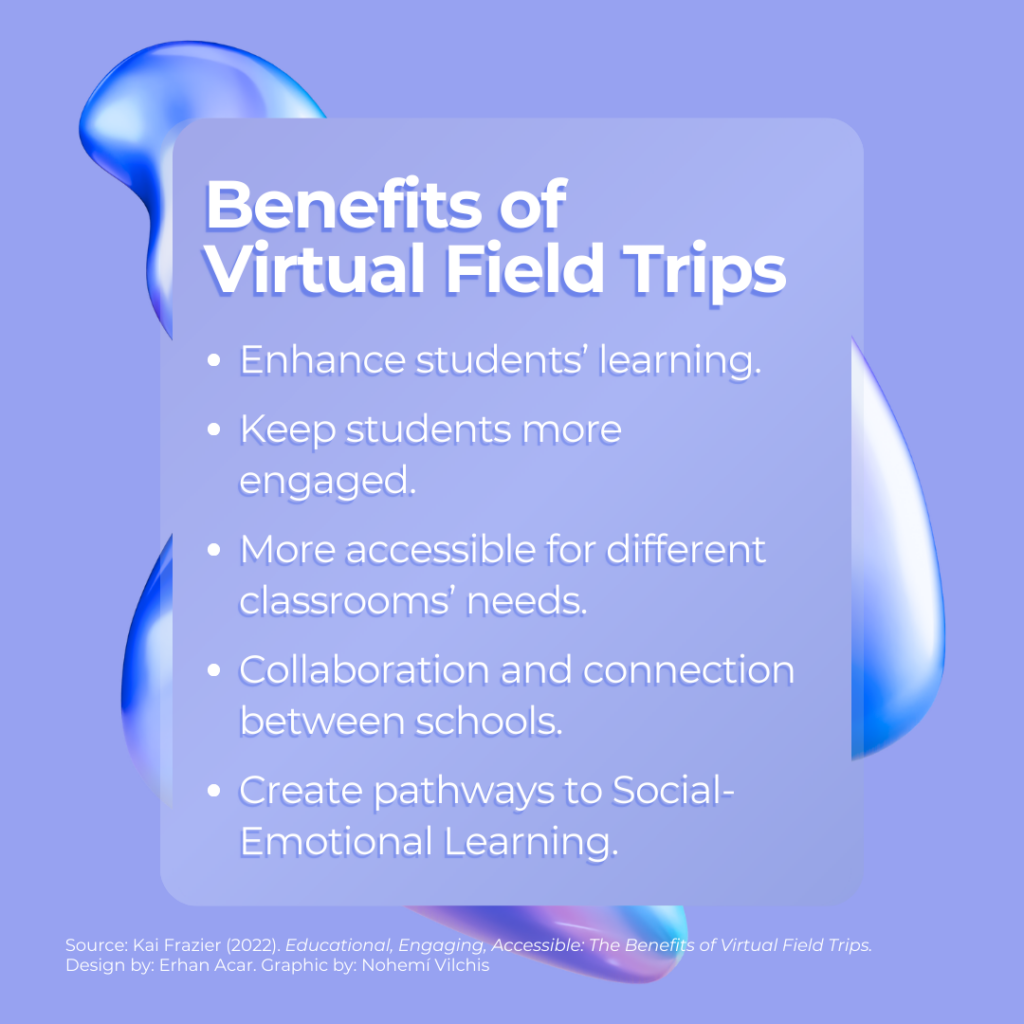
Professor Kai Frazier, founder and CEO of Kai XR, describes why virtual exploration trips are helpful in education, highlighting five benefits:
1. They improve learning experiences and help students understand concepts more clearly. Occasionally, it is easier to assimilate particular notions in a digital environment, mainly when the lesson is oriented toward a specific or manual skill using a realistic simulation without the expense or risk that physical training can entail.
2. Many students find virtual explorations more engaging than traditional learning experiences. Virtual excursions improve the students’ attention and presence, commitment, self-perception, and motivation. Researchers have found that when students interact directly with the material (or, as in this case, immerse themselves in it), they tend to have more enthusiasm and a sense of responsibility for their learning. This approach puts the students at the center, allowing them to proceed with the experience at their own pace.
3. They are more accessible, promoting inclusion and diversity in the classroom. Their potential allows learners to see themselves in the courses, acquiring knowledge about their history and culture. Also, individuals in remote areas or different learning periods can have opportunities for experiences they might not otherwise have. Traveling to distant destinations is more economical and flexible. In addition, virtual excursions are an ideal option for students with mobility restrictions or who are immunocompromised.
4. They facilitate borderless collaboration, learning about out-of-the-way places, and working with people in other regions. The digital world allows students to communicate and interact through avatars, exchange virtual resources with other professionals and institutions, and have the support of experts to increase the quality of their learning.
5. Digital excursions are more environmentally respectful, as traditional student visits require bus rides, which emit greenhouse gases. This alternative reduces the carbon footprint, presents possibilities for developing Socio-Emotional Learning (SEL) skills, and invites reflection.
A clear example of its relevance was during the pandemic when applications such as Google Earth and Google Arts & Culture offered a view of the world without leaving home. International organizations such as National Geographic, NASA, and the Louvre Museum generated free digital tours that anyone interested could access.
On the other hand, even educators can create virtual exploration trips that offer valuable experiences adapted to students’ and curricular needs. Marketer Kyla Ball established a guide for teachers to build their first digital tour.
Similarly, EDUTEKA recommends some preparation guidelines through a downloadable worksheet to incorporate virtual trips into classes. It provides guidance on what aspects to consider when designing a digital excursion. Likewise, El Comercio provides similar concepts for creating these classroom resources. Their trip planning suggests that the project should have a specific topic, a purpose that explains the advantages, didactic resources that accompany the exercise, tasks that consolidate and support the objectives set at the beginning, and a diary for realistic travel itineraries. It indicates that this practice allows students to learn how to organize financial resources or create a tourist guide that promotes places of interest.
Materials to apply in class
Below are some examples of free virtual excursions to put into practice, developed by different platforms or organizations on various topics, from visiting the Amazon warehouse to observing polar bears in their natural habitat. All are ready to use in the classroom:
Discovery Education | On-Demand Virtual Field Trips
Discovery Education | 12 Days of Virtual Field Trips
Rowan University | Resources for Virtual Field Trips
We are Teachers | 40 Amazing Educational Virtual Field Trips
The Nature Conservancy | Nature Lab Virtual Field Trips
Nearpod | Top 10 Virtual Reality (VR) Field Trips for Students
Common Sense Education | 30 Tools: Virtual Field Trip Apps and Websites
The Academy Totemguard | 14 virtual trips that teachers can take in the classroom
Virtual exploration trips forge students’ skills for the professional world as virtual training has become prevalent in many organizations. These digital visits help the workforce align important concepts and adapt to changes.
These exciting practices merge technology with curiosity, opening a panorama to discover new ways to explore the planet. With the help of these tools, educators encourage imagination and design a pathway to navigate reality expansively.
In the comments, please let us know what trips you would implement in your sessions.
Translated by Daniel Wetta

)
)
This article from Observatory of the Institute for the Future of Education may be shared under the terms of the license CC BY-NC-SA 4.0