


Definition
Cybergogy originated in the early 2000s with the evolution of ICT, which gained tremendous momentum during and after the COVID-19 pandemic (Amiruddin et al., 2023), when online and virtual learning environments became crucial to delivering education and mitigating educational lags.
Initially, Wang and Kang (2006), who coined the term, proposed that cybergogy refers to the use of technology and the internet to enhance education by integrating digital connections, networks, tools, and platforms for the development of competencies, enabling students to participate in relevant learning activities actively. This approach incorporates pedagogy and andragogy to foster active online learning.
Currently, authors such as Mafarja et al. (2025) define cybergogy as a teaching-learning methodology that leverages the benefits and opportunities of digital technologies, including virtual reality (VR), simulations, and gamification, among others, to create immersive learning experiences that increase motivation and promote higher cognitive skills. This paradigm focuses on the teaching and learning processes in digital spaces and virtual classrooms, enhancing student participation, collaboration, and autonomy.
The cybergogy model
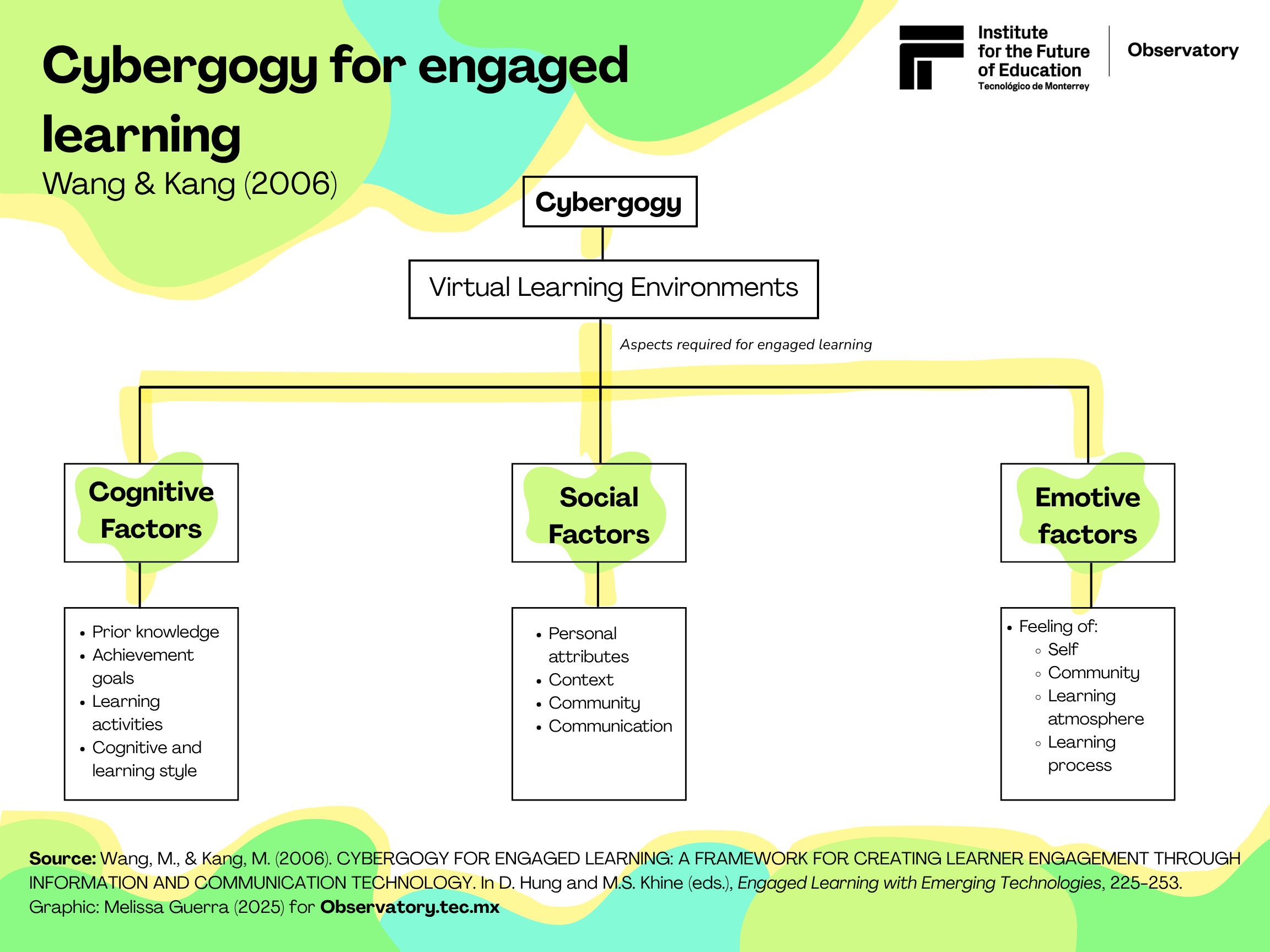
Wang and Kang (2006) proposed a cyber pedagogy model for participatory learning, which considers the three key factors of virtual learning environments: social, cognitive, and emotional. The social factor refers to interaction and collaboration that promote learning; the cognitive factor is related to learning processes and the construction of knowledge; and the emotional factor draws attention to emotions during the teaching-learning process.
Key principles
In cybergogy, pedagogical principles and strategies are applied in online educational environments and those mediated by technology. Digital tools and platforms are utilized as a vehicle for learning to encourage student participation and collaboration (Mafarja et al., 2025).
The key principles of this approach are 1) the use of technology to improve learning outcomes, so it is not only about implementing technology to give an illusion of “innovation,” but also about the conscious and responsible use of technology in the classroom, especially with tools with artificial intelligence (AI) integrations, which carry critical ethical considerations (such as sensitive data and their use); 2) the character of learning is collaborative, autonomous, and student-centered, because cybergogy borrows principles from heutagogy to develop an effective teaching method employing digital media to respond to current needs; 3) in cybergogy, the curriculum is flexible and customizable, since, as in heutagogy, the students contextually decide their learning paths; 4) the student actively participates and collaborates profoundly because virtual learning environments require these characteristics for the lessons to be practical; and 5) the learning experiences are meaningful, boosting participation, connection, and motivation. As noted above, distance, online, and virtual learning environments require these virtues, as a classroom lacking them can become monotonous and boring, leading to student demotivation and dropout.
Teacher’s role
The teacher’s role in this approach is not only to facilitate learning, but also to create experiences. The challenges that teachers must consider when designing activities utilizing the cybergogical approach include (Mafarja et al., 2025):
- Understanding the challenges of online learning: distractions, information overload, and the need for student autonomy.
- Designing activities that encourage critical thinking, problem-solving, and decision-making.
- Promoting creativity and innovation.
- Providing classroom opportunities for collaborative learning and feedback.
- Using digital tools (resources, simulations, etc.) to create meaningful lessons that motivate students.
- Creating immersive or gamified experiences that foster creative problem-solving skills.
- Ensuring that the student knows and understands the term “digital literacy” and develops digital skills.
Student’s role
On the other hand, the student’s role considers the following:
- The student actively participates in the learning process.
- The student is autonomous.
- The student must learn collaboratively in flexible educational environments.
- Their connection to learning is emotional, cognitive, and social.
- The student must be digitally literate to develop fully.
- The student is digitally competent.
Benefits
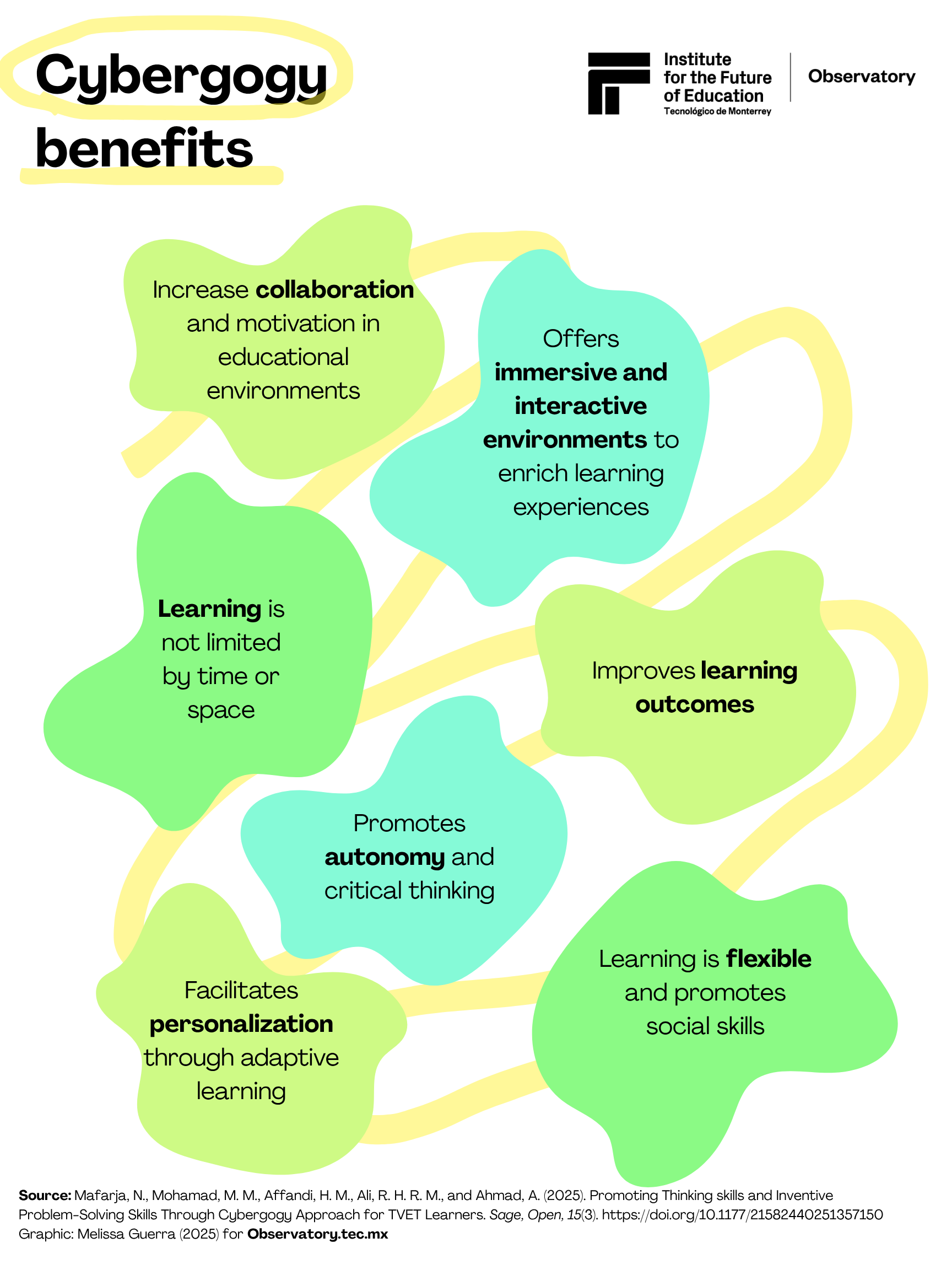
According to Gading et al. (2024) and Mafarja et al. (2025), the benefits of applying the cybergogy approach include:
Challenges
According to Odvina et al. (2024), this approach has four substantial implementation risks in teaching-learning processes: 1) excessive and inappropriate use of digital devices, 2) insufficient basic reading skills, 3) the challenges facing students and teachers in using technology, and 4) the dual impact of technology.
1. Excessive and inappropriate use of digital devices
The excessive use of electronic devices has counterproductive effects, as they can impair reading and comprehension skills. Odvina et al. (2024) mention that “the excessive use of non-educational digital activities, such as online video games and social networks, distracts students’ attention from reading tasks, which reduces their reading skills.” Also, the current generation’s addiction to cell phones generates significant distractions. Therefore, these authors suggest that institutions should take proactive measures, such as hosting seminars on the responsible use of the internet or striking a balance between academic, recreational, and digital activities, to mitigate the adverse effects and raise awareness about using digital devices.
2. Insufficient basic reading skills
Idulog et al. (2023), as cited in Odvina et al. (2024), argue that the lack of instruction in essential skills, such as decoding and reading comprehension, affects students’ progress. They note the need for specific programs to address these gaps, which prevent students lacking strong digital literacy from reaching their full potential; such literacy is essential for student training throughout their lives.
They highlight that interventions are required from early childhood in the reading area, so that children not only complete general tasks but also improve their academic performance to fulfill more advanced tasks. Therefore, such interventions aim to “strengthen basic skills and improve reading comprehension, especially in educational settings that integrate technology. Teachers can better support students’ reading competence, ensuring that technology enhances, rather than hinders, their academic development” (Urbano et al., 2021, as cited in Odvina et al., 2024).
3. Students’ and teachers’ challenges in using technology
Some authors, such as Herdina and Nigrum (2023), as cited in Odvina et al. (2024), highlight the challenges related to technological infrastructure and teacher training, indicating that the lack of the basic skills noted above impacts the quality of teaching and the students’ motivation.
Widodo et al. (2020, as cited in Odvina et al., 2024) report that, in addition to the problems already presented, software errors, device failures, unstable internet, and lack of connectivity, among others, also “generate barriers to the development of students’ reading skills in learning environments with technology.” Therefore, comprehensive solutions are needed to prevent technological failures from hindering the quality and potential of education.
4. The dual impact of technology
An example of the dual impact of technology on education is reading. While digital devices have enhanced the reading experience, they have also negatively impacted reading habits, decreasing the time spent on concentrated reading and increasing levels of distraction due to the availability of digital connections. Diallo (2023), as cited in Odvina et al. (2024), points out that “while technology fosters independence, motivation, and collaborative learning, it can also lead to negative consequences such as over-reliance on devices, eye strain, and distractions from academic tasks.” Therefore, both the benefits of technology and its repercussions must be considered when planning and implementing technology in the classroom, since it can also decrease critical thinking, attention span, and reflective analysis (Thapliyal, 2023, as cited in Odvina et al., 2024).
Cybergogy is an approach that, through technology, the internet, and AI, can transform digital education to create immersive and collaborative environments, developing key skills in a connected society. However, it also poses significant challenges related to the responsible use of technology. In this context, a virtual learning environment must be designed and customized to meet students’ needs, as the same formula (even with other approaches or methodologies) may not be efficient for everyone.
Consequently, these approaches require significant time and effort, as technology and AI can help optimize specific processes. However, time must still be allocated to review activities, analyze whether the instructional design is adequate for institutional and learning objectives, and so on. Notably, this approach is not directed towards basic education, since it requires considerable student autonomy in its implementation. Thus, all these things must be considered when choosing an appropriate planning methodology.
Translation by Daniel Wetta