
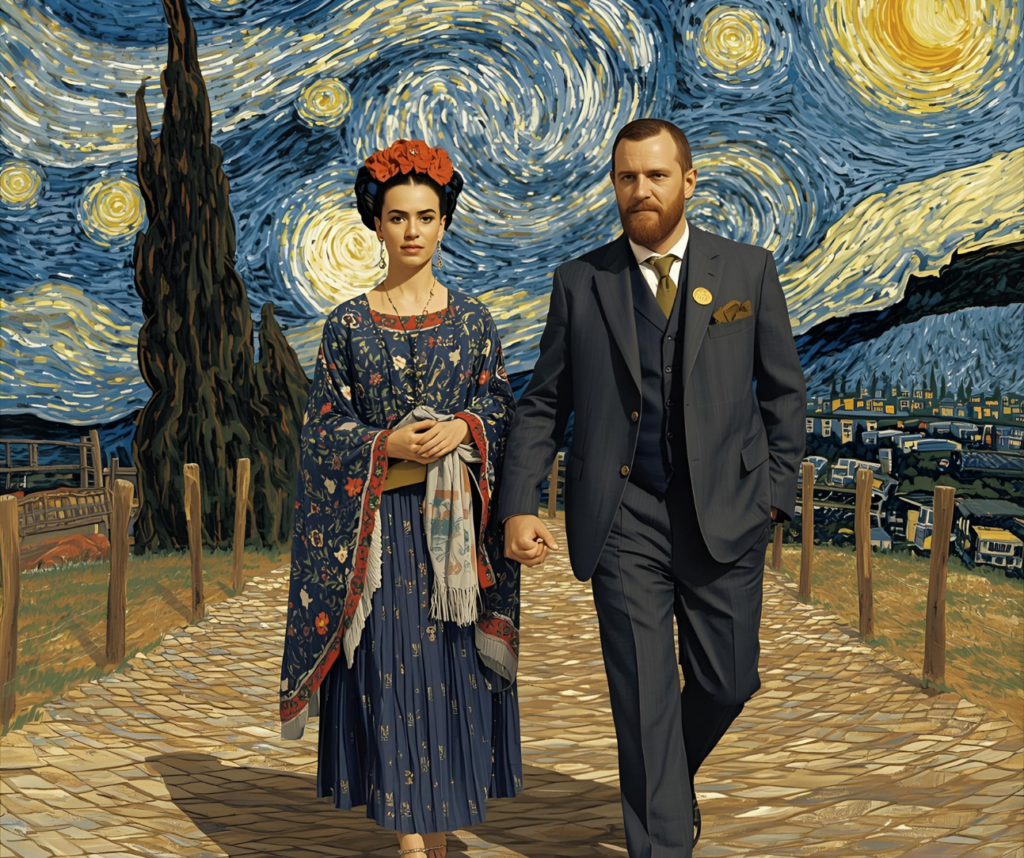
I have a hypothesis—one more of my usual philosophical fantasies—about why artificial intelligence (AI) can never equal human creativity. The idea came to me when I saw those, for me, grotesque representations, so fashionable, in which artists of the past (Van Gogh, Frida Kahlo) are turned into contemporary celebrities and cross the catwalks and walk red carpets, as if they had been reborn for today’s glamour.
Watching them, my question was: why, despite their shocking illusion of reality, do they seem to me a bit stiff, softly false (without this having to do with Van Gogh looking like the hipster he would never have been and Frida an unlikely Vogue intellectual)?
Why does the rhythm of their bodies seem not to attain the speed of the eye but stays a little behind, slightly delayed, as if some internal obstacle prevents them from flowing; as if, when the eye sees them – (the eye, accustomed to the speed of life, to the non-stop fluidity of truly animated life, i.e., endowed with a soul) – the eye expects something more but has to stop, and even go back and wait for the two characters to catch up. However, they advance as if subject to a mechanized clock (a hypersensitive clock, precise, but in the end, a clock, a clock mechanism), which makes them clumsy, not at all spontaneous or natural.
Why, on the other hand, in reality, do the eye and things seem to be one, to couple as if they were one?
An answer to these questions is provided by neuroscientific theories, which, if the reader will allow me, I will try to explain and then associate with our topic.
To begin with, these theories place the structure and functioning of the psyche on a numerical, quantitative basis. According to them, the number of neurons and their possible interrelationships is so enormous that it can be said that they are “almost” infinite, and therefore sufficient to construct an exact representation of the surroundings. In addition, they carry out biological processes at such unimaginable speed that they make us experience ourselves as autonomous beings, that is, not as dependent on the interaction of chemical substances or tiny organic procedures, but as if our thinking and, in general, our minds, were not subject to any physical restriction, as if they flowed independently of matter (by the way, such would be the origin of the sensation of having a soul).
The same would happen with our body and our environment, which are so complex and expedient at the molecular level that, even subject to mathematical laws, they would flow in a way that would seem anything but mechanical, never as part of machinery.
Thus, for AI to generate an exact version of reality as we see and live it, it would have to begin with a number of connections and circuits similar to that of our mind, and attain a speed identical to that of our mind (The figures are immense but not infinite, and, therefore, we can dream of achieving them due to the advancements of today’s technology.)
Moreover, once endowed with this material substrate, artificial intelligence would have to reconstruct the environment at the same speeds at which it moves, taking into account not only the individual objects and their dynamics but also the harmonious way in which they relate to one another. What do I mean by this? I will explain it with an example. A moment ago, my two cats were sleeping peacefully next to me when a rumble of thunder woke them. Although each reacted in their turn, one faster or more abruptly than the other, their movements looked “harmonized” to me, as if a cadence coupled the similarities and differences between them. To reproduce this effect, artificial intelligence would have to recreate not only the movements of each cat but the subtlety of those movements, in theory independent, and their articulation with each other (to me, it seemed an exact fusion of my mind and reality).
Another example: in a television series I’m watching, a long line of characters sits, mesmerized and terrorized, as an explosion blasts outside. Each actress and actor interprets their personal reaction masterfully; however, the ensemble’s response feels forced and a little fake. In such a case, the director is responsible for this mistake, since responsibility for the scene’s overall composition rests with their external gaze. To recreate the same situation, artificial intelligence would have to fulfill not only the roles of each actress and actor but also those of the director, who creates the “reality” of the whole.
The above also clarifies why I perceive a certain artificiality in Van Gogh and Frida; even being together, I do not feel that they are. There is something in their walk that does not harmonize spontaneously, as happens when two people walk together in reality.
Undoubtedly, artificial intelligence has a great future as an artistic tool. Indeed, it has surpassed other tools because it works not only by recreating the external reality of things, but also, above all, their internal mechanisms, that is, those that structure and move objects from within. (It is vital to distinguish AI from cinema and television, which couple the external image of things, but they do not recreate these, precisely, “from within.”)
This growing mastery of both the external form and the internal mechanism (which, for science, are everything) is what pushes us to think that one day AI will be able to undertake its own creations and, thanks to its technical advantages (efficiency and durability, above all), will gradually replace humans. Such a type of AI will no longer be just a work tool, but an actual autonomous organism, capable of replacing the creative spirit.
That’s scary.
A fear, by the way, as legitimate as that of people who refused to be photographed because they believed that the camera stole their souls. Almost all of us have long since overcome this superstition, and we know that the representation constructed by the artifact is not reality itself. The same thing happens to us with cinema, which, in its beginnings, at the end of the nineteenth century, made people stand up from their seats for fear that the locomotive appearing on the screen would destroy them. However, similar fears return again and again because we believe – in effect, superstitiously – that reality has a limit that can be calculated, and that we can therefore understand it in its entirety and even recreate it with machines and mechanisms. Given that belief, we are now afraid of artificial intelligence, believing that it can actually create “animated” (that is, soulful) copies of ourselves and our environment.
Terrifying! (I insist.)
To find the antidote to these gruesome fantasies, we must return to the beginning of this text and rethink the idea that the human mind, and reality in general, are governed by mechanisms (even if they appear otherwise).
Consider, for example, one essential component of our reality and our perception of it: time (significantly associated, by the way, with the rhythm of Frida and Vincent’s walk). Science relates it to the clock’s mechanism. (Albert Einstein said that time is “what clocks measure.”.
However, let us consider other versions, which seem as accurate as this one. St. Augustine said: “If you ask me what time is, I do not know; if you don’t ask me, I do,” which, I dare to say, we interpret as follows: “If I don’t have to enter the world of questions and answers, that is, that of logical and successive reasoning (which, by the way, is the same as that of clocks), then I know what time is”.
Well, I hypothesize that with this “knowledge” that St. Augustine emphasizes, we perceive reality, that is, the mysterious harmony of the movements of two people walking together, for example. We do not do this with the knowledge we gain in the world of watches or with the reasoning language that asks and answers. We perceive it with an ineffable understanding (that is, knowledge that cannot be spoken of).
Strangely, miraculously, human beings can recreate that mysterious harmony through art.
Through, yes. Art is a door through which we can reach that other world. Or, instead (and I correct myself when I remember my time, now distant, as a theatrical actor), art is a room that unites these two worlds, namely, that of everyday reality, where a miracle is so ordinary that we stop perceiving it, and the other, that of art, that of the radiant moment in which we manage to isolate that miracle and witness it with all its brilliance and mystery (the thing that everyday reality always surrounds. “Miracle” is a strange, and perhaps overly fanciful, way of describing art, I know).
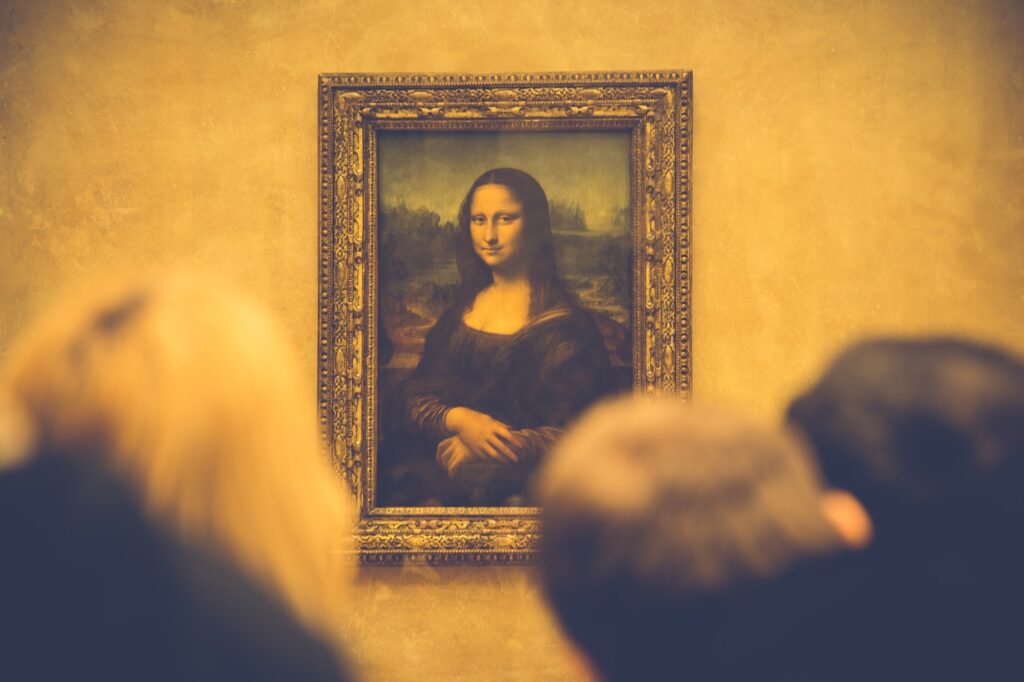
The room we consider here (built using techniques such as pictorial, sculptural, musical, literary, or scenic, and sometimes even artisanal sets) has a door. That door is the one that must be found as an artist and then as a spectator, no longer through a technique but through the creative act. Sometimes the door is the first thing we see when we enter the room: that is what happens with prodigious works of art, such as Velázquez’s Meninas or Albinoni’s Adagio. Other times, the door is more hidden.
In the art of acting – at least, from my experience as a not-so-bad actor – the door has a name that, for me, is simply perfect, and that I am convinced can be applied (if not already) in other arts. That name is timing.
Timing –I will try to describe it, probably without succeeding – it is that kind of suspense we experience when a work of art takes our breath away: the floor falls from under our feet, and we enter a state where there is no time, no after or before, where all time and space is occupied by a simple, perfect radiance that fills and envelops us. It lasts a second (a second without a before or after, I insist), after which the door closes, and we return to the room where the colors, shapes, sounds, or actors continue, as well as our daily life as an audience.
To make art is to try to find reality as it is in that eternal time, to take as many risks as possible to experience it. I have a friend, a masterful actress, who told me that one day when she was playing a woman in a Greek tragedy chorus, as soon as the play began, she “levitated from the floor” – a very approximate way of describing what happened to her – and only “landed” again in the last speech, before the curtain closed and the applause came. About what happened between one thing and another, my friend retains only a vague sensation, a memory that cannot be located in time.
Attempts have been made to translate the word “timing” as “rhythm,” “synchrony,” orsimilar terms, but none capture its essence in depth. In my practice as an actor, timing was always an irreplaceable term, a word that evoked not a way of acting, moving, or saying, nor a technical resource that is mastered through training and therefore can be explained to others (even in different languages). Timing was untranslatable because it was unique and unfathomable: an experience over which one has no control, a true knowledge expressed in a word that is also unique, separate from all the others, a word without language, as François Doltó says. Timing, if you want to associate it with how it occurs in time, would be the moment in which nothingness and eternity elapse.
Timing cannot be measured. It is present in the arts that move in time (such as theater, cinema, dance, literature, music) but also apparently static arts, such as painting and sculpture, where it expresses how two or more visible features of reality are harmonized (mysteriously, I insist) to lead us to that other world (which, as Leibniz said, is within this one).
Now, what I want to affirm (the ultimate purpose of this essay) is that without this eternal knowledge and meaning, this immeasurable timing, any recreation of reality will always be artificial, and (the most essential point), knowledge, due to its very condition of alienation from time, cannot be part of a mechanism. The AI clock will never know. The latter can only take the place of a tool and never the creative spirit. As a tool, it will be able to reproduce more and more accurately those aspects of reality and our experience that are quantifiable; however, for the works it produces to enter time (and make us enter), human intervention will be needed.
For Vincent and Frida to truly walk together, as we all do in our daily eternity, it will be necessary to start by molding matter with the artificially intelligent tool and, afterwards, endowing it with eternity through our souls.
Translation by Daniel Wetta