
I have always liked the analogy between the preschool educational level and a flower garden, where each infant is a seed that needs to be attended, nurtured, and accompanied to grow in a healthy, strong way. This comparison perfectly reflects the importance of caring for children’s cognitive, physical, and emotional development during the first years of life. But how do infants’ thinking and understanding manifest themselves at this stage of their development? How can we make their learning visible? The thinking routines developed by the Harvard University Graduate School of Education are simple and structured strategies that help students show their thinking and promote a culture of reflection in the classroom. Due to their flexible and transversal nature, thinking routines can be applied at all educational levels from preschool to postgraduate. In this article, I share four practical exercises inspired by this strategy to motivate the little ones to express their ideas, develop their cognitive abilities, strengthen their confidence, and make their thinking visible.
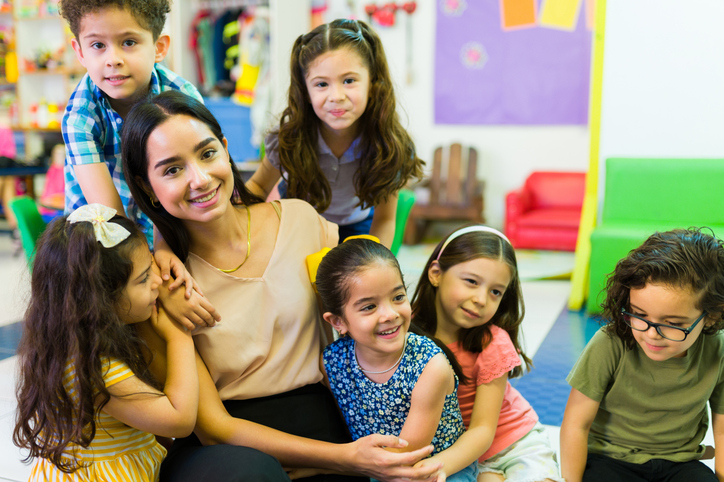
Preschool or early childhood students are characterized by their curiosity and an amazing ability to marvel at the world around them. Every situation they experience is an opportunity to discover and create. Spontaneously, they ask simple but profound questions and often surprise us with answers or solutions that escape the logic of adults. They are empathetic, enjoy the company of other people, laugh easily, and express their emotions authentically.
Student Learning in Preschool
In my experience as a teacher and librarian, working with preschool students is unique because no day is the same as the others. Children’s learning occurs through various dynamics, such as play, exploration, discovery, interaction, seeking answers, and decision-making. Each workday brings discoveries, experiences, and learning that enrich both the children and those of us who accompany them.
In the classroom, our youngest students enhance their skills and enrich their way of learning through meaningful experiences and thinking routines that stimulate observation, reflection, and the active construction of knowledge. For example, when a child interrupts a story to say, “That happened to me too!” recognizing themself in the character and making the story their own, it reveals to us what is often underestimated about children at this age: their deep capacity to reason, connect ideas, and reflect on what they live and learn.
What are Thinking Routines?
Thinking routines are sets of questions or sequences of steps used to structure and support students’ thinking. They were developed through Project Zero, founded by Nelson Goodman in 1967 at Harvard University’s Graduate School of Education. Thinking routines strengthen students’ cognitive skills, promote inquiry, collaboration, discussion, and reflection. They also guide teachers’ work, inviting them to listen, ask questions, accompany the children, and guide each student’s thought process. Due to their flexible and transversal nature, thinking routines allow the integration of different topics, disciplines, and age groups; therefore, they can be applied at all educational levels. In the preschool context, this flexibility allows children’s thinking to be visible through different perspectives of meaningful experiences.
For this project, a Thinking Routines Toolbox with more than 100 thinking routines was designed. It was organized by thought categories that describe the cognitive processes sought to be promoted. Some of these categories were: 1) introducing and exploring ideas; 2) synthesizing and organizing ideas; 3) deepening reasoning; 4) adopting a perspective; 5) generating possibilities and analogies; 6) exploring art, images, and objects; 7) global thinking; 8) controversies, dilemmas, and perspectives; among others. Each category presented different activities, suggestions, and resources that could be adapted and implemented in class.
Project Zero has had a sustained impact on education internationally for more than five decades since its inception. According to an institutional publication, more than 4,000 educators from various countries participate each year in training and collaboration programs with Project Zero researchers, underscoring the usefulness and value of these programs in educational practice.
Thinking routines applied at the preschool level
This proposal, inspired by the strategy of thinking routines, was collaboratively designed with my colleagues. It was implemented in the classroom and in the preschool library of the Monte Tabor Nazaret Educational Unit in Samborondón, Ecuador.
1. People, Roles, and Community
Skills: explore, inquire, organize, and deepen.
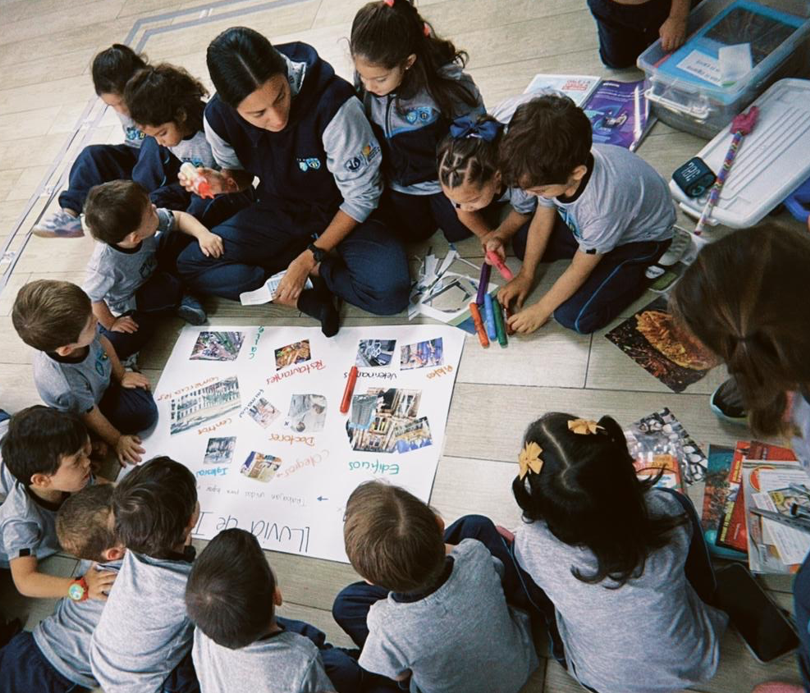
Brainstorming was done with three-year-olds about how to think together. Although one might think that at this age it is difficult to apply thinking strategies, in this practice, the teacher demonstrated that, with the right resources, children can actively participate in such a process. The “brainstorming” strategy was introduced for the first time in a pre-kindergarten class, with children as young as three. In the session, the concept of community was explored; to this end, the teacher gave the children magazines to look for images of community elements: people, objects, clothing, professions, places, modes of transportation, etc. Each student cut out their images and pasted them onto a flip chart. At the same time, the teacher wrote down what the children named, thus collectively brainstorming.
Subsequently, this information was used to create a comparative table with three columns: Who is it?, Where does he work? and what does he do? This prompted the children to organize and deepen the ideas they had in the brainstorming. For example: “The doctor works in the hospital and heals people.” This activity not only fostered language, classification, and the connection of ideas, but also the ability to work in a group and construct meaning collaboratively.
2. Learning with Mr. Sun
Skills developed: classifying, drawing, writing, remembering, collaborative knowledge building, reflecting, and languages.
In an English class with three-year-olds, a creative strategy called “Learning with Mr. Sun” was used, allowing students to visibly show their thinking after completing a unit on animals.
The teacher worked on the unit “How we share the planet,” where the children learned to classify animals into three groups: domestic, wild, and sea animals. At the end of the unit, each student received a paper “sunray” on which they had to draw or write what they had learned, what they liked the most, or what they remembered from their work.
These rays were placed around a large sun in the center of the classroom, forming a collective mural with everyone’s learning. Thus, the whole class could visualize how each child had understood and remembered something different, while everyone contributed to the construction of knowledge. This strategy promotes individual reflection and reinforces the idea that thought is shared, diverse, and valuable, even across languages.
3. Discovering culture: three spotlights to illuminate thought
Skills: identifying, drawing, expressing, and sharing.
In a third-year preschool class with five-year-olds, the teacher proposed an activity that allowed them to reflect on what they knew and locate themselves in their learning process. The concept of culture was explored in the learning unit “How we express ourselves,” focusing on customs, traditions, and ways of life in different countries.
The strategy used was called “Comes to light,” which utilized a graphic with three spotlights: one off, one half on, and one fully on. Each child was given a Post-it note on which to draw what they meant by “culture,” then place themselves on the spotlight that, in their view, best represented how much they knew about the subject.
The answers were diverse. Several children drew globes or flags and placed themselves in the half-lit spotlight, explaining that “culture is about countries.” One child stood on the fully lit spotlight and said confidently, “Every country has its own culture.” This strategy allowed the teacher to gain a valuable assessment of what her students knew and the ability to consider what they know, what they don’t know, and what they want to learn.
4. Reading Detectives: thinking while reading
Skills: imagining, thinking while reading, inquiring, and taking a position.
My experience as an entry-level librarian has shown me that the thinking routines activities can also be applied outside the classroom. In a session to encourage young children to read, I implemented a strategy called “Reading Detectives,” inviting them to observe, interpret, and ask questions about the story.
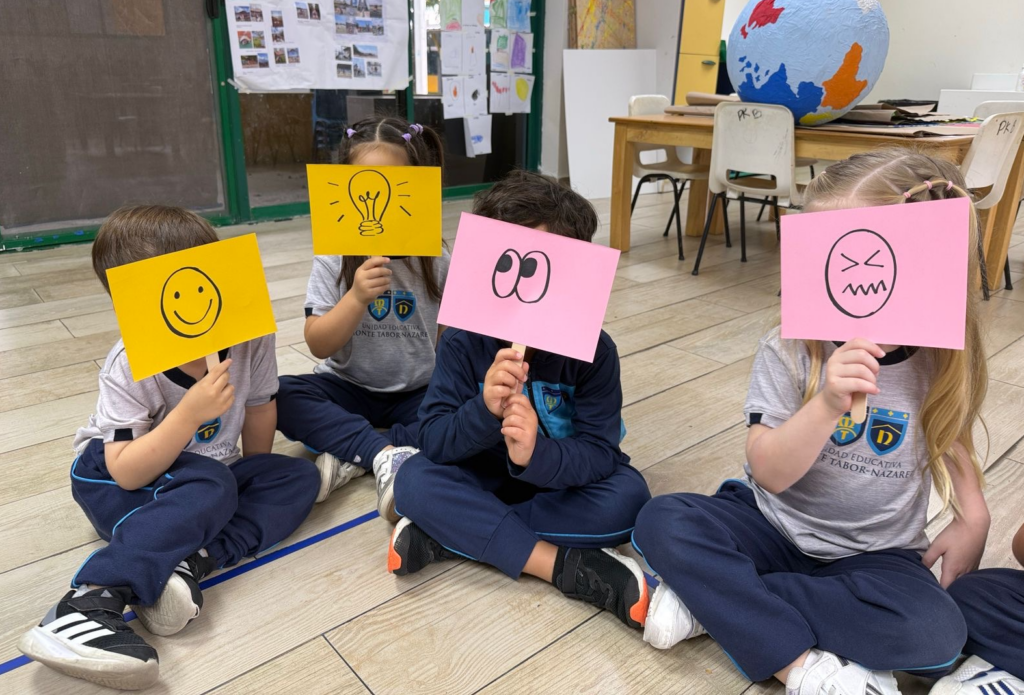
To do this, I used small posters with emojis representing different moments of thinking.
- Eye emoji: Before starting, they were asked to look at the book cover and answer questions such as “What do I see?” and “What will this story be about?”
- Spotlight emoji: During the reading, each child was invited to ask themselves a question: “What am I wondering?” or “What else would I like to know about this story?”
- Happy or disappointed faces emojis: After reading, each child shared what they liked the most, what they didn’t like, or what they thought about the story.
This activity transformed reading into a meaningful experience by allowing students to connect ideas. The most incredible thing was seeing how, with visual support and open-ended questions, the children could think out loud and share their hypotheses, questions, and opinions with enthusiasm.
Reflection
Through these real-life experiences, it’s evident that preschoolers can not only think and reflect but also love doing so! When we offer them a safe environment, accompanied by visual strategies and appropriate language, children can observe, classify, connect ideas, reflect, and express their thoughts in depth. Thinking routines are not abstract or impossible exercises, but opportunities to make what you understand about your world visible.
I want to invite teachers, librarians, and early childhood professionals to trust in children’s ability to think from a very young age. Thinking routines are not exclusive to higher levels but are a valuable tool for all ages. Including them at the preschool level enriches the teaching process and enhances our students’ autonomy, language, and curiosity from the earliest years.
About the Author
María Mercedes Chavarría González (mchavarria@uemtn.edu.ec) holds an undergraduate degree in early childhood education, a master’s degree in Psych pedagogy, and a master’s degree in children’s literature and the promotion of reading. She has been working with young children for more than fifteen years. Since 2013, she has been a reading promoter, a role she developed in both the classroom and the preschool library. In 2015, she implemented the IB PEP program, adopting an inquiry-based approach. In this, she designs reading experiences that encourage curiosity, research, and a taste for reading, fundamental elements of learning in the first years of life.
Acknowledgement
I want to express my thanks to Dr. Jessica Jasso Ayala for motivating me to take this step to write and share this experience during the Universal Design for Learning (UDL) training. I also recognize the support of my colleagues Mara Ponce, Nathaly Álava, and Anica Pandzich, who put the strategies into practice and collaborated with photos and materials. My special gratitude goes to Soledad Puyol, IB and PAI Continuum Coordinator, for supporting this initiative from the beginning. I also thank the director and coordinators of the preschool at the Monte Tabor Nazaret Educational Unit for trusting me and allowing these activities to be implemented.
References
American Academy of Pediatrics. (2023). Developmental milestones: Ages 2 months to 5 years. Pediatric Patient Education.
https://doi.org/10.1542/peo_document113
Project Zero. (n.d.). Thinking routines. Harvard Graduate School of Education. https://pz.harvard.edu/thinking-routines
Harvard Graduate School of Education. (n.d.). Home base for human potential: Project Zero. https://www.gse.harvard.edu/hgse100/story/home-base-human-potential
Editing
Edited by Rubí Román (rubi.roman@tec.mx) – Editor of the Edu bits articles and producer of The Observatory webinars- “Learning that inspires” – Observatory of the Institute for the Future of Education at Tec de Monterrey.
Translation
Daniel Wetta