


Formally, the field of Artificial Intelligence (AI) dates back to the 50s, with Alan Turing, well before Google’s creation in 1998. However, back then, long before AI as we know it today appeared, many experts were already concerned about the Google effect, i.e., the availability of information at one’s fingertips, which reduced internal memory. This effect suggested that people remember better where they found the information than the information itself.
In academia, Google was a subject of controversy among many teachers at the time, as it was initially seen as a threat rather than an educational tool. Students could copy and paste information without having read or analyzed the content for academic tasks, resulting not only in serious breaches of academic ethics but also in the hindrance of the development of critical skills, such as critical thinking.
The Google effect, the lack of digital literacy, and the scarcity of information technology skills led teachers to look for alternative, analog, or unplugged strategies to promote meaningful learning, setting aside the use of the Internet and Google as allies in the teaching-learning process. However, we know that over time, educational technology and innovation have enhanced education through technological development. Currently, the hype around generative AI is undeniable; concerns focus on how this tool harms our cognitive abilities and higher-order skills, while fostering a culture of convenience that permeates society.
The effects of AI on learning
The positive effects of generative AI on education include improving lower-level cognitive skills, e.g., language and image comprehension, word decoding, etc. (Liu et al., 2025; Rahyuni et al., 2024), as well as fostering communication and argumentation skills (Rahyuni et al., 2024).
Although this technology has brought significant changes to education, new lines of research have emerged regarding its potential negative cognitive effects on learning processes, which will be described in more detail.
Cognitive debt
The term “cognitive debt” comes from the field of clinical neurology, specifically from Alzheimer’s research. This concept suggests that certain cognitive processes do not promote mental development and can deplete cognitive reserves (Watts, 2025). In this process, the main mechanism is repetitive negative thinking (PNR), common in conditions such as depression and anxiety (Marchant & Howard, 2015, as cited in Watts, 2025).
In education, cognitive debt is defined as “an opportunity cost accrued by the absence of a beneficial internal process: reflective thinking, deep processing, and the construction of schemas that constitute genuine learning” (Kintoni et al., 2025; Sweller, 1988, as cited in Watts, 2025). According to these studies, when AI is used to perform critical-thinking tasks without a pedagogical purpose, the opportunity to invest in one’s cognitive reserves is lost, which, over time, leads to harmful cognitive debt. Namely, two mechanisms promote cognitive debt in education: cognitive offload and automation bias:
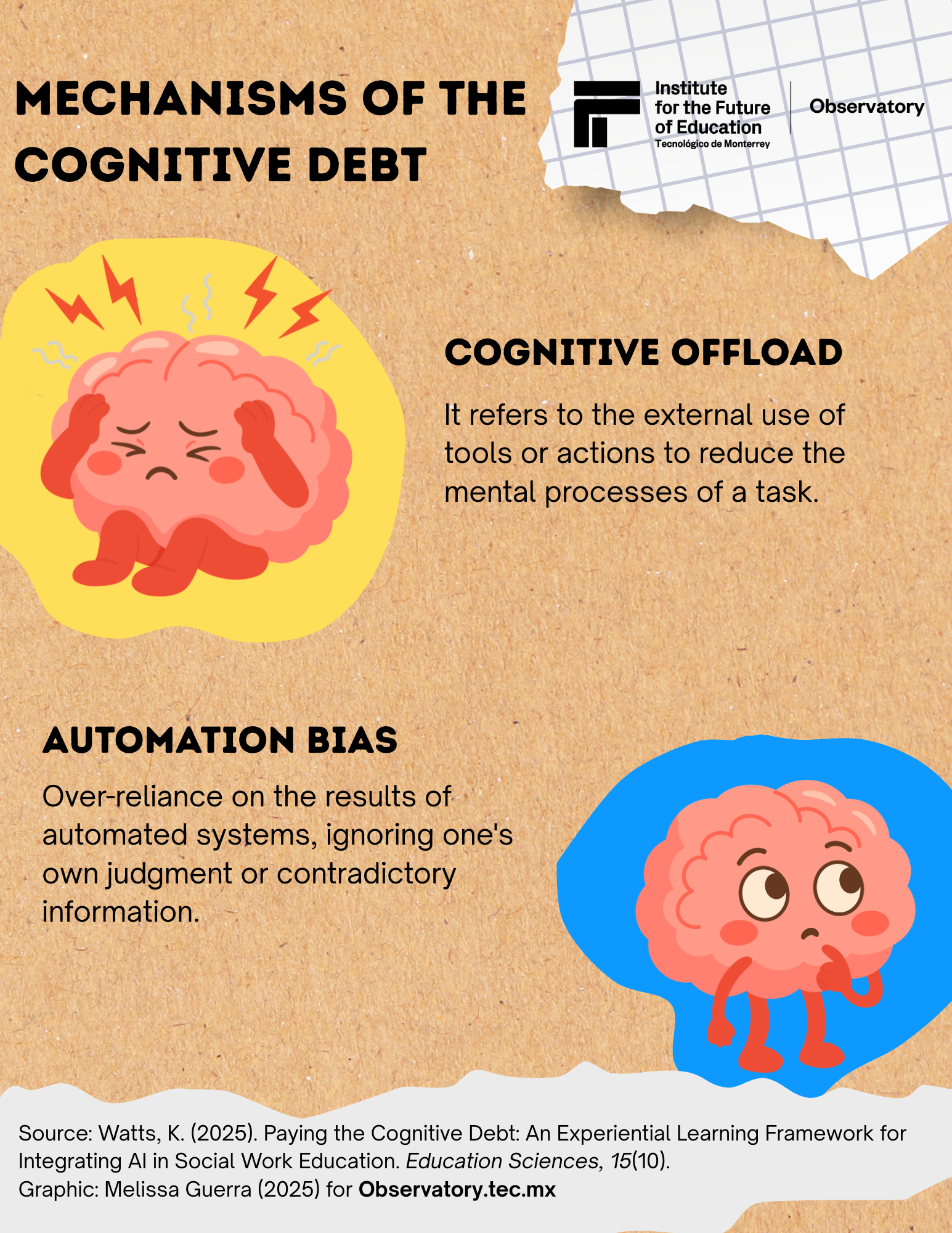
Studies show that automation decreases cognitive load (cognitive offload), thereby improving efficiency and performance by enabling cognitive processes to focus on higher-order thinking, i.e., processes related to analysis, evaluation, creation, etc. (Gerlich, 2024). However, reliance on these tools can impede the development of complex mental processes, leading to a degradation of cognitive abilities (Watts, 2025).
On the other hand, automation bias can manifest itself in two ways: errors of omission and commission; the former occur when the student is unable to solve the problems that the information may contain, and the latter, when the information provided by AI systems is accepted, but the student does not verify it and takes it as correct.
The controversial MIT study
Recently, a frontier study by MIT (Massachusetts Institute of Technology) titled Your Brain on ChatGPT: Accumulation of Cognitive Debt when Using an AI Assistant for Essay Writing Task by Kosmyna et al. (2025) revealed negative effects on the brain from the use of LLMs (Large Language Models), such as ChatGPT, in writing tasks.
In summary, this study used electroencephalography (the recording of brain activity via electrodes placed on the head) to assess two variables: cognitive engagement and cognitive load. The nature of the study required the use of specific frequency bands to obtain specific data from EEG (electroencephalogram) studies.
The following summarizes the bands used in the MIT study (Kosmyna et al., 2025):
- Alpha-band connectivity: associated with inner attention and semantic thinking during creative ideation.
- Beta-band connectivity: related to cognitive processing, focused attention, and sensorimotor integration.
- Delta-band connectivity: reflecting a broad and large-scale cortical integration, related to attention, monitoring, and language processes, among others.
- Theta Band Connectivity: linked to working memory and executive control**.
*Cortical functions refer to the cognitive processes and abilities of the cerebral cortex.
**Executive control refers to high-level cognitive processes (of the prefrontal cortex), such as working memory, cognitive flexibility, verbal fluency, planning, thinking speed, and attention control, among others.
The results of the study showed that students assisted by the LLM had a lower connectivity profile than those in the group that did not use it or used only search engines (such as Google), and they showed reduced cognitive activation compared to the other groups. This means there was lower demand for brainwork thanks to the AI system’s assistance. Likewise, the results showed that the students did not actively engage with the topics or delve into the provided material.
These results led to the conclusion that the use of LLMs may carry cognitive debt, i.e., “a condition in which repeated reliance on external systems, such as LLMs, replaces cognitive processes that require effort for independent thinking” (Kosmyna et al., 2025). Moreover, this debt postpones mental effort in the short term, which, in turn, reduces capacity for critical inquiry, increases vulnerability to manipulation or bias, and limits creativity.
Critical thinking
Another negative effect of prolonged generative AI use is its impact on critical thinking, a rational, reflective skill focused on evaluating and making decisions. Indeed, critical thinking enables the analysis and evaluation of information to develop creative solutions; it complements other reasoning skills, such as reflection, problem solving, and reflective thinking.
Other definitions suggest that critical thinking allows people to question and revise their opinions in light of verified facts, so this skill also encompasses inference, interpretation, and self-regulation.
Therefore, students with critical thinking skills (Gerlich, 2025):
- Perform better academically.
- Are better at solving problems.
- Are less susceptible to manipulation.
To understand how using AI affects critical thinking, we must return to the concept of cognitive download, which refers to the use of external tools or agents (e.g., AI, calculators) that reduce cognitive load.
Because AI tools reduce cognitive burden, cognitive processes slow down; therefore, learning opportunities to develop these skills are hindered rather than enhanced by this technology, affecting memory retention and critical analysis skills.
In addition, the use of this technology can lead to cognitive dependence. This is defined as a regressive dependence, in which the person, despite having the resources to perform a task, chooses to rely on other means to accomplish it, thereby preventing the cognitive domains involved in its execution from strengthening. This causes developmental regression and a sense of uselessness (Correa, 2023). This cognitive dependence leads to a significant deterioration in cognitive abilities, which, in turn, fosters automation bias, as the user does not question or verify information from the AI.
Educators must find strategic ways to integrate AI into education beyond copying and pasting. According to a survey by the Digital Education Council, 80% of teachers worldwide report a lack of clarity about how to apply it in their teaching.
Generative AI tools are great allies; however, steps must be taken to mitigate their effects on critical thinking and cognitive development. While some studies have shown that reducing cognitive load with AI tools leads to greater output and efficiency, as well as reduced mental strain, this comes at a considerable cognitive cost.
Thus, activities that develop deep thinking and analytical reasoning skills must be encouraged, as must strategies that enable the responsible and purposeful use of these tools.
While the brain is an impressive organ with exceptional neuroplasticity, further cutting-edge studies are needed to explore the effects of AI and assess whether mitigation strategies exist.
Translated by Daniel Wetta