
“The street and the night are also ours” is a slogan that resonates in the voices of thousands of women in feminist and protest spaces worldwide, reaffirming the historical demand to reappropriate the places taken from women.
For women, public spaces, especially at night, represent not only the probability of being a victim of a robbery and assault but also experiencing an episode of gender-based violence. It should be noted that some factors, such as misogyny, have entrenched in society the idea that nocturnal mobility is one of the main risk factors for women; however, harassment, sexual violence, and other forms of aggression within the home are also suffered.
In response to this, women have established collective and individual self-care measures, such as wearing outfits that do not call attention, sharing their routes through real-time location apps, creating groups to monitor and follow up on departures and returns, ride-sharing with other women, and activating safety options on travel platforms, among others. However, such measures have not been sufficient to mitigate the violence that women experience.
Although gender studies analyze the particular causes of violence suffered by women, when a woman is a victim of an act of violence in public spaces, they are still held responsible for the situation, especially in cases of sexual violence, pointing out risk factors like the time, the place, and the clothes they wear instead of addressing the offense as a public and social problem.
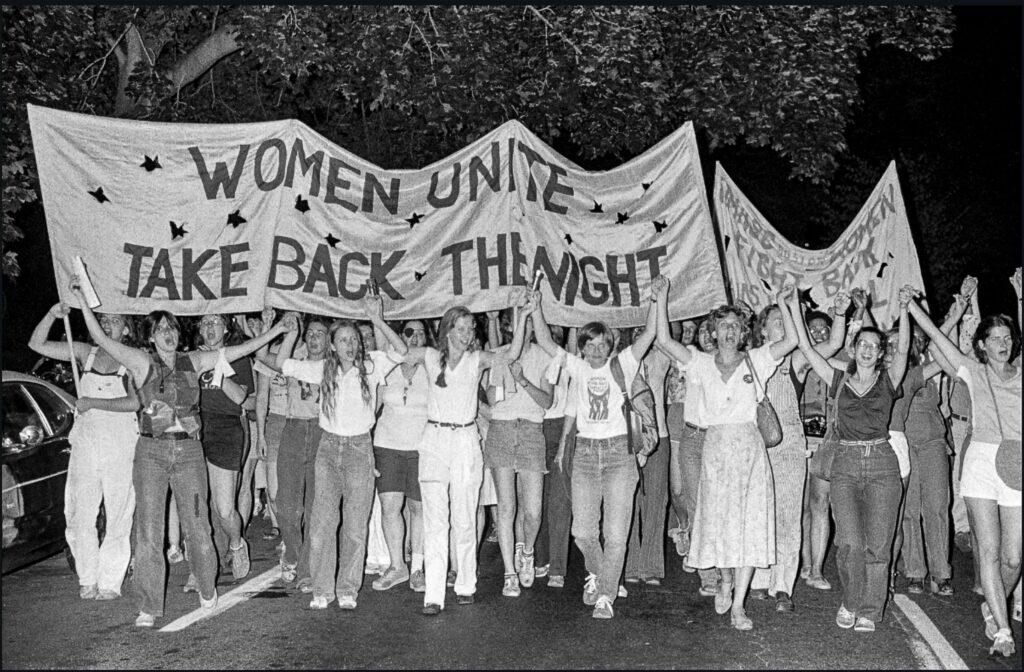
One of the movements promoting safe spaces for all women is Take Back The Night (TBTN), founded in the seventies. It is a pioneer in the fight against sexual violence in all its forms. More than 2,000 activists from 40 countries gathered in Belgium and raised their voices to protest the lack of safety for women who walk at night. In 1973, a group of women from the University of South Florida marched across campus, demanding a support center. Thanks to this and other mobilizations, thousands of women from different educational institutions worldwide have joined the cause to end all forms of sexual violence, trafficking, gender harassment, and violence in relationships, in addition to supporting survivors in their healing processes.
In the face of women’s situation, it is crucial to question why men and women have different experiences when exercising their mobility and the actions carried out to guarantee safe spaces. In this sense, feminism and women’s movements have led to strategies to raise awareness and denounce gender violence in public places and demand full access to human rights. It is necessary to have an agenda that includes the analysis of gender and the interactions of class, race, and other social categories to achieve security for women; public policies must be proposed that guarantee security for all people.
Since 2021, Tecnologico de Monterrey has embraced the Take Back The Night movement to reflect on the different expressions of sexual violence in public spaces through communication campaigns aimed at the student community. Similarly, as an institution, we generate actions and mechanisms for the prevention and attention to gender violence, emphasizing the formative and reflection processes, always accompanied by listening sites for the student community, student groups, and collectives.
From the Human Dignity Center (CRDH in Spanish), through our Office of Institutional Networks and Alliances, we seek to form connections with different universities, organizations, and companies, nationally and internationally, to develop collaboration agreements to generate joint actions on issues of human dignity. These organizations include UN Women, ACNUR, RENIES, ONIGIES, and APRU, among others.
The institution and the CRDH are committed to elevating the visibility, reflection, awareness, dialogue, and actions that allow us to strengthen the culture of diversity and inclusion.
To learn more about the TBTN movement, visit their website WEB About Us | Take Back the Night Foundation