


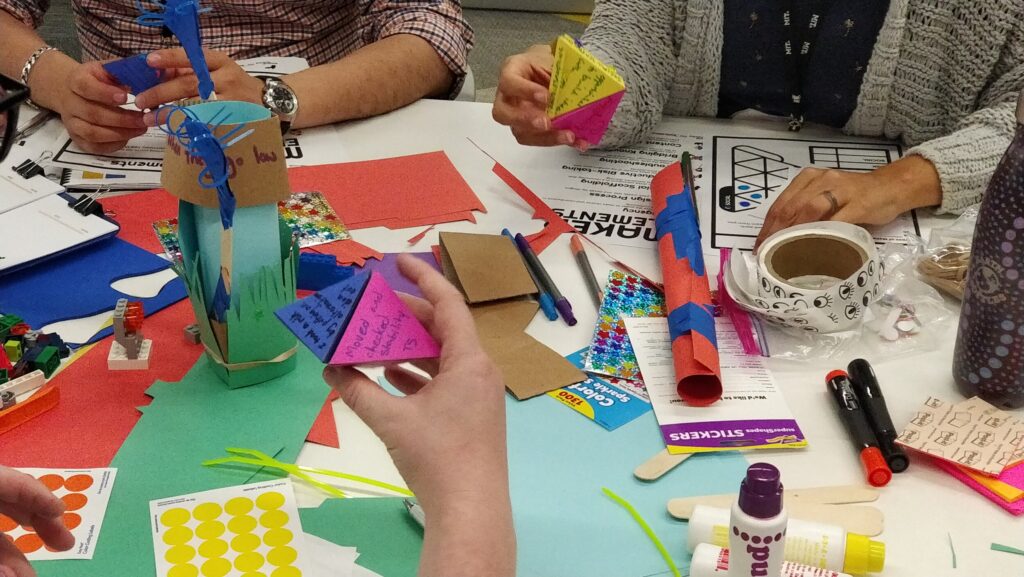
“Makerspaces have the potential to transform the type of learning that occurs in formal settings.”
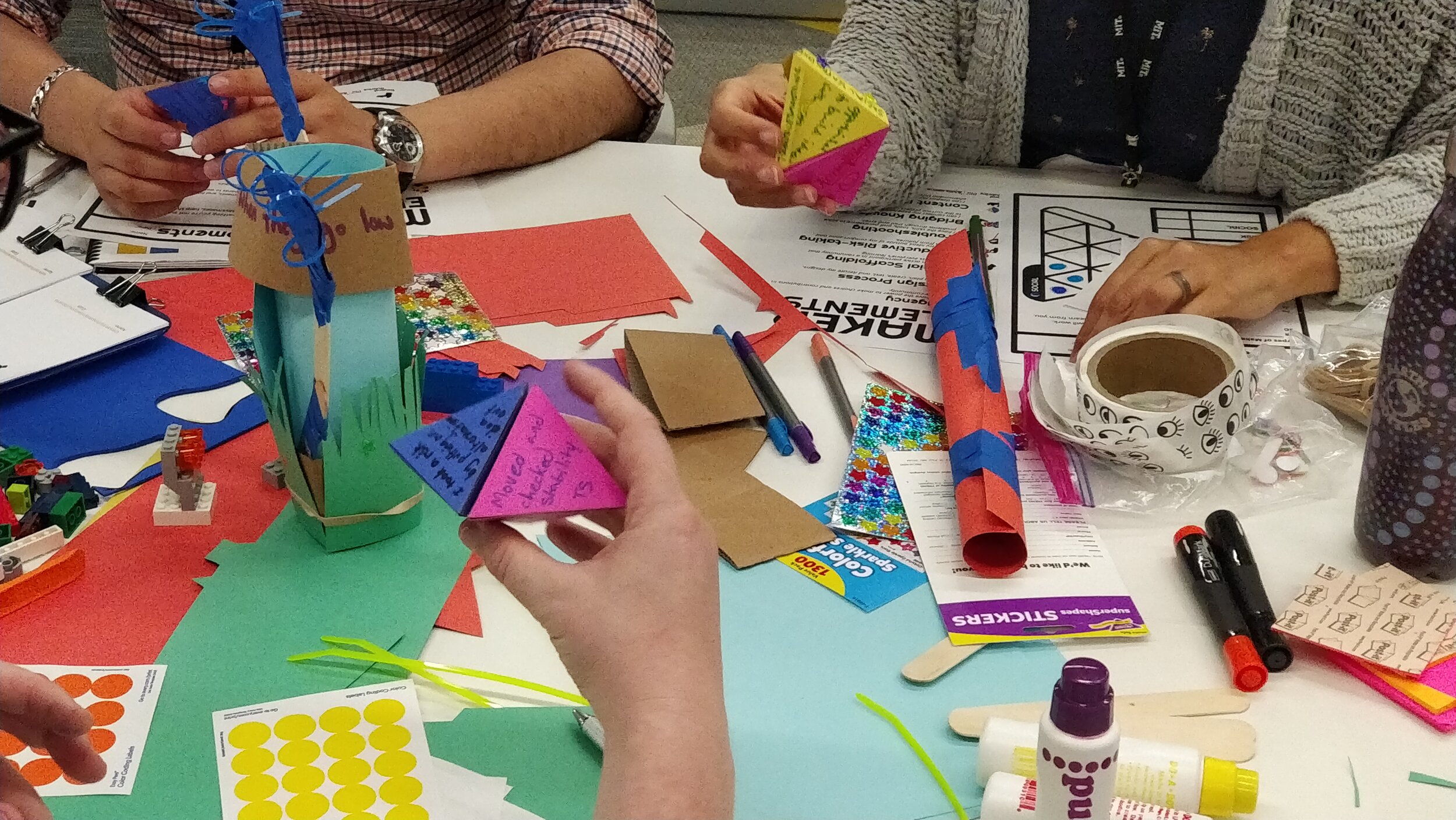
Photo: MIT Playful Journey Lab.
Makerspaces are places where learners can explore a variety of materials and tools to build and create their own projects. It is increasingly common to find a makerspace in schools in the United States. If you didn’t know about them before seeing this article, here I explain why they are useful for students’ education. If you are already familiar with makerspaces, I also share some strategies to get the most out of learning when using these. More important than the things we find in these spaces, however, is the approach, mindset, and community orientation that students and teachers bring to these areas. Maker education strives to give students the resources and motivation to explore their own ideas and see themselves as people who can tinker, build, and solve problems in the world.
While the hands-on building is not a new concept, it often lacks in schools, which tend to focus more on book learning and didactic pedagogies. As such, makerspaces have the potential to transform the type of learning that occurs in formal settings. Hot glue and cardboard, copper tape and LED lights, laser cutters, and 3D printers – these materials and tools are commonly found in makerspaces just waiting to be used to create projects, explore ideas, and assist learning.
“Maker education strives to give students the resources and motivation to explore their own ideas and see themselves as people who can tinker, build, and solve problems in the world.”
Many valuable skills can be acquired through maker-based education. Indeed, the things that students put together sum to much more than just the final project on display. The process they go through, and their hands-on experiences help build future-ready skills beyond what they learn in many traditional classes.
“Students develop skills that in a traditional class would not be possible.”
But what are these skills exactly? What do they look like, and do we really know them when we see them?
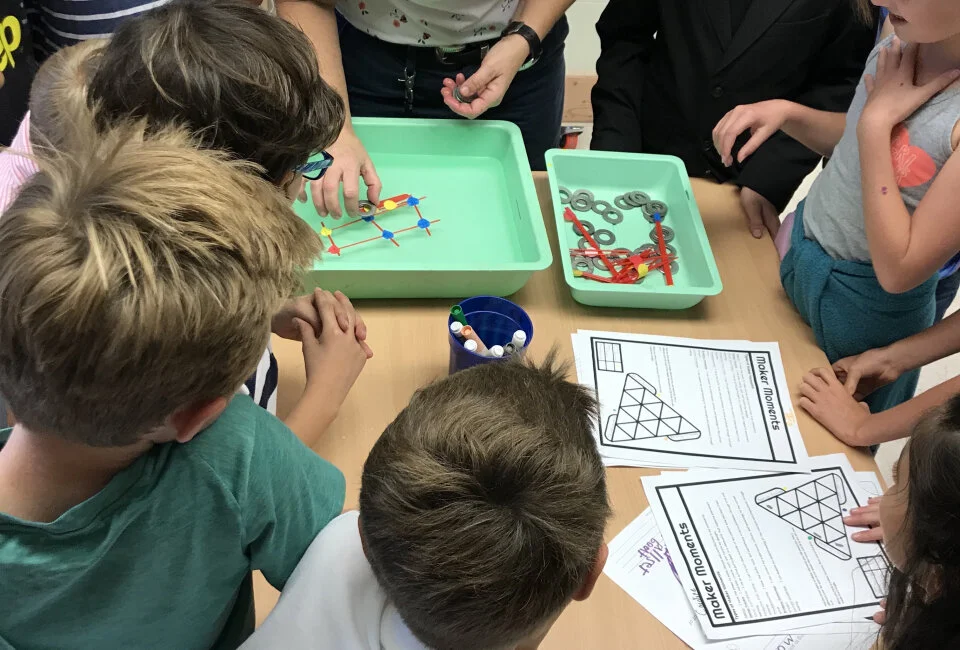
MIT Playful Journey Lab.
Over the past decade, makerspaces have been established in a variety of informal and, increasingly, formal educational settings (Peppler, 2016). Educators teach students how to use specific tools, give them guided projects to do, or let them dream up their own project ideas. They have students work alone, in small groups, or together on whole-class projects. Researchers study ways that makerspace activities can encourage and motivate students to have authentic, personalized experiences (Agency by Design, 2015).
Resources such as the Makerspace Playbook provide ideas for how to set up a makerspace, facilitate maker-based education, and host showcases for students to share their projects. Conferences like FabLearn and the MakerEd Convening bring together maker educators and researchers alike to share best practices and build community. Among all of these, one common thread is the common question, “What are students learning?”
“In these spaces, educators teach students how to use specific tools that they may not know, assign them guided projects and allow them to propose their own project ideas.”
This exciting question has been researched, too, by academicians and educators alike (Petrich et al., 2013). Surveys have shown that in many makerspaces, activities are conducted that align with the NGSS Science and Engineering Practices and Engineering Practices such as defining problems and designing solutions. These activities also accord with the necessary 21st century skills of communication and collaboration due to the prevalence of group projects in makerspaces (Chang et al., 2017). And much has been written about building a “maker mindset” as one of the key outcomes of participating in a maker community (Dougherty, 2013). But can we get more specific about describing these skills in the context of making? Based on observations and research literature, frameworks have been developed that foster the skills students learn through maker-based education.
One such framework is the Dimensions of Making and Tinkering from The Tinkering Studio at the Exploratorium. The five dimensions laid out are Initiative & Intentionality, Problem Solving and Critical Thinking, Conceptual Understanding, Creativity & Self-Expression, and Social and Emotional Engagement. These dimensions were identified through collecting video data of kids engaging in maker activities both at school and at the museum and teasing out the skills that were demonstrated. The framework is meant to guide the design and facilitation of activities and environments for making (Bevan et al., 2018). By keeping these outcomes in mind, educators can better evaluate whether their students are engaging in truly deep learning.
Another useful framework, the Learning Practices of Making, comes from the MakeShop at the Children’s Museum of Pittsburgh. The skills that make up this framework are Inquire, Tinker, Seek and Share Resources, Hack and Re-purpose, Express Intention, Develop Fluency, and Simplify to Complexify. To identify these, researchers began with a content analysis of Make Magazine and continued by observing families doing maker activities together in the museum and discussing and refining the learning practices they saw applied there. This framework describes how people learn through making, but these methods are themselves key outcomes, representing the transportable skills that makers are acquiring through their projects.
Frameworks like the Dimensions of Making and Tinkering and the Learning Practices of Making are valuable resources for illuminating the learning that goes on in maker-based education in general. For any educators new to the idea of making and who are wondering what the potential for learning is, these sets of skills and dispositions are mind-opening and inspiring. In fact, they lead to the next logical question: As an educator, how will I know if my students are building these skills and how they are progressing? The answer, of course, is through authentic and relevant assessments! But given that these process skills are difficult to measure with traditional assessments, how are open-ended, student-driven projects assessed?
A 2017 survey showed that many maker educators are experimenting with their own assessment methods, with some of the most common methods being the use of portfolios, exit surveys, and rubrics—including a mixture of both self-and-peer assessments (Peppler et al., 2017). While it’s great to see educators applying assessment methods that they believe are a good fit, they could also benefit from a principled, more systematic approach to assessment, specifically designed to target the skills built in the maker activities.
So, to transfer the rich practices found in informal, often family-based making to the more formal setting of school-based makerspaces, we at the MIT Playful Journey Lab have selected a subset of constructs to explore in this first phase of research. Our “Maker Elements” are Agency, Design Process, Social Scaffolding, Productive Risk-taking, Troubleshooting, Bridging Knowledge, and Content Knowledge. While we recognize the incredible richness of maker learning, we chose this list of specific constructs as a starting place for our assessment designs and teachers’ assessment practices. With these as a foundation, later design and research phases can expand the constructs and explore their nuances. Targeting these learning outcomes, we have developed a set of embedded assessment tools, called the Beyond Rubrics Toolkit. The toolkit and the underlying approach are meant to help learners and teachers recognize and evaluate the hard-to-characterize, deep learning that is occurring, whether they are new to making or are seasoned makers.
The toolkit has three main phases that educat
ors should prepare. The first is the context setting. Build a shared understanding with your learners to identify which skills are most valued in your community and what those skills look like in real life. Practice noticing them so that learners can identify these skills in themselves and their peers. The second phase is the collection of evidence. Use a variety of tools to document and collect evidence of how students demonstrate each construct at the moment or soon after. An example is Maker Moments, in which a few skills are labeled on a bingo card, stamped each time a student notices an example of skill in use, and ultimately comprises a visual record of the types of work they practiced that day. Finally, the third phase is “meaning-making.” Take all the evidence collected from a student or the whole class, interpret the data to make claims about student learning, and communicate the information with stakeholders. While we are still working on the toolkit and exploring different research questions, we have shared our prototypes so that teachers and classrooms can use, remix, and adapt them.
These maker learning frameworks and the Beyond Rubrics toolkit are things that you can use in your makerspace or maker-based education. To start, try taking the Maker Elements, and think about which skills you’ve seen your students demonstrate. Which ones are best supported by your activities and pedagogy, and which ones could be strengthened? If you haven’t tried maker projects yet, use your school’s makerspace or do a hands-on project in your classroom. Talk about a couple of the maker elements with your students and see what resonates with them! Finally, pick one assessment tool and implement it together with your students. Explore the evidence you and your students collect, decide which pieces best align with the constructs you care about, and reflect on how you can change your lessons to support that outcome better. And most of all, when it comes to the assessment of makerspaces, keep making things and having fun!
About the author
Louisa Rosenheck (louisa@mit.edu) is the Associate Director and Creative Lead of the MIT Playful Journey Lab. She brings the playfulness of games into her assessment design work, creating digital and non-digital tools to help both students and teachers assess creative work and soft skills.
References
Agency By Design. “Maker-centered learning and the development of Self: Preliminary Findings of the Agency by design Project.” Cambridge, Mass.: Harvard Graduate School of Education, January 2015. www.agencybydesign.org/wp-content/uploads/2015/01/Maker-centered- learning-and-the-development-of-Self_Abd_Jan-2015.pdf.
Bevan, B., Ryoo, J. J., Vanderwerff, A., Petrich, M., & Wilkinson, K. (2018). Making deeper learners: A tinkering learning dimensions framework. Connected Science Learning, 7.
Chang, S., Keune, A., Peppler, K., & Regalla, L. (2015). Open portfolio project research brief series. Maker Education Initiative, Palo Alto, CA, available at https://makered.org/wp-content/uploads/2016/01/MakerEdOPP_full-Research-Brief-Series_final.compressed.pdf.
Dougherty, Dale. “The Maker Mindset.” In Design, Make, Play: Growing the Next Generation of STEM Innovators. London: Routledge, 2013. llk.media.mit.edu/courses/readings/maker-mindset.pdf.
Peppler, K., Halverson, E., & Kafai, Y. B., (2016). Makeology: Makerspaces as learning environments (Volume 1). Routledge.
Peppler, K., Keune, A., Xia, F., & Chang, S. (2017). Survey of assessment in makerspaces. Open Portfolio Project. Retrieved from https://makered. org/wp-content/uploads/2018/02/MakerEdOPP_RB17_Survey-of-Assessments-in-Makerspaces. Pdf.
Petrich, M., Wilkinson, K., & Bevan, B. (2013). It looks like fun, but are they learning? In Design, make, play (pp. 68-88). Routledge.










Kathia Rebeca Arreola Rodríguez
Kathia Rebeca Arreola Rodríguez
Kathia Rebeca Arreola Rodríguez