


The development and implementation of Artificial Intelligence (AI) in mobile applications, software, and educational platforms, among other areas, are here to stay. Thanks to its integration, we can access more and better tools that optimize time and processes.
In the prevailing era of AI, a world of possibilities for personalized learning opens up, so learning a language becomes a more pleasant experience for the user. Being competent in another language opens doors now more than ever.
In this article, I share mobile and desktop (PC) applications practical for language learning, either as a complement to a class or as a first experience with AI to begin the path of learning a second or third foreign language.
Likewise, these tools can be helpful for language teachers who need extra-class activities or reinforcement for specific students because some tools support students when the teacher is unavailable or offer extra practice to strengthen skills.
Lingolette
This application integrates listening, reading, written, and oral expression skills. Based on the CEFR (Common European Framework of Reference for Language), the user can start from a false beginner level A0 to a C2.
Main features
The languages offered include Catalan, English, Spanish, French, Italian, Russian, Portuguese, Finnish, and German. Hebrew, Japanese, Arabic, Persian, and Chinese are also in the beta phase (for testers).
The operation of Lingolette is simple. First, the user profile must be configured, which can be customized with native language, target language, proficiency level, how to display teacher feedback, voice speed, and teacher’s accent and type of voice.
The user can access the Read, Talk, Words, and Sources sections. It is essential to configure the source preferences, like subscriptions to specific topics (technology, health, EU news, etc.), which yield various materials for the learner.
- Read: You can read and reproduce the article (which is adjusted to your language level, i.e., from A0 to C2). This section allows discussions with the AI teacher and hearing and practicing pronunciation. Also, each reading session has comprehension questions at the end, which can be answered orally or in writing). Interestingly, the reader can click on any word throughout the reading to learn its definition and pronunciation. The AI also explains whether the word is a noun, verb, adjective, etc.
- Talk: This section allows chats with the AI teacher on any topic. The chat can be written or spoken. One outstanding aspect is that if grammatical, spelling, tone, etc., errors are made, the teacher leaves a note with the correction. The aim is to learn new words, grammar, and pronunciation and practice oral expression. You can have conversations with the AI teacher, who will ask you follow-up questions to know your opinions on the topics being addressed. Each response has options to translate or repeat your answer (written or oral).
- Words: The app constructs a glossary of the words used, an example from the chats with the AI teacher, and user mastery.

Limitations
Although it is an excellent tool for reinforcing and learning another language, it could be a good option for some students at the A0 level or even A1 to complement their classes. Students with an A2 level or higher could get more out of using it without an intermediary teacher, but they must have some notions to engage in conversations with the AI teacher.
Another relevant detail is that its free version is limited to specific resources. The reading section allows only one reading activity and 20 chat responses daily. The premium version provides access to an advanced AI teacher model, unlimited conversations, and topics, personalized daily articles, and accurate pronunciation analysis.
Gliglish
This platform aims to make learning a second language as natural as learning a native language. Therefore, it emphasizes oral expression (speaking) and listening comprehension (listening).
Main features
Its features include an AI teacher who provides suggestions. Hence, you never run out of things to say, a personalized speed adjustment for listening to the AI, feedback to correct errors, pronunciation (function in beta stage), translations, etc.
With Gliglish, conversations can occur in English, Chinese, Croatian, Bulgarian, German, French, Korean, Japanese, Portuguese, Spanish, Russian, Vietnamese, Swedish, and more.
This application’s operation assumes a situational approach, where you choose from various scenarios or require a specific one. Gliglish implements role-play activities and features individual lessons that emphasize specific and functional topics in a language.
If a role-play activity is chosen, it throws the user into a situation requiring either a written or oral response. For example, the graphic below provides some suggestions for meeting someone new at a party while unsure how to initiate a conversation.
Another section is Talk to Gliglish, involving speaking directly to the AI language teacher on different topics to practice a language.

Limitations
Being a platform that emphasizes listening and speaking skills, it could give some students the impression that it does not feel “complete” because it focuses on natural learning (natural approach), where there is no drilling or explicit focus on grammatical rules.
It should be noted that it can be a functional tool for basic-level students to practice real-life situations (orally) in another language. For example, they can ask questions in the native language about the target language, which could be a good option for beginner students.
Remember that despite having limited situations, they are still helpful when learning a language.
Entry-level students use this tool best, but advanced students can navigate conversations in specific contexts. Although there is an option to “request scenarios,” emailing the developer would be somewhat tedious; scenarios can be created using AI within Gliglish.
Soofy
Soofy is a more iterative and recognizable option for learning a language because it takes a more comprehensive approach. Its central panel is a dashboard that provides interesting information, such as expressions and words of the day, expanding your vocabulary, guessing the word, and activities to develop pronunciation.
Main features
Soofy facilitates learning English, French, German, Turkish, Chinese, Japanese, Portuguese, Russian, Italian, and others. It also offers different voices and accents. For example, one can choose British, Australian, Canadian, and American accents in English. This tool does not use CEFR leveling; its three levels are beginner, intermediate, and advanced.
The platform contains various sections, such as discussions, writing, listening, flashcards, and tools (helpful/writing tools). Each one has particularities and develops different skills.
- Discussions provide a space for conversations about content in the target language (of a subject/topic) or the language. It has options for discussing topics of interest using the open discussion option or role-play conversations.
- Writing allows polishing writing skills through written or image exercises.
- Listening provides the opportunity to perform listening comprehension exercises.
- Tools include a translator, simplified texts, notes, a dictionary, a homework and writing assistant, and a spell checker.

Limitations
Soofy is a complete application for developing the basic skills required to learn a language. In terms of content, it is the closest thing to a class. Its home board provides an experience that feels more integral.
A noteworthy detail is that it does not offer enough oral practice. Even in specialized sections, speaking is not sufficiently relevant because it does not have a section as such (as has been seen in other tools). So, if oral practice is your priority, Soofy is not the AI for you.
Moreover, its trial period is limited (I did not manage to perform an exercise in each tab); it soon requests that you subscribe to its paid version.
While still a good paid option, other AIs (not intended necessarily for learning or practicing languages) can perform the Tools tasks on this platform.
Langturbo
This tool encourages learning through authentic digital materials, podcasts, and the YouTube platform. Although anyone can use it, it is advisable to have intermediate-level proficiency in the target language because it does not have lessons per se.
Main features
Langturbo uses a more immersive learning method, which, in my opinion, helps expand vocabulary, learn idiomatic phrases and language in context, and reap other benefits from authentic materials from the Internet.
Its operation imports videos from YouTube channels or podcasts, which can be in various target languages: Italian, English, French, Spanish, Chinese, Arabic, Hebrew, Japanese, Korean, Czech, Lithuanian, etc.
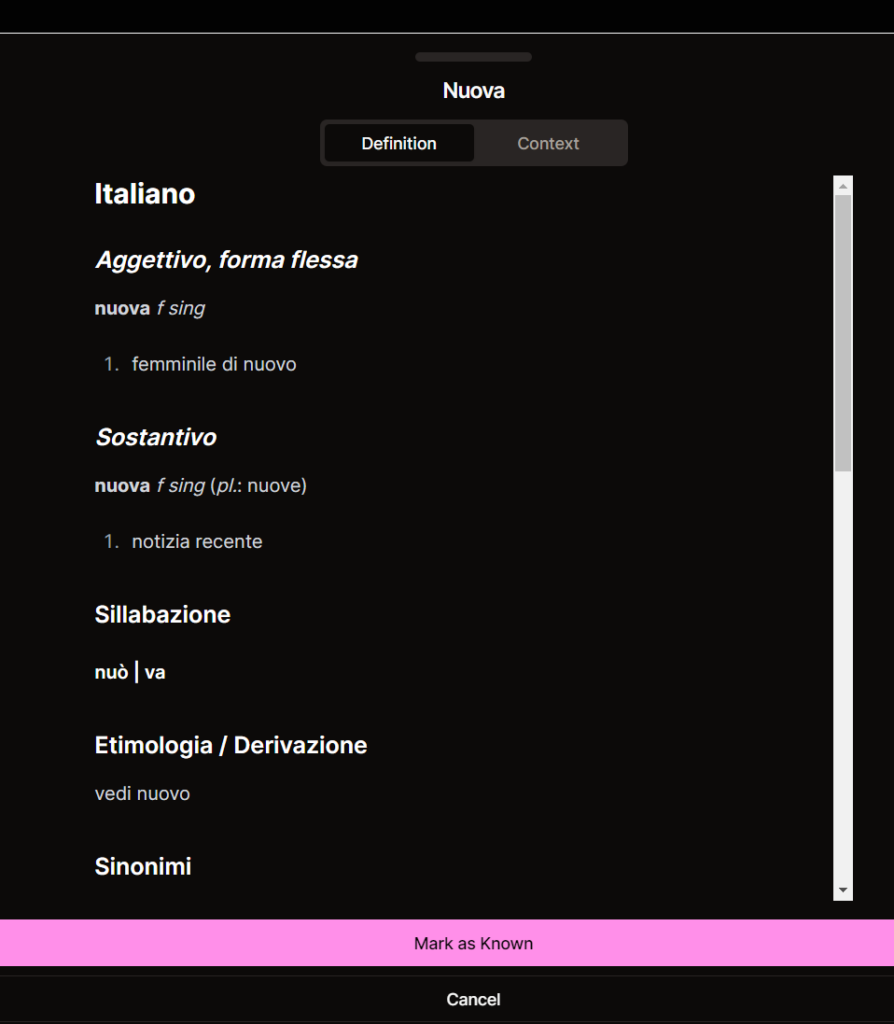
After step one (importing), the AI presents the video text in written form as a transcript while listening to the video audio.
Langturbo is intriguing because you can stop the video to review all or unfamiliar words for definitions and context to improve understanding. After reviewing the word(s), you can mark them as reviewed.
Limitations
Langturbo is a good tool for students from B1 to C2 levels, as it focuses more on language mastery. Although it has a paid version, its free one provides 150 minutes of playback per month.
It is not an application for students seeking to improve their oral expression (speaking); it is better for polishing listening skills and gaining proficiency in the target language in authentic contexts with appropriate new words, concepts, phrases, etc.
Mobile apps
Mobile apps can be helpful when you want to learn or practice a language. Some examples are:
- Conversly: Practice speaking and listening skills. Engage in conversations with a chatbot developed by ChatGPT with different modalities. Available languages: German, Russian, Portuguese, French, Spanish and Japanese. It can be found on Google Play and App Store.
- Univerbal is a smart tutor that allows practice in more than 20 languages with real-time feedback. Their approach is conversational, whether written or spoken. Themes can be customized according to the user’s preferences. It contains activities that simulate functional/situational aspects of a language. It is available on Google Play and the App Store.
- Glosa provides personalized AI learning, instructional materials, interactive practice, and camera integration to learn about object translation instantly. You can create goals and track your progress. It can be used at all levels, even false beginners. It has a variety of more than 20 languages. Available on Google Play and App Store.
- Lang AI: Developed per CEFR, this app increases language fluency by focusing on speaking and listening. It provides in-the-moment feedback, more natural conversations, and authentic contexts. It is available in over 20 languages on Google Play and the App Store.
Thanks to AI integration, foreign language learning can become accessible and friendly. Whether you are a student looking to learn or practice a language or a teacher seeking new activities to complement or integrate in class, these and other tools await.
However, to avoid future frustrations, you should always consider some relevant factors when choosing an AI tool, i.e., the objectives (the skills you want to master), the proficiency level in the target language, and the application’s design (its methods and approaches).
To avoid unforeseen events, it is always essential to do good research before investing time, effort, and money and test the tool in its free and trial versions.
Translation by: Daniel Wetta