

Extreme weather, atypical natural phenomena, and pollution, among many other problems, are climate changes caused by industrial activity, human activity, and poor public policies to combat them. Thus, a transition to sustainability in all areas of human endeavor is urgent for environmental care and the necessary actions to conserve the balance of biodiversity and ensure that present and future generations enjoy a high quality of life and resources. Such should not be the privilege of a few.
“Low-carbon economy” and “green skills and jobs” are topically emerging terms in the face of concerning, aggravating crises in this new societal panorama where education plays a fundamental role in training and integration.
What are green skills?
Green skills comprise the knowledge, capabilities, values, and attitudes necessary for a sustainable, resource-efficient economy and society.
The objective is to improve resource efficiency, promote biodiversity, and mitigate global warming by reducing the carbon footprint and pollution and caring for the environment. These competencies must apply and transfer from one area to another (e.g., problem-solving can be used for programming in computer sciences, the business sector, and many other regions).
Types of green skills
Green skills are distinguishable in different contexts:
- Techniques associated with green technologies must adapt or implement processes, services, and technologies that protect the environment and reduce resource consumption.
- General Transversal skills applied to green environments derive from a sustainable mentality.
Notably, green skills and competencies are essential for green jobs.
What are green jobs?
A general definition of green jobs refers to those that aim to reduce harmful environmental impact and preserve and restore the environment. Green jobs are characteristically quality jobs with good benefits and competitive salaries. Green economies favor jobs in different sectors seeking sustainable and responsible development. There are several approaches to green jobs.
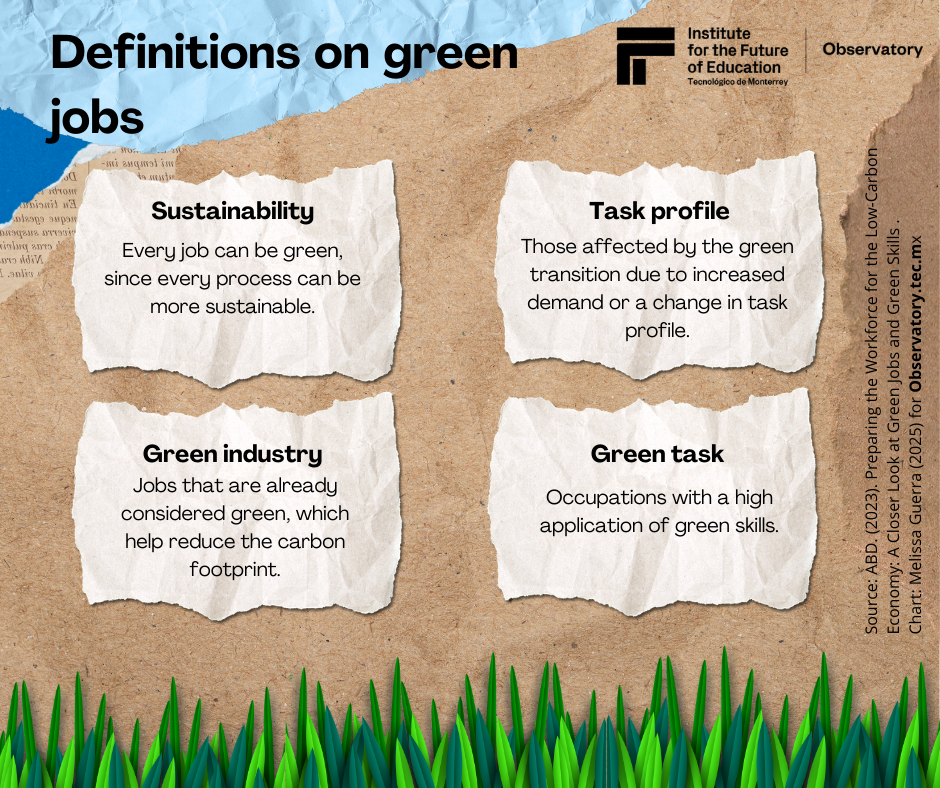
According to the Bureau of Labor Statistics, green industries in green economies include goods and services addressing energy from renewable sources, energy efficiency, pollution reduction and elimination, greenhouse gas reduction and recycling, conservation of natural resources, environmental compliance, education and training, and public awareness.
Job profiles in green industries are subdivided by the degree of impact of the green transition: demand for green jobs (including indirect green jobs), perfected green skills (representing changes in task profiles), and emerging green jobs (exclusive to the green economy; direct green work).
Why are green skills necessary?
Within the 17 United Nations Sustainable Development Goals (SDGs), green skills, competencies, and jobs are key components of the green transition, necessary for developing sustainable and resilient futures, directly and indirectly impacting several of the SDGs (goals 2, 3, 6, 7, 8, 9, 11, 12, 13, 14, 15 and 16). Some of their benefits are:
- They promote economic growth and societal well-being.
- They promote sustainable societies and care for the environment.
- They play an active role in mitigating environmental impact.
- They promote sustainable practices for the transition to green economies.
How are these integrated into education?
Connecting educational exercises with environmental issues is vital so students have the tools, knowledge, skills, and attitudes to deal with present and future ecological challenges. A green curriculum is also necessary to prepare students for the upcoming needs of the work world.
This educational framework allows for developing critical thinking and problem-solving skills, acquiring environmental literacy, and maintaining a sense of responsibility towards the planet. An interdisciplinary approach, that is, applying and implementing green terms and concepts in the real world in various subjects (humanities, sciences, etc.), gives students a more holistic knowledge about the environment and the interactions of human activity, giving rise to reflection, and cranking the engine for sustainable projects and ventures.
In addition, the United Nation’s 2030 agenda positions lifelong education as a key element to achieving sustainable development and quality education.
What roles does AI play in the green future?
Although artificial intelligence has recently brought tremendous advances to science, such as the AlphaFold (an AI model that accelerated research on proteins, something that could never be achieved without the help of current computing power), it is also highly polluting.
Its harmful environmental impact results from the amount of electricity (mostly from burning fossil fuels) and water consumed to operate servers in data centers and train AI models. So, how can AI boost support for the environment? While AI can be an enabler for specific Sustainable Development Goals, it can also be an inhibitor. For this reason, ethics plays a relevant role because, without it, developing and implementing AI would create a world with more inequality, bias, and environmental risks and feed economic interests (more than now) in every area.
Moreover, experts highlight that developing AI models that favor achieving sustainable development goals by 2030 can generate many benefits. Still, an open dialogue among nations is needed to avoid an AI-generated unequal and unsustainable future.
The current emphasis on digital skills, primarily in machine learning and generative artificial intelligence, AI literacy, programming, etc., has led to overlooking the development of green skills. Therefore, educational institutions are issuing calls for action not to neglect training in these skills. It is important to remember that although AI could enhance training and green skills, not all educational institutions have the same access to technology.
It is time to reflect on and take action for the benefit of the environment before it is too late!
Translation by: Daniel Wetta