


*Explanatory note: This text alternates the use of the expressions “person with autism” and “autistic person” to respect the diversity of preferences. Some people have a greater affinity for person-centered language (person with autism), by not labeling someone as just their condition. Others, on the other hand, opt for identity-centered language (autistic person), recognizing autism as an inseparable and significant part of who they are. As both forms are valid, their use in this document seeks to reflect an inclusive and respectful stance towards all perspectives.
The number of people diagnosed on the autism spectrum continues to increase; however, their opportunities for school, social, and personal development do not grow at the same rate. Although research and information have advanced, significant gaps remain. Many teachers and caregivers still feel unprepared to provide support, and social awareness of living together is limited. This poses a complex challenge that requires coordinated work between families, schools, and health professionals to improve the quality of life and integration of autistic people.
Globally, studies suggest that one in every 100 children manifests Autism Spectrum Disorder (ASD). However, this is an average estimate delimited by the research of Zeidan, J. et al., which explored different analyses. Some studies report considerably higher numbers, while others indicate that the prevalence of autism in low- and middle-income countries is not yet known with certainty. In addition, sometimes this condition is not timely diagnosed; it remains masked, which challenges the person’s ability to function.
Autistic people think, behave, communicate, interact, and perceive the world differently. The definition and terminology related to ASD have evolved in recent years, reflecting that these people share certain particularities, such as difficulties in social communication, which leads to an increasing incidence of bullying and exclusion or isolation. This can cause students with autism to perceive schools as lonely and unwelcoming places.
Moreover, while the number of people with Autism Spectrum Disorder has increased, teachers often feel poorly trained to adequately meet the needs of these students, given that the school environment can present them with various challenges. This kind of environment is frequently stressful due to the autistic students’ emotional and sensory needs, such as sensitivity to noise and disruptive behaviors from other peers. The high prevalence of co-occurring disorders, such as anxiety, increases the complexity of their needs and can lead to challenging behaviors that are difficult for teachers to manage.
While most teachers support inclusion, many feel insecure and unprepared to handle the behavioral and social challenges presented by autistic students. This lack of preparation is attributed to a shortage of practical training, inadequate resources, and insufficient support staff, resulting in a gap between the strategies recommended by research and those actually implemented in the classroom. As a result, inclusion becomes less effective, and the educational experience of these students is affected. That is why it is critical to provide educators with evidence-based training and tools to create a truly inclusive school environment.
Studies show that students with Autism Spectrum Disorder (ASD) benefit from being in inclusive general education classrooms, as they offer an ideal environment to develop social and communication skills with their peers who do not have a neurodivergence.
Understanding Autism
First of all, neurodiversity is the concept that recognizes that each brain operates differently, and that no form of brain functioning is superior or inferior to another. People whose mental processes align with social norms are often considered neurotypical, while those whose neurological processing occurs differently are described as neurodivergent. This term encompasses a wide variety of conditions, such as autism, Attention Deficit Hyperactivity Disorder (ADHD), specific learning difficulties, mental health disorders, intellectual disability, and traumatic brain injuries.
The definition of Autism Spectrum Disorder (ASD) has evolved with the progress of research, allowing a better understanding of its characteristics and the needs of people who have it. ASD is a permanent neurodevelopmental condition that manifests itself with delays in social skills, communication, and behavior. For its diagnosis, specific criteria must be met, such as restrictive and repetitive behaviors (in interests or activities).
People on the autistic spectrum may experience difficulties in sensory processing, as well as cognitive functions related to executive skills such as planning, organization, problem-solving, and time management. They may also struggle with social reciprocity, emotional relationships, nonverbal communication, atypical sensitivities, a need for routine, and peculiar motor behaviors.
Although the causes of autism are not yet known with certainty, it is claimed that many autistic people possess average or higher intelligence. The autistic spectrum presents significant variability, so it is inappropriate to assume that all students with ASD will respond identically to the same support or programs. Although their ways of interacting with the world differ from those of their neurotypical peers, they can successfully participate in inclusive environments with the proper support. Autistic students have also demonstrated academic success in a wide variety of college disciplines.
Moreover, to truly understand their perspective, one should not infer how they feel in various situations but ask them directly. For example, not everyone prefers person-first language (such as a person with autism), which is traditionally favored when referring to people with disabilities. Some consider it inappropriate or offensive. Therefore, respecting individual preferences for how they wish to be considered is essential for strengthening their self-determination and identity, and for building an effectively inclusive environment.
The Maori, a Polynesian ethnic group that arrived in New Zealand, use the word takiwātanga to refer to autism. This comes from the expression “tōku/tōna anō takiwā”, which means “in my/your own space and time.” This cultural vision enriches the view of autism as part of human diversity, distinguishing that each individual is unique, advances at their own pace, and can follow different paths to achieve their goals.
Autism is on a spectrum, and, therefore, it is essential to understand that it is non-linear and that each human being has a unique combination of strengths and challenges across different areas, which can change over time and in their environment. Therefore, it is not pertinent to classify people as “more” or “less” autistic, or to use labels such as “high” or “low functioning,” as these do not reflect the complexity or variability of their experiences. Just like anyone else, they develop new skills and face various challenges throughout their lives.
Although there is classification by degrees of affectation (from 1 to 3), the simplest way to understand it is through diagrams. Autism is a developmental condition; therefore, everyone experiences it differently. In addition, the differences in an autistic person can change or become more or less evident over time, as shown in graphs such as those below. Many have what is known as an uneven profile, or peak profile; that is, there is a significant difference between their areas of strength and those in which they face more difficulty. Although research and professional practice have traditionally focused on the challenges of autism, it is also critical to recognize and enhance the strengths of autistic people.
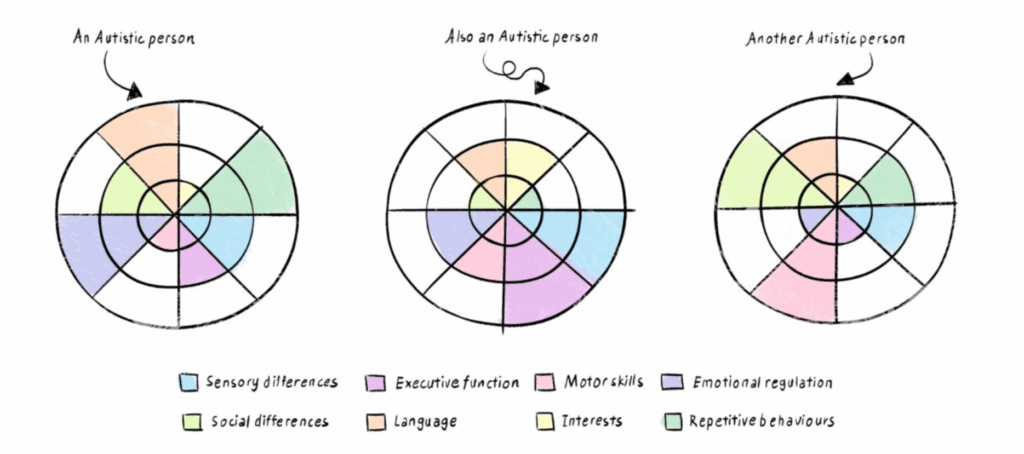
No two individuals with autism are the same. Although diagnosis follows specific standard criteria, autism manifests uniquely in each individual. Therefore, teachers must understand that each student’s strengths, challenges, and support needs vary. This implies that adjustments and adaptations in the school environment must be tailored to address the specific characteristics of each student with autism effectively.
Although the condition varies significantly in each person, specific characteristics may be present, including:
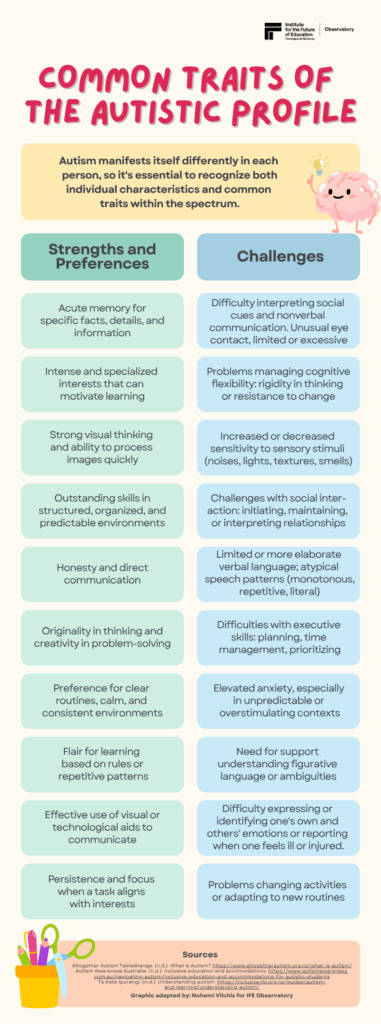
Early support after an autism diagnosis is key to improving the person’s quality of life and reducing family stress. However, many families face difficulties in accessing adequate services, which are often limited, insufficient, and unsatisfactory. Parents and caregivers often struggle to access support, while many professionals express a desire to provide more assistance, especially in educational settings, where tailored resources are scarce. This situation is compounded by a lack of understanding and awareness about autism, given the diversity of needs within the spectrum.
Keys to effective inclusion of neurodivergent people
Educational inclusion for autistic people involves their participation in regular classrooms, where they can learn alongside their neurotypical peers. Thus, they can function socially and derive an understanding and acceptance of all students, creating an enriching learning environment. This pedagogical approach advocates for equal learning opportunities to build a more equitable society.
To enable learners with autism to learn and participate fully in the school environment, it is essential to provide them with appropriate support and adjustments. This involves recognizing their individual needs, working closely with their caregivers, and designing adaptations that not only facilitate their day-to-day life but also promote their autonomy, develop skills, and foster active participation in the educational community. These adaptations go far beyond physical accessibility. They must be designed with each student’s social, emotional, and academic development in mind.
The developmental skills essential for integrating into society often challenge autistic people. They are learned in different environments: family, school, and community. If their interaction is limited to only small or segregated groups, they lose the opportunity to develop age-appropriate social skills.
Inclusive classrooms also expose students with ASD to diverse perspectives, which supports their cognitive development and academic performance. In addition, being part of a supportive school community helps strengthen their self-esteem and sense of belonging, which are key to their emotional well-being.
Extensive published evidence supports that school inclusion is a practice that not only benefits people with autism but also their peers without neurodivergence. However, all stakeholders involved must share a clear definition of inclusion. It’s not just about physically placing autistic students in regular classrooms, but about ensuring that they participate equitably and actively in school activities.
Inclusion does not mean forcing students with autism to “fit” into neurotypical models, because everyone benefits from learning to coexist, respect, and relate to different people. An inclusive environment allows everyone to grow and comprehend diversity, fostering empathy, understanding, and broader interpersonal skills.
However, the Sambhav Foundation reports that inclusive education faces significant obstacles, including a lack of resources, inadequate teacher preparation, and social prejudices. Overcoming these challenges requires collaboration between educators, caregivers, government actors, and communities. To achieve real inclusion, it is first essential to invest in training, raise awareness of autism, and create school environments that value diversity.
To advance towards effective inclusion, various authors such as Rebekah Dyer, Doris Priscila Castro López et al, James N. Meindl et al, Laura J. Graham, and Alison Nuske, and also organizations like Sambhav Foundation, Mastermind Behavior, Australian Disability Clearninghouse on Education and Training, Autism Awareness Australia, Autism Toolbox Working Group, and University of Kansas Center for Research in Learning, propose a variety of educational approaches and practices that can be applied in the classroom. These strategies seek to integrate autistic students into everyday school environments and to ensure their active, equitable, and meaningful participation in the learning process. Below is a compilation of recommendations from all these sources, organized into five thematic axes that reflect areas of consensus.
1. Awareness and literacy
First of all, the understanding of participants in the environment that interacts with children and adolescents with ASD is fundamental. All professionals, teachers, and colleagues must incorporate this notion of inclusivity to establish an empathetic environment. Promoting inclusion starts with this path. To begin, educational institutions can hold workshops, seminars, or training sessions to raise awareness of diversity and respectfully address possible stereotypes or prejudices.
Daily interactions in an environment like this will foster a general understanding and acceptance of others. When children share activities, they learn to see beyond differences and recognize individual strengths, forging authentic friendships and generating an appreciation for human diversity.
In addition, all staff and the institution’s culture must align with an established definition of inclusion and of what an inclusive classroom entails. An articulated effort among all those involved must consider caregivers and the community, fostering a positive attitude toward an inclusive classroom. Open, ongoing communication, in conjunction with a development plan for the student with autism, will be vital. If adjustments need to be made to the autistic person’s learning, they and their family should be consulted, as they usually know what works best for them, which will simplify the process.
This establishes a consolidated support network, with room for specialized professionals such as occupational therapists, speech therapists, or psychologists to provide additional support to the student and the educational team, fostering synergies that yield valuable, practical learning strategies.
A school environment where neurotypical students are literate about different disabilities has been shown to have a positive effect on autistic students’ outcomes and the acceptance of their peers. Although there is a debate about whether people with ASD should present their diagnosis, it is a purely personal decision. However, it has been shown that knowing this information has improved others’ attitudes towards autism, leading to more favorable social interactions.
2. Tailored teaching approaches
To ensure inclusive, high-quality education, it is essential to adapt teaching methods to the diversity of the student body, particularly for students with autism. In the first place, this requires teachers trained in differentiated instruction and the use of evidence-based methodologies, such as Universal Design for Learning (UDL), positive reinforcement, visual support, and structured teaching.
Attention to diversity requires pedagogical strategies appropriate to the individual characteristics of students with ASD. In their case, it is essential to consider differentiated instruction and the design of personalized curricular adaptations that address their strengths, interests, and specific needs. Task simplification, activity segmentation, and additional time are relevant for promoting participation and understanding, as well as for providing individualized support in areas such as communication, social skills, and emotional self-regulation.
It is also essential to incorporate scientifically backed pedagogical approaches, such as Applied Behavior Analysis (ABA), structured teaching (e.g., TEACCH), and Augmentative and Alternative Communication (AAC). Likewise, strategies such as positive feedback and immediate reinforcement are emphasized. These methodologies can be adjusted to respond to the evolution and variability of the autism spectrum, as well as to other diagnoses such as ADHD or Fetal Alcohol Spectrum Disorder (FASD).
Autistic students benefit significantly from a structured environment that has clear routines and consistent visual supports. Visual agendas, pictograms, calendars, and daily schedules facilitate the understanding of the school environment, reduce anxiety, and promote autonomy. These tools help the autistic student anticipate what will happen and understand classroom expectations.
The collaborative work and active participation of interdisciplinary groups, such as teachers, families, and specialized professionals, lead to the design of coherent, individualized plans for the different contexts of the person (school, home, and therapy). Co-teaching and teamwork models in the classroom enrich the student experience by promoting a culture of acceptance, cooperation, and respect for differences.
For this, there must be ongoing teacher training, where the role of teachers is central and is grounded in inclusive practices, autism, and attention to diversity. Training should not be isolated, but part of a progression of professional improvement. In addition, time and institutional support are necessary for planning, reflection, and adjustment of pedagogical practices.
It is relevant to note that the language used must be specific and unambiguous, and avoid metaphors or abstract expressions. Instructions need to be explicit, and whenever possible, reinforced visually, and checked for comprehension. This improves participation and decreases student confusion or frustration.
Finally, encouraging autonomy, motivation, and understanding of behavior through a “difference, not deficit” approach strengthens ASD students’ well-being and learning while enriching coexistence for the entire educational community. In other words, letting them make decisions within specific limits promotes their autonomy; leveraging their areas of personal motivation helps capture their attention; and explaining the usefulness of particular tasks increases their participation.
3. Design and adaptation of the school’s physical space
Creating an inclusive environment for autistic students involves considering both the physical space and the classroom’s emotional climate. As mentioned, it is essential to minimize excessive stimuli that can cause sensory overload and to provide a space that promotes safety, calm, and active participation. This includes creating quiet spaces where learners can regulate their emotions when they feel overwhelmed, and using visual materials and supports to help them better anticipate and understand school routines.
Students with ASD often have hypersensitivities to auditory, visual, or tactile stimuli. Therefore, it is recommended to provide tools such as noise-canceling headphones, dimmable lighting, visual protectors, and alternative materials that respect the student’s tactile preferences. These accommodations help the students reduce anxiety, avoid disruptive behaviors, and maintain focus during activities.
It is also helpful to have specific areas in or near the classroom where students can temporarily retreat to calm down or regain emotional balance. These spaces should facilitate self-regulation without being perceived as punishment, allowing the student to resume classroom participation when they are ready.
Visual agendas, pictograms, and graphic reminders are primary tools for students with ASD. These allow them to anticipate what will happen during the day, reduce anxiety about change, and facilitate transitions between activities. These resources must be simple, specific, and consistent to be effective and avoid confusion.
In some contexts, blended schooling models, such as the resourced provision model used in the United Kingdom, have proven to be efficient. These offer small, sensory-adapted spaces where autistic students can spend part of the day; they combine moments of inclusion in the general classroom with regulation times in a more controlled environment. This approach can better balance students’ sensory, emotional, and academic needs.
4. Development of interpersonal bonds
Social interaction among learners with ASD is essential for their communicative, emotional, and school development. Socialization opportunities must be intentional and tailored, integrating both structured activities and free-play moments. This involves explicitly teaching social skills — such as sharing, taking turns, starting a conversation, and playing with others — using methods that fit the student’s level of development and comfort.
A respectful and inclusive environment enhances the sense of belonging. To achieve this, it is essential to implement tactics such as group work, collaborative projects, and peer systems that enable collaboration among students with and without disabilities. In addition, teachers can positively reinforce these interactions and allow neurotypical students to act as tutors or social role models, with appropriate guidance.
Effective communication is another fundamental pillar. For autistic students, for whom verbal communication is complex, augmentative and alternative communication (AAC) systems, assistive devices, or sign language can be used, as needed. Similarly, it is crucial to train both teachers and colleagues in the use of these tools to facilitate mutual understanding.
The role of colleagues is especially significant. Through awareness-raising, students can learn about ASD, understand diversity, and take an active role in inclusion. Teacher support can make a big difference in the social relationships of autistic students by helping them to integrate into activities, prevent isolation, and avoid situations of harassment or discrimination. Fostering empathy, respect, and acceptance of differences creates a safe environment where all students can fully develop.
5. Evaluation and continuous support
A thorough, ongoing assessment is vital for understanding the strengths, weaknesses, and specific needs of each ASD learner, including academic, social, communicative, and behavioral domains. Data collection and ongoing evaluation allow progress to be monitored and interventions to be tailored as needed. Based on this information, educational and therapeutic plans for children should be developed, with objectives tailored to their interests and developmental needs.
School tests should be accessible, using clear language, predictable structures, and, where necessary, alternative formats. Some students may benefit from pre-reviewing tests or clarifying instructions to reduce anxiety.
The family plays a significant role in the continuity of learning and in the student’s well-being. From home, skills can be reinforced, structured routines maintained, and adapted communication strategies applied. Social inclusion is also promoted, enabling interactions with siblings, peers, and the community, leading to a greater understanding of ASD. In addition, families must have emotional support networks to accompany the inclusive process without neglecting their own well-being.
Low academic participation in students with autism is often attributed to their diagnosis, but research in Applied Behavior Analysis shows that interventions focused on environmental adjustments can significantly increase participation and reduce problem learning-related behaviors. The research addresses four key factors: student motivation, the consequences of their academic behavior, their learning history with the teacher, and their experience with the school environment and activities.
For these tactics to be effective, educational staff must be trained in evidence-based practices, receive ongoing professional development, and implement environmental modifications that support the whole student. Educators must recognize themselves as capable of teaching students with autism, without delegating this responsibility exclusively to specialists.
However, support should not fall solely on teachers. Autism is a complex disorder that requires a multidisciplinary approach involving family, school, and specialized experts. Collaboration among these actors is essential to ensure comprehensive support. By implementing these strategies, schools can create inclusive environments that support the academic and social development of students with autism, fostering a more diverse, respectful, and empathetic school community.
Teaching challenges, the gap between theory and practice
In perspective, the educational inclusion of autistic students poses multiple challenges that require a comprehensive, collaborative approach. Although parents, teachers, and professionals widely support inclusion, students with ASD constantly face academic and social difficulties due to factors such as deficits in social communication, high levels of anxiety, and disruptive behaviors, which can lead to exclusion and a stressful school environment for them.
Teachers generally manifest a positive attitude towards inclusion, but report feeling unprepared to address the specific needs of these learners, due to a lack of practical training, adequate resources, and professional support. This gap between scientific evidence and educational practice limits the success of inclusion in the everyday classroom. In addition, the lack of advanced training and adapted pedagogical resources affects the quality of the support provided.
To achieve results such as those described in this text, it is crucial that educators receive continuous training and that educational strategies be adapted to individual needs, including modifications to the environment and pedagogical methodology, without neglecting multidisciplinary collaboration between families, school staff, and professionals to build environments that favor the integral development of students with autism.
Similarly, the inclusion of students with ASD not only benefits these students but also enriches the educational experience of the entire school community, fostering a more tolerant and equitable society. To achieve this, an institutional commitment is necessary to guarantee resources, adequate policies, and permanent teacher training.
Beyond the overwhelming need for better-trained teachers, some argue that it remains unclear what it truly means to achieve inclusive education. Sometimes, inclusion is confused with the simple physical presence of students with disabilities in regular classrooms, and not always on a continuous basis. This limits the hope that these students will truly feel part of the group, develop positive social relationships, and learn without the obstacles posed by prejudice and stereotypes. This situation is especially concerning for students with ASD, who frequently experience feelings of loneliness and difficulty making friends, underscoring the urgency of strengthening their social skills.
The fact that this reality is not among the main concerns of educational decision-makers is a critical point that invites reflection and underscores the difficulty of integrating specific programs into an already saturated curriculum, constrained by time and space.
On the other hand, in disadvantaged socioeconomic contexts, research shows that inclusive education is practically non-existent. In these environments, barriers multiply, creating a very unequal and unfavorable environment for effective inclusion.
Some resources available to understand autism are the inclusive guide of Te Kete Ipurangi (TKI), the bilingual education portal of New Zealand, and an initiative of the Ministry of Education, as well as a selection of articles and good practices written by professionals and people with autism from the National Autistic Society in the United Kingdom.
Another valuable tool for understanding the autism spectrum is Naoki Higashida’s book, The Reason I Jump. Naoki, a non-speaking autistic person, wrote this work at the age of 13 to share how he perceives the world, expressing his thoughts and emotions, and debunking common myths about autism. In particular, he sought to challenge the misconception that those who cannot express themselves vocally lack opinions or thoughts.
Another excellent reference comes from the Regional Center for Teacher Training and Educational Research (CRESUR), which created a guide called “Inclusive School and Autism Spectrum Condition” for “the purpose of supporting teachers and other education professionals in the construction of an inclusive school model and attention to diversity.”
Understanding Autism Spectrum Disorder can be a complex challenge, full of nuances and continuous learning. However, it is even more difficult to live a life without real opportunities for development, participation, and belonging. For this reason, inclusion cannot depend solely on the goodwill or effort of a single actor. The role of teachers is fundamental, as is the accompaniment of families and the active voice of neurodivergent people themselves.
No profound change is achieved in isolation. A multi-stakeholder, sustained commitment is necessary from education, the community, public policy, and society as a whole to build environments where diversity is understood, valued, and supported. Only in this way can a future be achieved where both neurodivergent and neurotypical people benefit from a more empathetic, equitable, and humane coexistence.
Translation by Daniel Wetta