
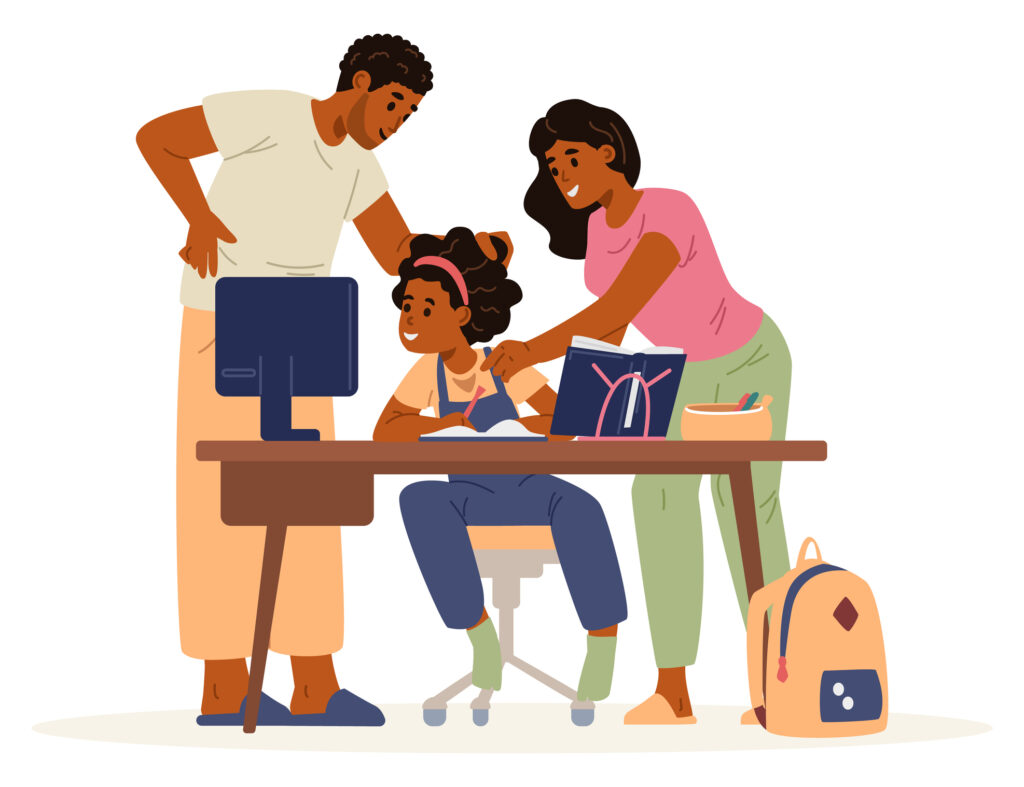
In recent years, homeschooling has unexpectedly boomed, with more and more tutors opting for this alternative to educate their children. However, this “education at home,” which differs markedly from traditional schooling, has sparked intense debates about its effectiveness and children’s well-being.
What is homeschooling?
Education at home, also called homeschooling, is an educational practice primarily home-based and parent-led. Fabio Jurado Valencia describes it as “education that transcends the school space and renounces its traditional regulative forms (classrooms, schedules, teachers, rituals, curricula, grades…) to assign a place to the collaborative work of families in the perspective of the education of their own children.” It is an educational model in which tutors assume an active and essential role in constructing their children’s knowledge.
This movement began to gain steam in the 70s, mainly influenced by John Holt, an American educator and pedagogue, who, after his time as a teacher, became disenchanted with traditional education. Initially, he advocated restructuring the school and the treatment of students; however, when he did not achieve results, his perspective shifted towards family tutors, calling on them to take control of their children’s education.
As Holt has maintained since then, the most important aspect of home education is that tutors appreciate their children, “enjoy their company, their presence, their energy, their mischief and passions. They have to enjoy all of their chats and questions and equally enjoy answering those questions.”
This educational model has become increasingly popular in recent years, especially after the pandemic, as it requires few resources. At present, the only requirements are the desire and willingness to carry it out and to accompany students in the educational process.
In the United States alone, 3.1 million students were homeschooled during the 2021-2022 school year, representing about 6% of school-age children. In Mexico, the data is unknown. Some claim that 5,000 families homeschool in the country, while others estimate that 20,000 do. However, the First Census of Homeschooling Families in Mexico (2019) identified 600 families.
How does homeschooling work?
As previously noted, homeschooling is characterized by parental instruction and offers possibilities that would not be viable in formal education. Among its most attractive aspects are flexibility and customization.
The main approaches to this modality are structured and unstructured; the former works similarly to traditional education, with a program and goals to achieve, while the unstructured approach (also known as unschooling) follows no program and bases learning on students’ everyday experiences.
Most homeschoolers opt for a structured approach. They are not governed by school calendars or institutional curricula, so families can establish the schedules and rhythms of learning, adapting them to the needs of the family nucleus. Likewise, they can design curricula aligned with their interests and incorporate activities or projects that promote significant learning more easily than in other environments. In addition, homework is reduced during the family’s free time, as homeschoolers, on average, dedicate four structured hours to educational tasks.
Although creating a curriculum from scratch might seem complicated, there are thousands of guides and educational resources available to families who homeschool. Some institutions offer both free and paid curricula, textbooks, and didactic materials that can be customized as required.
Homeschooling is more feasible if only one student is educated at home, though it can also be done with more students. In that case, the educational modality is similar to that of multigrade schools, where the same topics are taught with different content appropriate to each learner’s level.
Regarding the certification and validity of studies, educational legislation in Mexico does not prohibit homeschooling; however, it is unregulated. For this purpose, there are private institutions that offer programs endorsed by the Ministry of Public Education (SEP), known as umbrella schools, while other tutors opt for certifications from the National Institute for Adult Education (INEA). In this way, as long as their studies are certified, homeschoolers would not have any problem accessing higher education.
Reasons to Homeschool
The National Home Education Research Institute estimates that, in the United States, in the 2024-2025 school year alone, more than 3.4 million children studied at the K-12 level, representing a growth of 2% to 8% per year over the 2019 estimate of 2.5 million. According to the National Center for Educational Statistics, the reasons for homeschooling vary; their census mainly identified the following:
- Concerns about the school environment, such as safety, drugs, or peer pressure (80.3%).
- Desire to impart moral lessons (74.7%).
- Emphasis on family life (74.6%).
- Dissatisfaction with the academic offerings of schools (72.6%).
- Desire to teach religious lessons (58.9%).
- Desire to provide a non-traditional approach to children’s education (54.2%).
- Other reasons (34.8%).
- The child has special needs (23.1%).
- The child has a physical or mental health problem (15.6%).
- The child has a temporary illness (2.8%).
The “other reasons” responses from tutors included bullying, financial reasons, travel, and the search for a more flexible schedule.
On the other hand, Jamie Martin, the founder of Simple Homeschool, summarizes the main reasons for homeschooling as:
- Dissatisfaction with the educational options available.
- Greater flexibility in schedules and curriculum.
- Different religious or educational philosophies.
- Protection against bullying, peer pressure, and school violence.
- More opportunities for family bonding.
- The belief that childhoods do not progress within the traditional school structure.
- Better ability to address physical and mental health issues.
In Mexico, according to Aline Suárez del Real, a Global Press Journal reporter, the ABP Sustenta (an advocacy organization for the homeschooling community in Mexico) launched a call to learn about the situation of homeschooling in the country, to which 620 families responded with their reasons for homeschooling. According to the data of this census, in which more than one option could be chosen, 360 families chose the modality to provide a tailor-made education,126 to educate minors in the religious beliefs of the family, 125 did so due to bullying suffered in school education, 75 due to special needs not attended to in school, and 68 due to lack of resources for a private institution and reluctance to attend public education, among others.
In the article Homeschooling in Mexico: its regulation and perspectives of application, the authors explain that in previous research parents who decide to educate at home have been separated into two categories: first, those who “see homeschooling as something natural, opposed to false and restrictive structures of school education; those who consider home education as an alternative linked to their desire to transmit certain values to children, and those for whom homeschooling has been their last resort, that is, a non-choice, a necessity.”
Debates on this educational model
With the rise of this modality, concerns about the academic performance and well-being of homeschoolers have also increased. One of the main concerns about this educational model is the possible lack of children’s contact with the outside environment beyond family life. Various studies, such as those by Soto-Icaza, Aboitiz, and Billeke, highlight the importance of social interaction in childhood for cognitive, social, and communicative development, as well as the development of skills such as empathy and conflict resolution.
Authors such as Navarro-Arredondo and Gómez-Macfarlan also point out that the content administered in these classes can be of poor quality or shaped by the family’s ideology, leading to an “indoctrination” of students. Moreover, the idea that no experience or training is necessary to be a teacher is called into question, further evidence of the devaluation of the teaching profession.
On February 5, 2026, Keir Starmer, Prime Minister of the United Kingdom, stated that his government is seeking to regulate this modality because of the importance of traditional schools to integration. This initiative primarily responds to the increase in the number of homeschooled children, rising from 111,700 in the fall of 2024 to 126,000 in the fall of 2025.
Homeschooling is legal in at least 30 countries worldwide, including the United States, Ireland, Denmark, Portugal, France, and Poland; however, it is rejected and considered illegal in Germany, while in others it lacks sufficient regulation. In Spain, Colombia, and Mexico, for example, education is compulsory, but the mode of schooling is not. Moreover, Martha Rebolledo explains to Aline Suárez del Real that regulation is not always well received by families, as it would imply the loss of homeschooling freedom; however, the modality can also put some minors at risk because it could be unknown if they are victims of some violence.
On the other hand, the National Home Education Research Institute points out that homeschooled students tend to score between 15 and 25 percentage points higher than public school students on standardized tests of academic achievement, where the public school students average 50 points in a range of 1 to 99, and the homeschooled students attain 65 to 75 points. In addition, various studies show that these students tend to have a more favorable social, emotional, and psychological development. 78% of these studies show that homeschooled students perform statistically better than students in conventional schools.
Nevertheless, the same institute warns that these data do not prove that the results are related to homeschooling, but rather suggest that the findings are closely linked to the demographics of families that lean towards this type of study. Moreover, various media outlets, such as the Washington Post, have criticized Brian D. Ray, President of the National Home Education Research Institute, for altering his research to suit his dogma, rather than maintaining academic objectivity.
Besides these criticisms, some of Ray’s children have publicly highlighted their educational shortcomings, having worked in his organization during school days and having suffered physical abuse. Ray’s daughter, Ziebart, also describes her pain upon seeing her own children attend school: they “face challenges daily such as different belief systems, different children, and different ways of seeing the world,” a situation she says was denied because she was homeschooled.
Olga Khazan, in a report for The Atlantic, says that the lack of regulation of homeschooling can leave some children vulnerable to abuse. Although most parents are responsible and well-intended, some mistreat their children. The author explains that in recent years, various testimonies of homeschoolers who were victims of abuse during their homeschooling have come to light. According to data from a 2014 study that examined the cases of 28 severely abused children from several states, “eight of the 17 school-age victims had been withdrawn from traditional school to receive homeschooling. A Connecticut report found that between 2013 and 2016, 36 percent of families in the state who opted for homeschooling had at least one prior report of abuse or neglect.” In the United States, nearly 200 deaths of homeschooled children due to abuse or neglect have been documented since 2000.
Kazhan notes that while traditionally schooled children also suffer abuse and neglect, “at least they regularly see adults outside of their immediate family, which gives them the possibility to seek help.” The lack of contact between homeschooling families and the authorities can allow abuse to go unnoticed.
Education for All
UNESCO states that this type of education can provide quality teaching, but that, on its own, it is not guaranteed to do so. The quality will depend on whether it meets the standards determined by the State, as required by human rights, where quality “is defined by certain characteristics such as availability, accessibility, and adaptability, with special emphasis on culturally appropriate content, relevant curricula, and the ability to meet the diverse needs of students.” The institution points out that evaluating the quality of education at home is a great challenge due to the lack of data, as well as the diversity of contexts in which homeschooling occurs; however, it emphasizes the Rights of the Child, where education “must promote socialization, critical thinking, and participation in social life.”
Despite the negative connotations that may arise, homeschooling is, undeniably, largely characterized by community support. Hundreds of communities and families host study meetings or playdates that allow children to interact and share resources. However, many tutors who choose this form of education do so to gain greater control over what their children are taught, often because of religious or moral beliefs.
Moreover, UNESCO stresses that “although studies have shown that many homeschooled children participate in social activities and possess adequate social skills, concerns remain about the lack of exposure to diverse perspectives and the potential effects on social cohesion.” Depriving children of the interactions and civic participation afforded by formal education can affect their socialization and overall development.
After all, “coming out of the shell” and getting to know a world beyond our close circle is one of the most important experiences of traditional school. Although some blogs by homeschooling families purport to be as objective as possible in providing the best education to their children, it is necessary to emphasize that it is impossible to be 100% objective; not even traditional school education is. However, encountering different teachers and students, each with their own baggage of knowledge, ideas, and beliefs, makes it possible to learn different ways of thinking and to question one’s ideas or prejudices.
Homeschooling is a great alternative for those whose lifestyles are far from conventional. However, we must not forget that, in the end, school is not only about transmitting knowledge but also about expanding the way the world is understood.
Translated by Daniel Wetta