


Teachers’ versatility is admirable. They must be experts in their areas and have the necessary knowledge to share and effectively teach a group of students through meticulous class planning, homework, projects, and other activities, as well as correcting and evaluating each. Additionally, dedicated teachers must be comfortable standing and speaking before their students, which often requires motivating them to capture their attention and transmit new knowledge.
Therefore, support structures that help teachers plan topics and classes and the steps they will take to keep the class motivated and attentive greatly assist in optimizing their busy schedules, the efficiency of their classes, and the correct dissemination of information to their students.
For this, Robert Gagné, a United States psychologist and teacher, published his book “The Conditions of Learning” in 1965. This book significantly impacted the educational psychology environment by identifying the mental conditions of learning. This book includes an interesting structure that guides teachers through the nine stages of instruction, which are relevant milestones throughout the class to enhance students’ learning.
According to the author, by following the events in consecutive order, the students will become more interested, involved, and motivated during classes, and, additionally, their internal learning processes will be incredibly improved and supported. The nine events are the following:
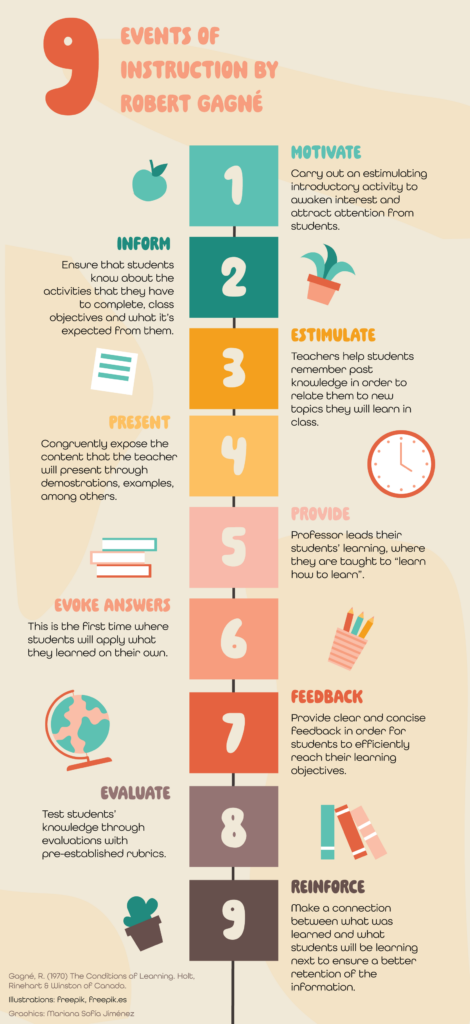
- Motivate: Conduct an introductory, stimulating activity that awakens and attracts students’ attention, which can be done through:
- A rhetorical question is one in which the class must reflect or comment on their classmates.
- An activity that introduces the topic.
- An image or video that leads to a discussion.
- Inform: Ensure that students are aware of the activities to be performed, class objectives, what they will learn, and what is expected from them at the end of the class:
- Inform about the evaluation criteria.
- Link learning to real-life situations
- List down class objectives.
- Stimulate: In this step, teachers review with students their previously acquired knowledge related to the topic to be presented to connect the information they already have with the new things they will cover in class, facilitating their learning.
- Ask students about previous experiences or what they know about a specific topic.
- Review related topics.
- Relate previous learning with the current class.
- Present: Here, the teacher organizes the content to be presented to develop a content guide that is explained through demonstrations, examples, etc.
- Teach the content through diversified media such as photos, videos, and testimonials.
- Incorporate strategies that involve all students.
- Provide additional information through the school platform, bibliography, and reliable Internet sites.
- Provide: In this step, teachers provide guidance into students’ learning, teaching them to “learn how to learn.”
- Instruct the student body with patience and clarity. Assure students that they will be accompanied throughout class and receive extracurricular advice if needed.
- Provide examples to show students the right and wrong ways to do what they should do for class.
- Present everyday life examples through different media, analogies, or metaphors.
- Evoke answers: This will be the first occasion where students will apply the knowledge acquired on their own through:
- Quizzes.
- Team activities where students discuss their knowledge with each other.
- Assignments, exhibitions, and small projects.
- Feedback: This is an invaluable step for student learning. Teachers must give clear and concise feedback so that students effectively achieve the learning objectives defined by the teacher. There are many ways to provide feedback. Some types are:
- Evaluative: Inform about the results obtained in activities, exams, projects, etc.
- Descriptive or analytical: The student is provided with relevant suggestions or information to improve performance.
- Peer evaluation: Students assess one another to correct or improve their results.
Similarly, an affirmative gesture such as a smile or confirming that the answer is correct can be an indirect way to provide feedback to students quickly.
- Evaluate: Assess students’ knowledge through more specific rubrics that are pre-established by the teachers:
- Exams and quizzes.
- Individual or team projects.
- Essays.
It is worth mentioning that before taking this step, each student should be provided with appropriate feedback through practices, tasks, and activities before continuing with more complex evaluations.
- Reinforce: The topics learned in class should be preserved during the lesson. Teachers can help their students connect what they have learned with the subsequent topics (and previous ones) to instruct or promote more retention of information in real-life situations.
Combined with Bloom’s Taxonomy, this structure can be a valuable tool for better organization and time management and a concrete guide that supports teachers when visualizing the class structure and how they will teach their subject.
Students’ attendance is essential for their learning, as it is how they acquire new knowledge, learn to manage their time, develop values such as responsibility and effort, and discover new perspectives. So, enhancing class structure is also valuable for their academic experience.
Every teacher has a history of experiences and knowledge that shape their teaching style and instruction in the classroom. However, knowing about structures and guides that can strengthen their pedagogical skills and help them understand more about the student’s learning process is a great asset to improving their teaching experience.
How about you? Would you use this structure to prepare for your next class?
Translated by Daniel Wetta