

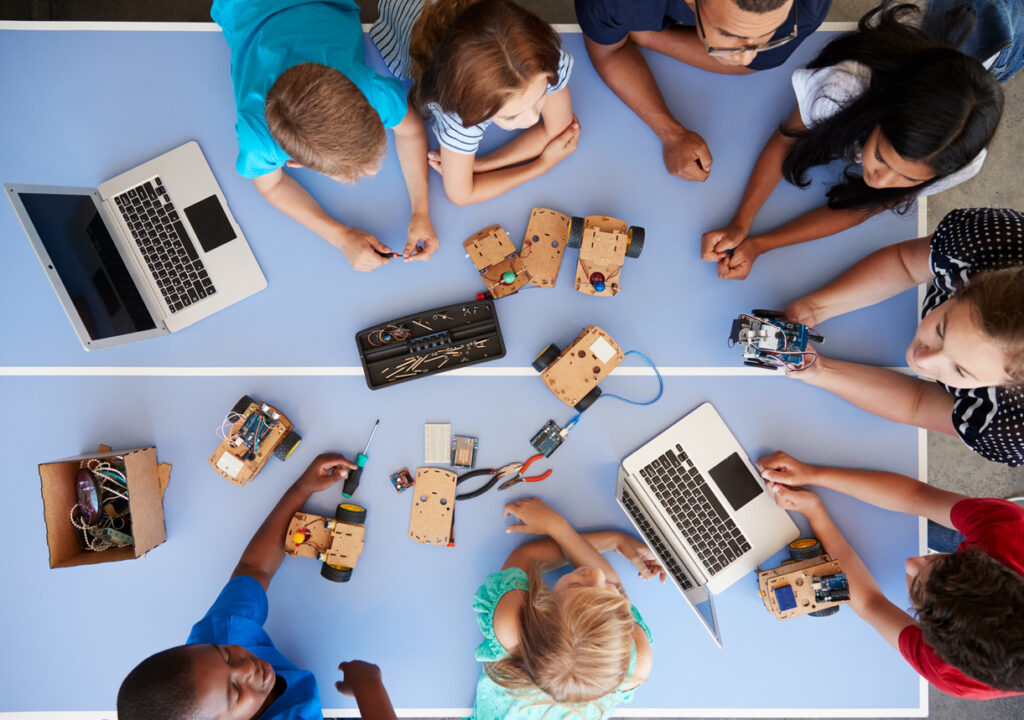
The most meaningful and successful classes always go hand in hand with good planning, where approaches and strategies are aligned to meet not only the learning objectives but also to create a well-rounded class full of enriching experiences that extend beyond academics.
In the creation of digital environments, design becomes techno-pedagogical; in addition to specialized computers and software, systems and implementations that integrate artificial intelligence (AI) are also employed. Consequently, the quality of the educational program and its teaching and administrative team determine the effectiveness of the planning, contents, activities, evaluation, adaptability of the curriculum, infrastructure, and other aspects related to the selection of practical and dynamic models that address the needs of current education, thereby enabling or affecting learning.
Along these lines, this article reports on a systematic review by Yue et al. (2022), Pedagogical Design of K-12 Artificial Intelligence Education: A Systematic Review, which describes some of the most relevant pedagogical approaches and strategies in primary education when designing learning experiences that integrate AI. Additionally, it explores Yim and Su’s (2025) article, “Artificial Intelligence (AI) Learning Tools in K-12 Education: A Scoping Review,” which outlines the four main pedagogical approaches and their corresponding strategies in primary education.
The systematic review by Yue et al. (2022) investigated learning units in kindergarten through high school, finding, generally, that the content in these learning units falls into four categories:
- Introduction and basic concepts of AI.
- Experience and exploration.
- Traditional machine learning.
- Social and ethical implications.
Therefore, the learning units must consider the students’ AI literacy, the teaching of AI (and some of its subdivisions), its use, and its limitations and risks. It is essential to recognize that AI in education extends beyond the use of generative tools to enhance activities and processes. The creation of comprehensive, high-quality learning units on artificial intelligence should aim to provide knowledge and promote skills and competencies. AI in education encompasses more than simply knowing how to use ChatGPT.
According to Yue et al. (2022), some of the most commonly used methodologies and approaches in AI teaching are:
- Direct instruction: the teacher presents knowledge through videos, demonstrations, and other means.
- Interactive learning: Students are partially involved in building the AI or ML process, but they do not define their individual projects.
- Collaborative learning: work is done in groups or in pairs.
- Design-oriented learning: students focus on design and work with open-ended problems, creating their own projects.
- Participatory learning: interactions among peers are encouraged, and work is parceled to different roles.
- Project-based learning (PBL): learning occurs through project development, which requires constructing an artifact or product to solve a real problem.
- Hands-on learning: students experiment with or explore tools and materials, but do not participate in their construction.
- Experiential learning: one experiences, reflects, thinks, and acts throughout the learning process.
- Game-based learning: Learning is acquired through educational games.
- Inquiry-based learning (reflective learning): students set their own learning objectives and questions, and attempt to solve problems; they do not necessarily construct an artifact or product.
Moreover, Yim and Su (2025) established four pedagogical strategy orientations in studies on AI learning tools in primary education:
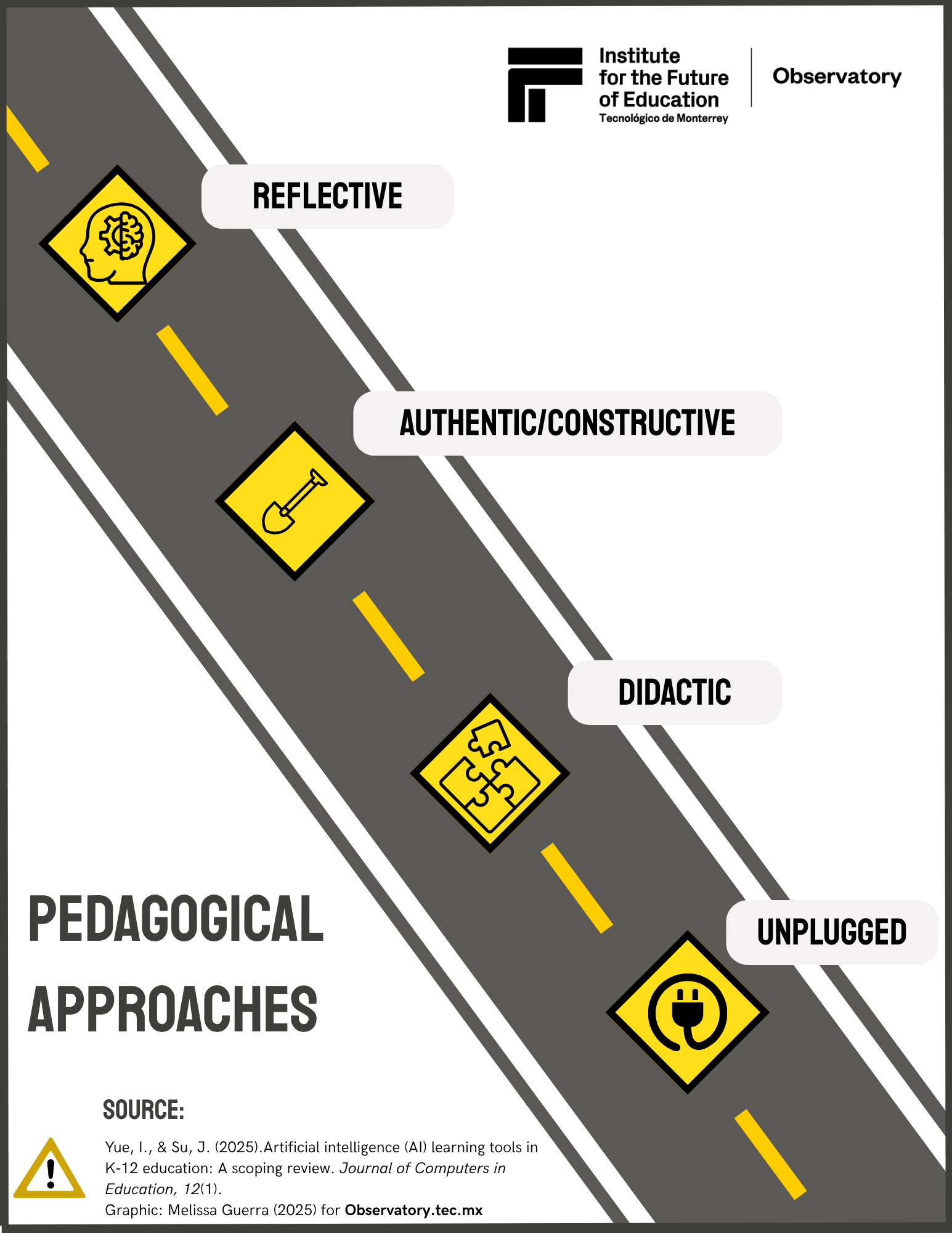
Reflective pedagogy: This strategy encourages critical reflection in learning, enabling individuals to reflect on the social and ethical implications of AI.
- Analogy-based approach: This approach can introduce AI concepts through connections to everyday experiences, for example, a “training model” that is similar to teaching a trick to a pet (which learns by repetition and reinforcement). Then, learners can create their own analogies.
- Student-computer interaction: is an interactive process between students and computers, for example, exploring generative AI tools under teacher guidance.
- Learning by design: enables students to create collaborative learning experiences with their classmates, for example, developing an interactive story using generative AI.
- Online synchronous learning: promotes the use of multiple forms/media and technologies in real-time.
- Programming: uses computer science concepts (abstraction and decomposition) and focuses on designing and implementing solutions to computational problems, for example, using particular software to create programs that answer basic questions.
Authentic/constructive pedagogy: emphasizes practical projects that are relevant to solving real-world problems.
- Collaborative learning: Group work, whether in teams or with teachers, is promoted to achieve a common goal, such as working in a team with defined roles (e.g., programmer, designer).
- Experiential learning: involves experimenting, reflecting, thinking, and acting. An example is creating a model in “Teachable Machine Learning for Kids” that recognizes facial gestures, and then reflecting on the model’s possible errors.
- Game-based learning: refers to the application of specific elements of particular games to real-world environments, for example, creating a digital escape room using AI concepts.
- Inquiry-based learning: involves discovering causal relationships and developing hypotheses to be tested with experiments or observations. An example would be investigating questions about AI: how does it learn, and can it learn from a few examples? Subsequently, this involves formulating conclusions about the model’s performance, among other things.
- Participatory learning: is a systemic process influenced by the students’ capacity and interest in the object of the activity, as well as their behaviors and emotions, for example, holding a debate and analyzing AI use cases with different roles (government, user, company, etc.).
- Play-based learning: is a student-driven process where play serves as a context for learning, for example, in a laboratory where free or guided play employs simple programmable robots.
- Problem-based learning: The objective is to involve students in resolving realistic problems with the support of the teacher, for example, analyzing ethical or practical dilemmas related to the use of intelligent systems.
- Project-based learning (PBL): Its purpose is to engage students through a process of inquiry based on challenging questions, resulting in the creation of products and activities. An example would be developing a project in a team that utilizes AI to solve a problem in daily life.
Didactic pedagogy: The teaching process is structured, making it ideal for introducing new concepts.
- Didactic/direct instruction: In multiple scenarios, students are passive learners, so the teacher is responsible for selecting appropriate content and activities, for example, expository and dynamic classes supported by images or videos that explain concepts.
Unplugged: This approach utilizes activities that exclude digital devices and narratives that support the understanding of how AI works tangibly and engagingly, thereby giving meaning to the learning experience.
- Unplugged and storytelling activities: These promote student interest and provide a structured approach to help them remember the content and share information. An example would be providing step-by-step instructions (as if it were an algorithm) to draw a picture and analyze the situation: what would happen if the instructions were unclear? Thus, introducing a new concept.
Consequently, teaching AI in primary education involves the following:
- AI literacy, which is the understanding and knowledge of its basic concepts.
- Understanding the social and ethical implications.
- Using AI responsibly, as well as avoiding early dependency.
- Developing critical thinking and problem-solving with AI.
- Interpreting and analyzing the results obtained from intelligent systems.
- Selecting, evaluating, and implementing the appropriate tools and approaches at each educational level.
- Understanding how to use and apply AI in different situations.
Moreover, it is necessary to review and adjust the approaches and strategies to what works best in each classroom, as there may be barriers, for example, not having a laboratory or one that is not functional for certain activities.
Teachers need to integrate the use of AI responsibly and consider activities that encourage critical thinking, problem-solving, and other essential skills. Meanwhile, institutions must ensure that teachers are properly prepared and regularly refreshed, so that they understand how, when, and why to teach AI, as well as its social and ethical implications.
Translation by Daniel Wetta