

Artificial Intelligence (AI) has revolutionized scientific research. It has facilitated and optimized scientific research, from automating processes and analyzing large amounts of data or patterns to managing, creating, and examining infinite resources in new ways.
Advances in technology have made human-machine interaction easier by implementing commands (prompts) without the need for advanced programming. However, there are concerns about the use of AI in science (and many areas), such as research integrity, data use, privacy, and more. Hence, creating ethical guidelines for honesty and the responsible use of artificial intelligence is imperative.
AI as an enhancer of scientific research
Currently, AI is considered an essential tool in scientific work. The numerous research activities facilitated by this technology include the following:
- Academic writing.
- Data management, analysis, modeling, and interpretation.
- Elaboration of tables and images.
- Proofreading (tone, style, etc.), translation, and paraphrasing.
- Simulations.
- Search and organization of resources.
- Title and keyword generator.
To this end, Universidad de Galileo created the guide “How to Use ChatGPT for Scientific Research: Effective Prompts.” This practical, didactic, and robust manual focuses on developing specialized prompts to enhance scientific research through generative AI. These and other tools drive progress in research, which, over time, improves design, development, and deployment to ensure updated and optimized versions for end-users of these technological instruments.
According to Rocael Hernández-Rizzardini, Director of the GES (Galileo Educational System) at Universidad de Galileo:
“The diversity of Generative AI tools provides today’s researcher with technology to accelerate the various scientific processes, many of which were previously done with basic computational assistance, but now provide capabilities for rapid, deep contextual analysis, connecting information that was previously dispersed, assisting the various research processes with AI.”
Therefore, proposed strategies must have an ethical and legal basis so that processes and scientific knowledge are not affected by AI’s negative implications, and the progress of science and the well-being of humanity can be perpetuated.
Recommendations for implementing AI in research
These are the recommendations made by the R4C-IRG Interdisciplinary Research Group: Scaling Complex Thinking for All and the Educational Technology Unit of the Institute for the Future of Education (IFE) on the use of generative AI in scientific work:
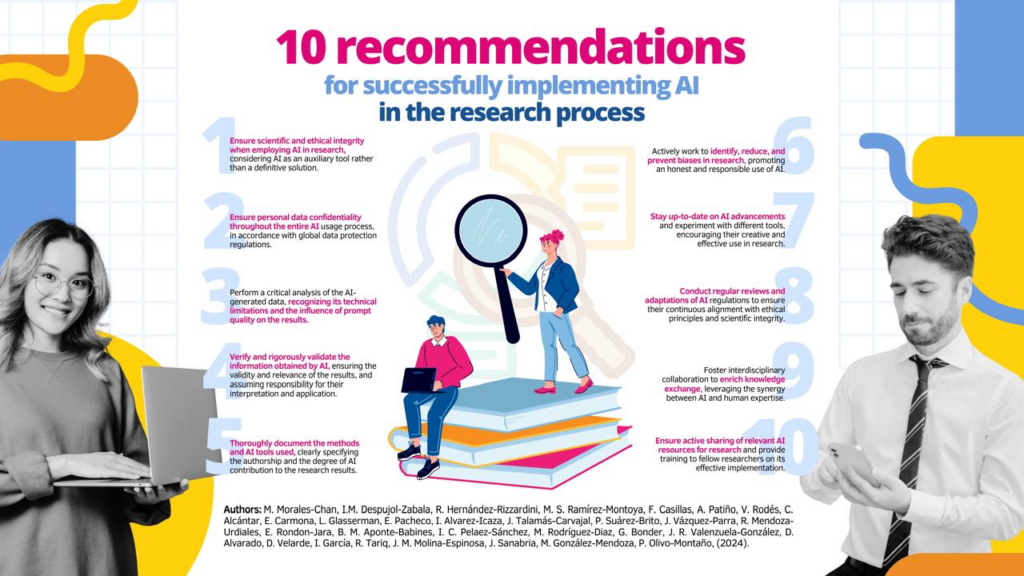
The Decalogue
- Ensure scientific and ethical integrity when employing AI in research: It should be considered an auxiliary tool but not a definitive solution.
- Ensure the confidentiality of personal data and comply with global regulations to protect it throughout its use.
- Critically analyze AI-generated data: Recognize its technical limitations and how the quality of the prompts influences the results.
- Rigorously verify and validate the information obtained: Ensure the validity and relevance of the results and assume responsibility for their interpretation and application.
- Document the methods and tools used in detail. Specify the authorship and degree of AI’s contribution to the research results.
- Actively identify, reduce, and avoid bias in research: Promote integral, responsible use of this technology.
- Continuously stay current on advances in AI: Diversify experimentation with tools and encourage their creative and effective use in research.
- Conduct regular reviews and adaptations of AI applications: Ensure the continuous alignment of ethical principles and scientific integrity.
- Foster interdisciplinary collaboration to enrich knowledge sharing: harness the synergy between AI and human knowledge.
- Actively share research-relevant AI sources and offer training to other researchers on their practical application.
Notably, artificial intelligence is characterized by a fluctuating environment; its design, development, and implementation will continue to increase, as well as the consequent adaptation of ethical guidelines. Inevitably, this technology will penetrate all spheres of human activity.
In this sense, Nacho Despujol from the Universitat Politècnica de València, argues that:
“The evolution of artificial intelligence tools has entered a phase of exponential growth, so those who are not prepared to incorporate them will be at a significant disadvantage in a very short time, but, like any new tool of great power, their improper use bears significant risks, so it is essential to lay the right foundations as soon as possible to proceed correctly.”
In other words, AI has reformulated how to conduct research, so it is necessary to reflect and act on the ethical implications of these changes.
Ethics, Science, and AI
To understand the field of ethics and artificial intelligence (AI ethics), one must understand the concept that provided the foundations for this new discipline: machine ethics (also called machine morality).
This notion refers to creating machines that adhere to ethical principles during decision-making processes. It addresses questions concerning the machines’ moral status, i.e., whether they should be given legal rights and morality. This consideration is interdisciplinary and multidisciplinary, as it lies within the domain of technology ethics.
Why is ethics important in science?
The efforts to incorporate ethics in technology, especially in an era when systems are becoming more pragmatic, automatic, and intelligent, respond to the need for regulation and action in the face of a wide variety of new challenges, including the following:
- Privacy and Surveillance
- Behavior manipulation
- Opacity and lack of transparency
- Biases (systematic, modeling, exclusion, interpretation, etc.)
- Human-Machine Interactions
- Impact on the Workplace
- Machine Ethics
- Moral Status of Intelligent Machines/Systems
- Technological Singularity
Ethical integration
General
Multiple models integrate ethics into the domain of machines and intelligent systems:

In scientific research
Integrating artificial intelligence into scientific research creates new ethical and integrity dilemmas that must be studied deeply. Similarly, the impact of algorithmic biases on scientific knowledge must be analyzed.
According to Miguel Morales, Director of Digital Education at Universidad de Galileo:
“The implementation of AI in research must be guided by solid ethical principles that ensure integrity, fairness, and accountability at all stages of the research process. Only then can we have full confidence in the findings generated and their ability to contribute positively to society.”
To respond to these ethical challenges (bias, integrity, accountability, etc.), intelligent systems must prioritize AI’s development and design, focusing on transparency and being explainable and auditable.
In addition, the term “AI ethical governance” should be considered in flexible and adaptable guidelines for the responsible and successful development and implementation of the technology, ensuring progress and knowledge.
Integrating ethics into scientific research requires collaboration in various areas. Therefore, it demands an approach that includes education, transparency, accountability, and proactive participation.
The Impact of AI on Scientific Publications
Institutions and research teams must consider new editorial standards and guidelines on using AI in research because each publisher has different degrees of acceptance for publication in their responsibility to promote the legality, ethics, and integrity of scientific work.
Researchers must be current on these new modifications by specific scientific publishing houses to understand their perspectives on the scope and limitations of AI use. These regulations align with the scientific community’s goals of having legal, ethical, and integrity frameworks for AI research.
Integrating AI into science is a broad exploration that should be undertaken to benefit humanity. Responsibility, transparency, and ethical and academic principles are required in its deployment to facilitate research, which must also align with the legal framework.
We must not forget that, thanks to AI’s exponential growth, we must be flexible to keep up with its progress and the changes it may bring to the scientific field.
Translation by Daniel Wetta