
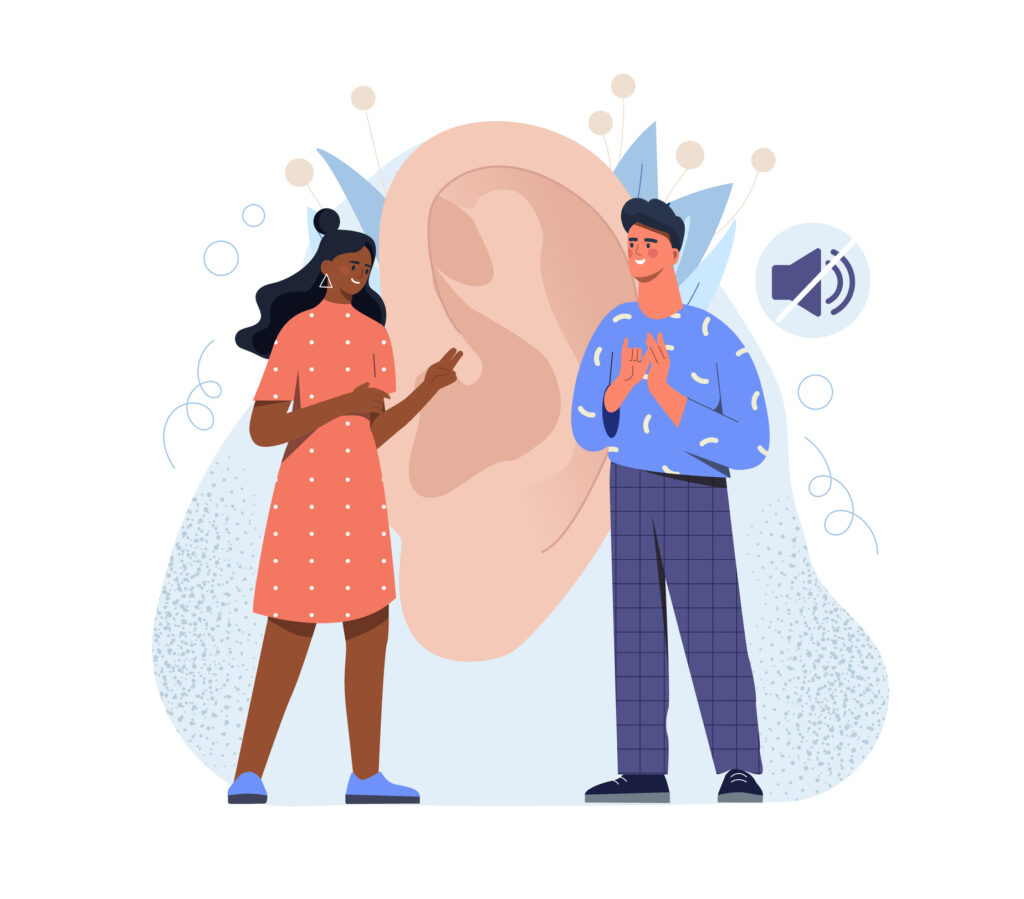
A person can transmit and receive information fluidly through gestures, facial expressions, and body movements adapted to a linguistic function, allowing thoughts, emotions, and needs to be expressed naturally. Thus, sign language is critical to the deaf community as an effective form of communication.
But what are sign languages?
A couple of concepts
Besides being a natural language, sign language is the mother tongue of deaf people. That is not very clear. That statement could be clearer if you dedicate yourself to linguistics, so it is necessary to understand two concepts: natural language and mother tongue.
A natural language is a linguistic variety that arises spontaneously among a group of people belonging to the same community. It includes oral languages (such as Spanish and English) and sign languages, such as the Lengua de Señas Mexicana (LSM Spanish acronym) or American Sign Language (ASL). These languages have developed naturally among a group of people solely to communicate.
On the other hand, “mother tongue” refers to the language learned during childhood, the first complex linguistic system we use. Our cognitive development begins with this; for this reason, it is of great importance in everyday student and professional lives.
Both seemingly isolated concepts, however, are of utmost relevance in the context of sign languages.
Sign language
By themselves, sign languages are highly complex linguistic systems, natural languages with their own grammar, syntax, and vocabulary. Contrary to popular belief, sign languages are not a visual or signed version of spoken languages; they are structurally distinct. Each country can have its own sign language with unique rules. Within these, different dialects can reflect diversity as in all languages worldwide.
Sign languages are the mother tongues of deaf people, “the means by which they access language and cognitive, emotional and communicative development.” This is important because it has been shown that the mother tongue promotes “better learning outcomes, self-esteem, and critical thinking skills.” Learning the mother tongue in the first years of life is vital for any human being. However, unlike hearing children, deaf children have more difficulty accessing a language in their early years.
Traditionally, culture is passed down from parents to children, but in deaf culture, this is not always the case. Often, deaf children have hearing parents, but it is not enough for family members to learn sign language later; children acquire language quickly and naturally in the first years of life, but learning a second language as an adult is a much slower process, explains Carlos Sanchez (cited by Ortega Díaz).
Language is essential to understanding the world and society. For hearing parents, learning a language is automatic, but for hearing parents of deaf children, learning sign language requires conscious effort. This underscores the importance of deaf children having early access to sign language, which is indispensable for their cognitive and cultural development.
Deaf community
“Deaf community” refers to people with a shared experience of deafness or hearing loss. This community includes not only those who are deaf from birth or those developing deafness later but also their families and friends.
The deaf community is notable for using its own language, Sign Language, which varies by country or region. They have their own cultures, values, and traditions. Within a deaf culture, deafness is not seen as a disability in the traditional sense but rather as a different way of living and communicating.
According to the United Nations, with information from the World Federation of the Deaf, an estimated 70 million deaf people are in the world, of which more than 80% live in developing countries, using more than 300 different sign languages.
The reality is that most deaf people are born to hearing parents, which challenges the transmission of this culture. Although families try to teach their deaf children, the proper transmission of values, customs, and language of deaf culture depends mainly on other members of this group, which emphasizes the importance of the deaf community’s involvement in the education and cultural development of deaf people.
Misconceptions about Sign Languages (SL)
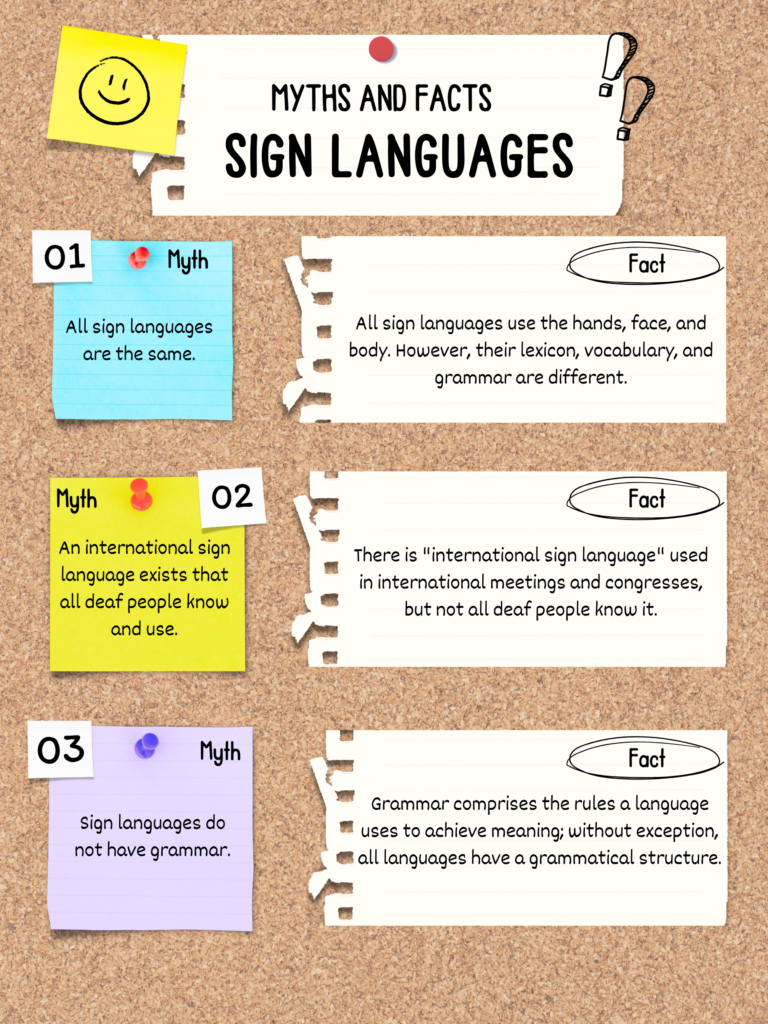
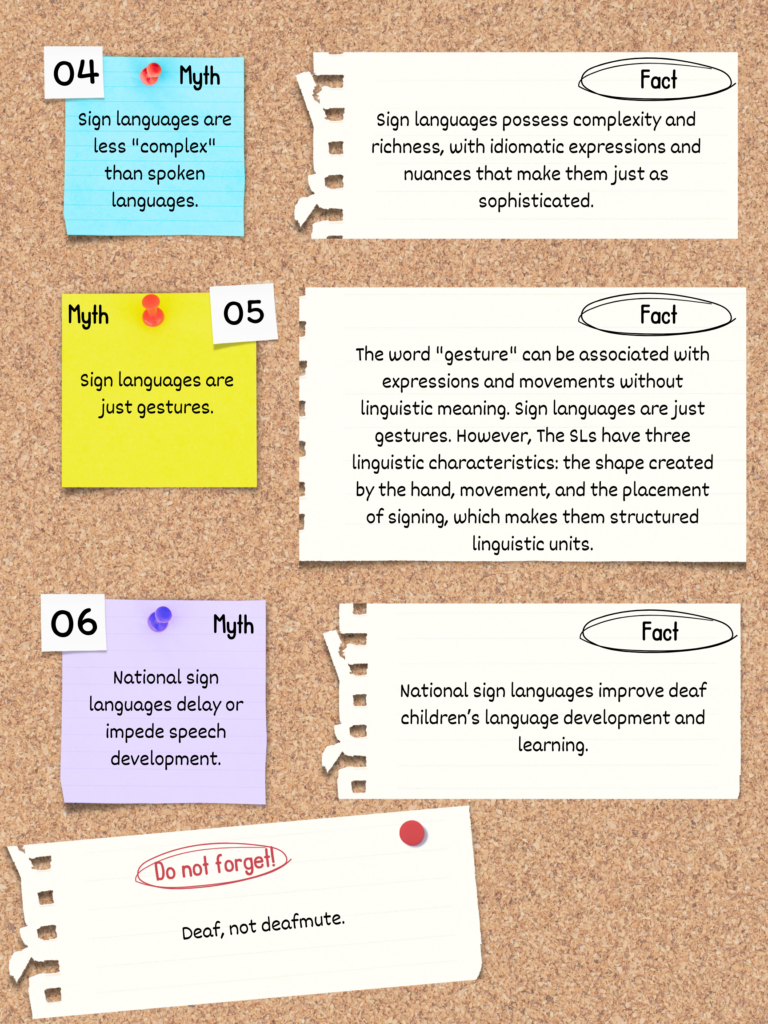
Deaf, not deafmute
The term “deaf” refers to a person with hearing loss, which can range in degree from mild to profound. This condition does not define the person. Deaf people can communicate in various ways, using sign language or a combination of methods. Using “deaf” (or “Deaf” with an initial capital letter in some deaf communities) recognizes their identity and ability to communicate and participate in society.
On the other hand, the term “deafmute” originates from a limited, often erroneous, perspective about people with hearing impairment. Assuming someone is “deafmute” implies they cannot speak, which is invalid for all deaf people. Many can communicate verbally or by other means. This word perpetuates stigmas and myths, contributing to a perception of incapacity or limitation within the community, which can result in discrimination or lack of inclusion in various areas of life, from education to employment.
Using the term “deaf” conveys a more accurate and respectful understanding of these people’s abilities and experiences, conveying the complexity and diversity of the hearing loss experience, promoting respect, and dismantling harmful stigmas.
Sign languages in Mexico
In 2005, Mexico began commemorating the Lengua de Señas Mexicana (LSM) (Mexican Sign Language) every June 10 when various associations meet to promote and preserve it. However, LSM is not the only one in the country; it coexists with Yucatec Mayan Sign Language (LSMY), Chatino Sign Language (Oaxaca), and Zinacantán Sign Language (Chiapas).
LSM has lexical changes depending on the country’s geographical region; it is also modified contextually through historical and social interactions so that signs that others see in disuse are used, or new ones are incorporated throughout the nation.
If a country like Mexico has more than three sign languages, imagine how many there must be worldwide!
Signs of change
Despite being a widespread culture, the deaf community continues to be discriminated against and isolated. Miroslava Cruz Aldrete and Edgar Sanabria Ramos clarify that the legal recognition of sign languages as national languages has been insufficient to improve the lives of many deaf signers, which spotlights the lack of language policy: In Mexico, only 14% of deaf people go to school, 35% have no studies, and only 4.1% have access to higher education.
The cruciality of sign languages transcends communication. They are vital tools for inclusion and equal opportunities for deaf people. By providing an accessible, effective means of expression, they facilitate full participation in society, access to education, employment, public services, and exercising their rights as citizens. In addition to their practicality, sign languages are a fundamental pillar of the deaf community’s cultural identity.
As someone who hears, what can I do? It is paramount to reflect on the role of sign languages in our society and our personal lives, to ask ourselves how we can support and promote their use, and to foster inclusion and equal opportunities for deaf people in all walks of life. These are essential aspects that deserve our attention and action.
As the Cultura Sorda website explains, “The deaf person is not sick; he is more a foreigner.”
Translated by Daniel Wetta