)
)
)
)

Digital literacy has become essential for daily personal and professional life. However, achieving it in the classroom is complicated: It requires teaching students how to use technological devices and providing them with the necessary tools and knowledge to function adequately in a world saturated with information, virtual interactions, and digital resources. This goes hand in hand with critical thinking and ethical perspectives regarding the use of digital platforms.
What is digital literacy?
Digital literacy facilitates navigating, evaluating, and communicating information through digital formats. According to Hiller A. Spires (2019), it encompasses three essential skills:

- Finding and consuming digital content: This comprises performing digital tasks such as using an e-book reader in the classroom, checking bank statements online, or reading news on the Internet; that is, everything done to access digital information.
- Creating digital content: This includes skills such as creating and editing videos, writing articles, or modifying documents in PDF format. It refers to generating digital content.
- Communicating and sharing digital content: Digital communication can take many forms, such as composing an email, posting on social media, or collaborating with others on an online document.
Essentially, the activities mentioned above are daily 21st-century tasks, many of which, such as writing an email or editing digital documents, are necessary to complete the different educational levels in schools. However, today, despite being surrounded by technology, many young people do not know how to use digital tools and are challenged by simple tasks such as sending emails, using word processors, or downloading and installing software.
One of the biggest challenges for teachers is integrating effective educational practices that teach students to search for information on the Internet efficiently.
Benefits of digital literacy
Digital literacy’s distinct benefits enable access to various online tools and resources that improve written and oral communication skills. Students learn to navigate, identify, and use authentic information, reinforcing their critical thinking. Additionally, the frequent use of digital technologies allows them to develop technical skills, collaborate easily with peers and teachers, and actively participate in learning environments, encouraging more commitment to their education. These tools allow for a more interactive and personalized learning experience that can be adapted to the needs of each student.
Matt Evans of the University of San Diego summarizes the benefits of digital literacy as follows:
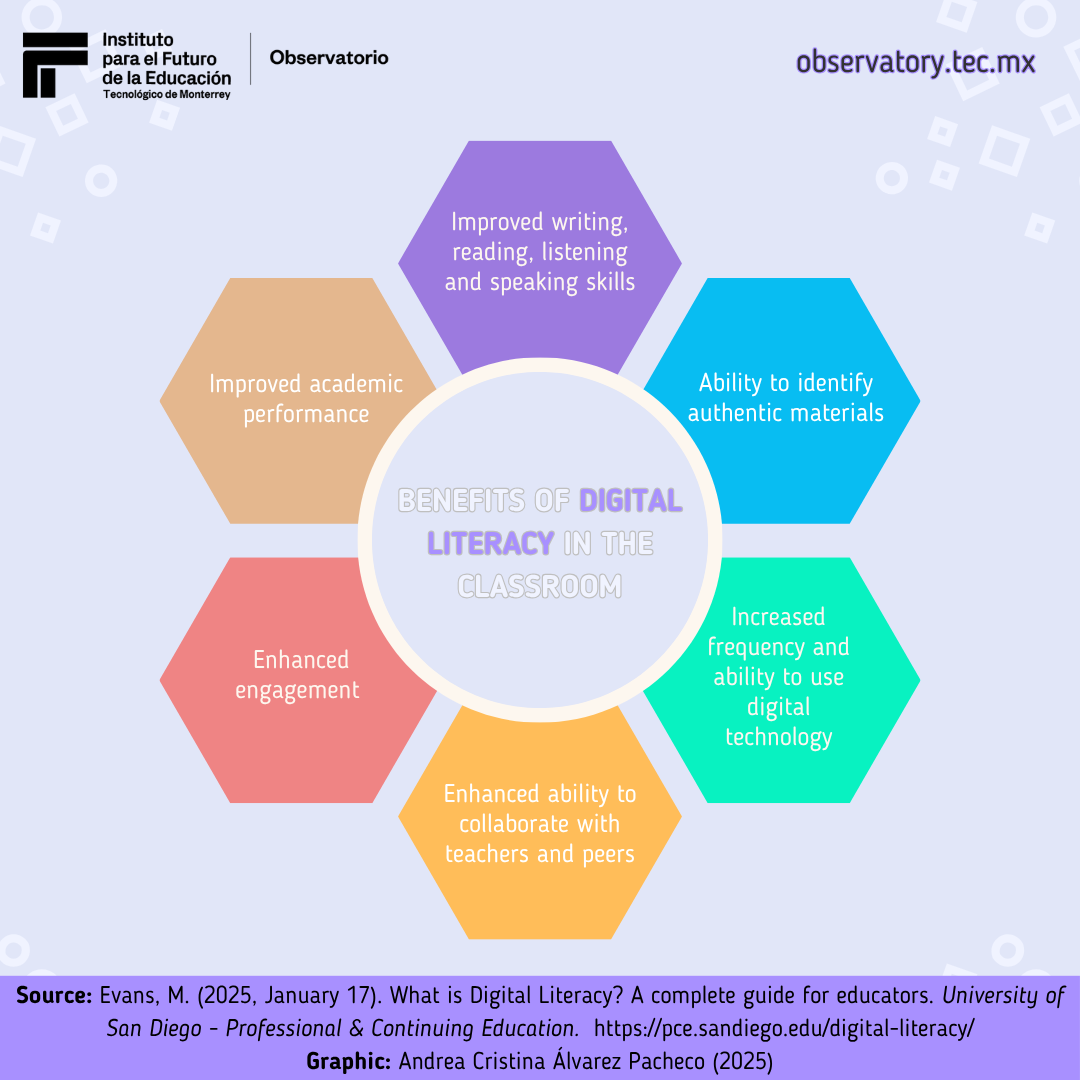
These benefits are also related to key competencies required in the digital era:

These domains are essential to guarantee practical competencies in the digital environment, which requires information to be managed and used critically, efficient interactions and joint work on digital platforms, privacy protection, and online risk avoidance.
Digital literacy must be addressed in classrooms at all educational levels; however, how can such a complex competency be taught when the curriculum is already overloaded and teachers do not have the time?
Digital literacy in the classroom
Despite the continuity of digital literacy programs established in recent decades in Mexico (and worldwide), which have been accompanied by the proliferation of Internet access devices, the reality is that most students are still not trained to use digital tools effectively in their education, whether due to the lack of access to appropriate technology, insufficient training in digital skills from an early age, or the absence of pedagogical support to guide their use for educational purposes.
Moreover, such programs should be adapted to the local context. Copying a successful program does not guarantee the same results in a completely different environment. It is necessary to conduct an initial diagnosis of the local context, establish guidelines for their application, and evaluate their impact – essential activities that are not always considered, resulting in a waste of resources due to the lack of success.
The new generations are called digital natives, but their capabilities are limited to using social media. Searching for information or interacting with educational platforms and content is challenging and ineffective for their learning, pointing out the urgent need to improve our students’ digital training. Using smartphones is not enough; every technique or skill requires practice and instruction. That is why the daily use of a computer does not automatically develop digital skills. So, how does one become digitally literate?
How to teach digital literacy in the classroom?
Matt Evans emphasizes that training students in digital literacy requires showing them the relevance of responsibility within the digital world, teaching them critical thinking, creating an online identity, and establishing limits for a balanced use of technology. He highlights the following digital literacy tips:

Likewise, Ethan Wiseman suggests that successful digital literacy requires starting with three steps:
Step 1. Teach the student body the main aspects of this broad concept, such as online safety, search skills, and digital etiquette, which will promote students’ safe and responsible navigation.
Step 2. Incorporate scenarios that students identify and encounter in real life into the classes.
Step 3. Include various digital tools in the classroom’s day-to-day life, which will allow students to develop these skills naturally and meaningfully.

Life skills
Through time, humans have taught themselves to communicate through new digital tools. The speed of information transmission makes it difficult to distinguish between reliable information, opinions, and disinformation, which requires habitually verifying and validating received information. These actions are usually skipped by a large number of Internet users.
Our task as teachers is to promote these skills and habits that allow our students to function safely and respectfully in real and virtual life. We must train them in core competencies to ensure they not only consume technology but also become responsible digital citizens.
However, this is not an easy task. Beyond the need for equitable and quality access to digital devices and infrastructure, users must be able to leverage technologies and protect themselves from online threats. Governments are also tasked with developing strategies that encourage the use of current resources and offer innovative solutions adapted to different needs.
And you, as a teacher, how do you touch on these topics in class?
Translated by Daniel Wetta

)
)
This article from Observatory of the Institute for the Future of Education may be shared under the terms of the license CC BY-NC-SA 4.0