)
)
)
)

The work culture tends to misperceive stress, burnout, and mental health disturbances, normalizing these conditions as “occupational habits.” In addition, common sayings like “Roll up your sleeves and jump in” often infer the existence of a healthy work environment when it is usually the opposite.
Although mental health problems can appear at any time in our lives, an alarming number of statistics point to the deteriorating mental health of those who start postgraduate studies and pursue a career in academia to improve their employability and personal and professional development.
Some background
Currently, studies show that 50% of graduate students experience symptoms of depression, anxiety, or burnout, causing many of them to decide to leave academia due to this increase in mental health problems. Other research indicates that anxiety among graduate students is six times higher than that of the general population. Precisely, anxiety disorders rank 6th globally as the most significant contributor to non-fatal health decline.
The prevalence of anxiety disorders and mental health issues is primarily, but not exclusively, due to uncertainty and job insecurity and to the loss of balance between professional and personal life from the long, intense working hours invested in research, work activities, events, etc.
Some of the most common graduate student stressors that affect negatively mental health are:
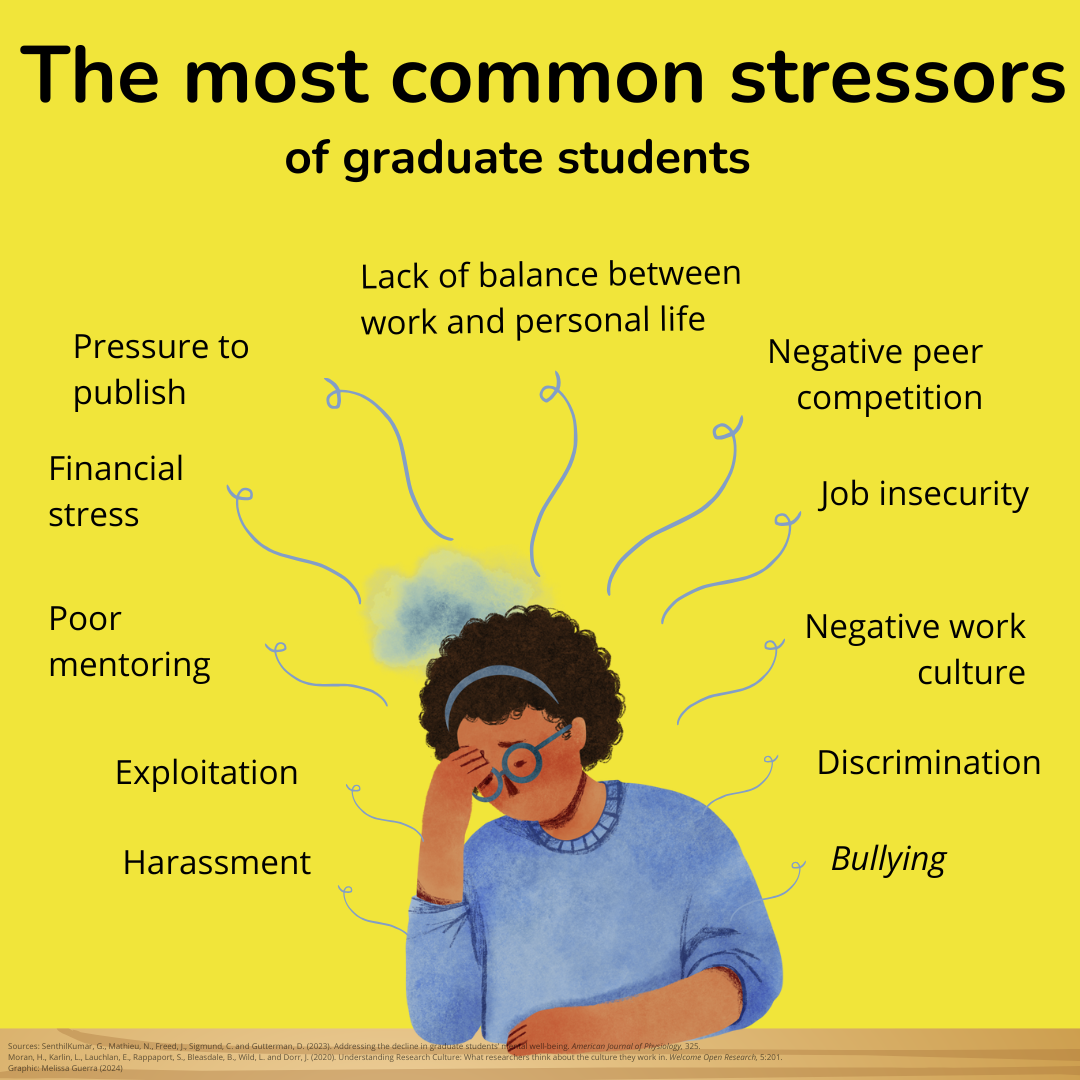
Harassment, bullying, and discrimination
One study surveying 4,000 researchers found that 60% witnessed harassment or bullying in the workplace; about 50% of those incidents were gender-related, and 20 to 30% were related to the person’s race/ethnicity or nationality. Other studies indicate that these incidents are also linked to age (19%), socioeconomic class (16%), sexual orientation (8%), disability (8%), and religion (6%). Along these lines, a study reported that 35% of respondents suffered discrimination, while 46% had witnessed it. About 60% of the study participants indicated that the work environment favored specific groups.
Behaviors related to bullying and harassment have a systemic origin, as many work leaders or area managers ignore these incidents. Most of the events (harassment or intimidation) have been carried out by people in positions of power, with the most affected being those with disabilities (62%) and women (49%). Notably, women encounter challenges before, during, and after pregnancy. They must overcome the limitations of motherhood, financial stress, and gender work/pay disparities. In addition, some students receive differential treatment, being perceived by their peers as different because of their backgrounds (for example, nationality or socioeconomic position). This contributes to a decrease in their sense of belonging, which increases stress and accentuates the imposter syndrome.
Whether we want it or not, these issues are causing a humongous amount of mental health problems among students. It is absurd that today, in 2024, we still have this kind of issue, and more wistfully at this academic level.
Negative work culture
Due to these and many other aspects, the perception of work within the scientific culture is not entirely positive. One study showed that many words used to describe experiences within scientific culture have negative connotations, even though they may be seen as positive at first.
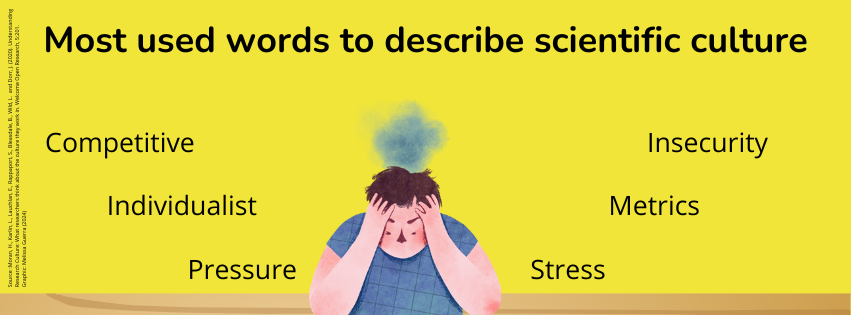
Exploitation and the “publish or perish” culture
In 2018 alone, more than 7,000 articles were published daily, 40 to 50% of which were from the biomedical area. This might suggest tremendous scientific advances, but the underlying figures are the overproduction and exploitation of people, which make this number of investigations possible. In addition, the time it takes to publish the first article by the primary author is four times longer than in 1980.
Some aspects characterizing exploitation are:
- Demand for long working hours and shifts.
- Performing difficult or tedious tasks.
- Crediting one’s ideas to superiors or other team members.
- Performing tasks demanded by superiors not related to the research.
Lack of work-life balance
The above stressors also cause a lack of balance between life and work. Research has shown that postgraduate students work long hours: 76% work more than 41 hours a week, and 25% work more than 61 hours. Another study indicated that 48% felt pressured to work long hours. These issues affect work-life balance and cause burnout, which 50% of students at different stages of their graduate studies suffer from.
Financial stress and job insecurity
A 2022 Nature survey indicated that 85% of graduate students worried about not having enough income for living expenses, and 45% said they might need to abandon their studies because they could not afford them and personal expenses. This adds more pressure, stress, and anxiety, so the prevalence of mental health issues is remarked.
In addition, some students must work extra jobs to support themselves and finance their graduate studies, which adds to future financial stress and worries. Thus, the current high cost of living adds to the uncertainty about not accessing or developing a career in academia due to favoritism, nepotism, and discrimination and its associated problems, among others.
Negative peer-to-peer competitiveness
This aspect is often related to financial stress and job insecurity because many students must compete for scholarships, financial support, and jobs in institutions. Therefore, the toll on their mental health due to stress and anxiety is something to think about in the way these grants are given. Also, in this age of social networks, studies have shown that social media increases peer comparisons, resulting in envious feelings that contribute to mental health problems.
Poor mentoring
According to a study by Tuma et al. (2021), several causes of bad experiences in students’ academic training include:
- Filters: Poor mentoring reinforces the idea that only those with the necessary talent or willingness can succeed; it filters those who succeed from those who do not.
- Power structures: The hierarchies of power are very marked. Mentors exercise all their power in the relationship with their mentees; the latter have no decision-making power. Also, mentors may not be incentivized to motivate them to provide quality advice.
- Inaccessibility: The mentor is absent from their responsibilities due to the vast number of activities and advisements.
- Social undermining occurs when the advisor participates in unprofessional behaviors that affect establishing a healthy relationship with their mentee, such as promoting a hostile work environment.
- Limited professional and psychosocial support: When the mentee does not receive counseling, networking, coaching, emotional support, or experience commitment, a lack of interest in research or professional development can occur.
We are in an era of overproduction, aggravated by the pressures of generative AI to manage and analyze millions of data and variables in scientific research. The speed with which these are demanded, the pressure, and the other issues noted above comprise red flags for educational institutions to take action on these matters and stop normalizing something wrong.
Poor mental health is profound. Its prevalence should be an alarm to change harmful practices and processes within the scientific culture. Inclusion must not be lip service and showcase spaces; instead, it must be true inclusion that helps eradicate systematic discrimination and harassment by superiors and leaders.
Graduate students and recent graduate researchers must be able to express their voices without fear of repercussions to improve the professional and personal quality of their studies and their lives in academia, which would help inspire others to pursue a career in the sciences. Similarly, decision-makers, public policymakers, and institutions must begin to dialogue and find solutions for accessible scholarships and support programs for those who need them.
Changing organizational culture is complicated because thousands of researchers and graduate students must enjoy quality educational programs without adverse mental health consequences.
Translated by Daniel Wetta

)
)
This article from Observatory of the Institute for the Future of Education may be shared under the terms of the license CC BY-NC-SA 4.0