
Thinking about education often calls to mind schools, universities, and classrooms. We often understand it as a process of transmitting knowledge or developing skills within a school context. However, it also implies learning to live together, interpreting the world, and relating to those who are different from us. In this full context, perhaps dog literacy also has a place in that consideration.
When we talk about dogs, we usually think of teaching them commands, preventing them from pulling on the leash, or correcting difficult behaviors. Dog education is usually understood as a set of techniques to train the pet to “behave well”. For a long time, I also thought this way.
However, the experience of living with Arnold, my pet dog, forced me to rethink what I meant by canine education. What if the change doesn’t start with my dog, but with me, the person who lives with him? What if the most important learning was not to correct a behavior, but to learn to understand it?
Literacy has never only meant learning to understand letters; it involves developing the ability to interpret information, discern a context, and make decisions based on that knowledge. That is why we have scientific, digital, or health literacy, where everything is based on the idea that learning transforms how we understand the world and, consequently, how we act in it.
That same principle can be applied to the relationship we build with other species. In the case of dogs, it means knowing their language, identifying their needs, and making decisions that favor their well-being and strengthen coexistence. In other words, learning stops focusing only on what the pet should do and begins to ask what people should learn to understand them better.
It is not a question of replacing training or minimizing its importance; it is about changing the starting point because when the conversation is exclusively about obedience, we run the risk of asking ourselves only what the dog needs to learn without stopping to think about what we should learn.
Although the term “dog literacy” is relatively recent, the idea behind it has gained traction as science, transforming our understanding of dog behavior and well-being. Before becoming an educational proposal, it was necessary to understand how dogs learn, what influences their behavior, and why many of the behaviors that were previously interpreted as disobedience are now considered forms of communication. That scientific journey has led to understanding why learning about dogs is a literacy process.
From teaching behaviors to understanding behaviors
The way we understand dogs has changed profoundly in recent decades thanks to advances in animal welfare science and ethology. This discipline studies the behavior of animal species, including humans, in their natural environments. The findings of ethology have shown that, while for a long time the objective was to understand how dogs learn, today the focus is on understanding what they feel, what they need, and what they try to communicate through their behavior.
Russian physiologist Ivan Pavlov showed that dogs could learn to associate different stimuli through a process known as classical conditioning. In one of his best-known experiments, he observed that after dogs repeatedly heard a bell before receiving their food, the canines began to salivate when they heard that sound, even when food was not present.
Although today this research is usually cited with a few lines in psychology books and in popular articles such as this one, at the time it represented a radical change because it allowed learning to be studied from an experimental approach. Until then, many animal behavior processes were primarily explained by observations. Pavlov showed that the processes and behaviors could be systematically analyzed and measured scientifically. His work not only transformed the study of learning in dogs but also laid the groundwork for the development of learning psychology during the 20th century.
Years later, the American psychologist B.F. Skinner expanded this knowledge by developing the theory of operant conditioning, which holds that the probability of a behavior occurring again depends on the consequences that follow it. In other words, when a behavior produces a pleasant consequence, it is more likely to be repeated; on the other hand, when the pleasant consequence stops or becomes an unpleasant experience, its frequency likely decreases. This theory continues to underpin many strategies to teach skills to dogs and other species, including humans.
These contributions have helped us understand that dogs can learn new ways of acting, acquiring habits, and adapting to different environments. For decades, the main objective of training was to teach obedience, correct undesirable behaviors, and strengthen the coexistence of dogs and people. Thus, the success of this education was usually measured by the dog’s ability to respond correctly to its owner’s directions.
As time passed, new questions began to arise: Was it enough to evaluate a dog solely by its ability to obey? Should the success of education be measured only by the behaviors that people wanted to observe? These questions prompted the development of applied ethology and animal welfare science. These disciplines broadened the view of behavior and proposed understanding the dog as an individual with its own physical, emotional, and social needs. In this new paradigm, behavior was no longer seen only as something that had to be modified and began to be understood as a source of information about the animal’s condition.
Science also made it possible to identify that behavior does not depend solely on what a dog has learned. Factors such as genetics, early experiences, the environment in which they live, emotional state, and even the presence of pain or illness continuously influence their behaviors.
This perspective is also shared by veterinary behavioral medicine. Veterinarian Natalia Álvarez Hernández explains that problems such as animals’ fear, anxiety, or aggressiveness should be understood as multifactorial phenomena in which medical, physiological, environmental, and learning aspects are involved. Thus, a bark, a growl, or apparent “disobedience” are no longer interpreted exclusively as behaviors to be corrected but also as valuable information about the animal’s physical and emotional state.
This change in perspective also began to be reflected outside academia. As evidence on animal welfare grew, different countries began to review the use of potentially harmful training tools and promoted more dog-friendly methods. The discussion shifted from focusing solely on the efficacy of a technique to considering its implications for the animal’s physical and emotional well-being.
This paradigm shift also transformed the role of those who live with dogs. Although for a long time, dog education consisted mainly of training them, today it also involves our own learning. It means observing, interpreting their body language, and recognizing when a behavior expresses curiosity, fear, pain, frustration, or well-being. In other words, stop focusing on how to make a dog obey us and start asking what it is trying to communicate.
This way of understanding behavior was also promoted by trainer and dog behaviorist Turid Rugaas, who introduced the concept of the “calm signals” in her book The Language of Dogs: Calm Signals. In it, she describes a set of behaviors through which dogs seek to reduce tensions, prevent conflicts, and communicate with other dogs and people. Her work helped to systematize an idea that today seems obvious: before trying to modify a behavior, it is necessary to interpret it within its context.
Perhaps this is one of the most significant transformations of dog education in recent decades. When we stop seeing behavior merely as something that should be modified and start seeing it as a form of communication, our relationship with our pets also changes. Education ceases to be a one-way process, in which one species teaches, and the other learns; rather, it becomes an exercise in mutual understanding. Precisely at this point the concept of dog literacy begins to take shape.
If science transformed how we understand dogs, the next challenge was to disseminate that knowledge to the people who live with them every day. In recent years, initiatives have emerged that are dedicated precisely to translating scientific evidence into practical tools for families. One of them is LomBom, whose proposal is based on a simple idea: understanding a dog is also something that is learned.
When science reaches families and their dogs
For the knowledge generated by ethology and animal welfare science to have a real impact, it must reach those who live with dogs every day. This is the idea behind LomBom, a Mexican educational project for canine well-being that seeks to translate scientific evidence into practical tools for dogs’ disease prevention, healthiness, and comprehensive well-being. From its perspective, learning doesn’t end at the veterinarian’s office or training but is ongoing in the day-to-day decisions families make to care for their dogs.
As part of this work, Italibi Gutiérrez Félix, founder of LomBom, developed a reflection on a concept that summarizes this philosophy of canine literacy. Her proposal is based on a simple but profoundly transformative idea: education does not begin by teaching the dog what to do, but by teaching people to understand who the dog is, what it needs, and what it is trying to communicate.
From this perspective, literacy in the canine world involves developing the ability to observe, interpret, and make informed decisions about the dog’s well-being. As with scientific or health literacy, beyond acquiring information, it requires understanding it and using it to act with more awareness. In the case of dogs, this means learning to recognize their body language, knowing their physical and emotional needs, and interpreting their behavior contextually.
This orientation also transforms how we understand their behavior. A yawn, a licking of the muzzle, a change in body posture, a loss of interest in the game, or an unexpected reaction to certain stimuli are no longer seen only as something that must be corrected. Instead, these behaviors provide valuable information about the dog’s physical, emotional, or environmental state. As Gutiérrez Félix explains to The Observatory, “behavior is not an isolated issue. It’s biology, it’s health.”
Thus, the role of dog guardians also changes. Rather than simply reacting when a problem appears, dog literacy prompts observation, prevention, and responding more appropriately to the dog’s needs. Information only acquires true value when it facilitates actions before problems appear and when it builds environments that favor the dog’s integral well-being.
Thus, beyond learning training techniques, it requires developing criteria that help identify needs, recognize problem signs early, and build environments that favor the dog’s integral well-being. This vision is reflected in LomBom’s educational materials, where topics such as nutrition, first aid, cognitive stimulation, communication, and stress management are part of its educational proposal. From this perspective, feeding a dog, walking it, and playing with it are still part of care, but also understanding its behavior, preventing stressful situations, and responding more appropriately to its physical and emotional needs are necessary.
Perhaps one of the most important ideas of the LomBom proposal is that learning never ends. Understanding a dog requires curiosity, observation, and a willingness to keep learning. As Gutiérrez Félix commented, “Canine literacy does not seek to turn dogs into robots; rather, it seeks to construct dog safety, well-being, and resilience.” She points out, “Love is not always enough if it is not accompanied by tools.” Dog literacy means precisely that: transforming affection into knowledge and then into actions that build healthier relationships between people and dogs.
For a long time, the health of humans and that of animals were considered to be separate issues. However, approaches such as One Health are a reminder that the two are deeply connected. The way we understand, care for, and live with our dogs not only influences their well-being, but also our own health, daily coexistence, and the relationships we build with them. Thus, dog literacy is no longer just a tool to understand animal behavior better; it is a way to strengthen the shared well-being between people and dogs.
When learning changed our story
So far, I’ve talked about dog literacy as a science-backed concept promoted by specialists. However, it was my experience with my dog Arnold that allowed me to really understand what it is.
Arnold came into my life when he was ten months old. He never received the socialization that a puppy needs, and part of the training he received involved using shock collars to correct his reactions to other dogs. Far from solving the problem, those experiences made him learn to fear encounters in the world at a young age.
For years, I thought Arnold was a “difficult” dog. Walks ended before they started because he began to tremble, whimper, or attempt escape before reaching the corner. Like many people, I interpreted all this as behavioral problems and looked for ways to correct them. Sometimes I felt frustration, guilt, and even the feeling that he would never improve. Today I understand that, rather than teaching Arnold how to behave, I needed to learn.
Over time, I discovered that Arnold and I shared more than just a house. We both lived with anxiety, and we both learned, little by little, to feel more secure. As I learned to manage my fears, he also began to trust the world a little more. That experience made me understand that taking care of a dog also means reviewing the relationship we have with it.
That change meant a new direction earlier this year, when Arnold was ten years old, and I reached out to LomBom. Rather than focusing solely on changing his behavior, the LomBom team wanted to first learn about Arnold’s history, health status, and the possible causes of his reactions to other dogs. It was then that I understood something that no one had ever explained to me before: Arnold had never learned to explore the world through smell.
While most dogs use their noses to get information from the environment and feel safer, Arnold lived permanently in a state of alertness. He did not stop to investigate smells or to “read” the environment; he just tried to get through it as fast as possible. Understanding that completely transformed how I began to interpret his behavior. What for years I had seen as stubbornness, disobedience, or reactivity was, in reality, a persistent response of fear.
From that moment forward, we started a plan that included changes in Arnold’s diet, supplements, environmental enrichment, smell games, acupressure, and many hours of observation. The goal was no longer his obedience but helping him feel safe enough to explore the world.
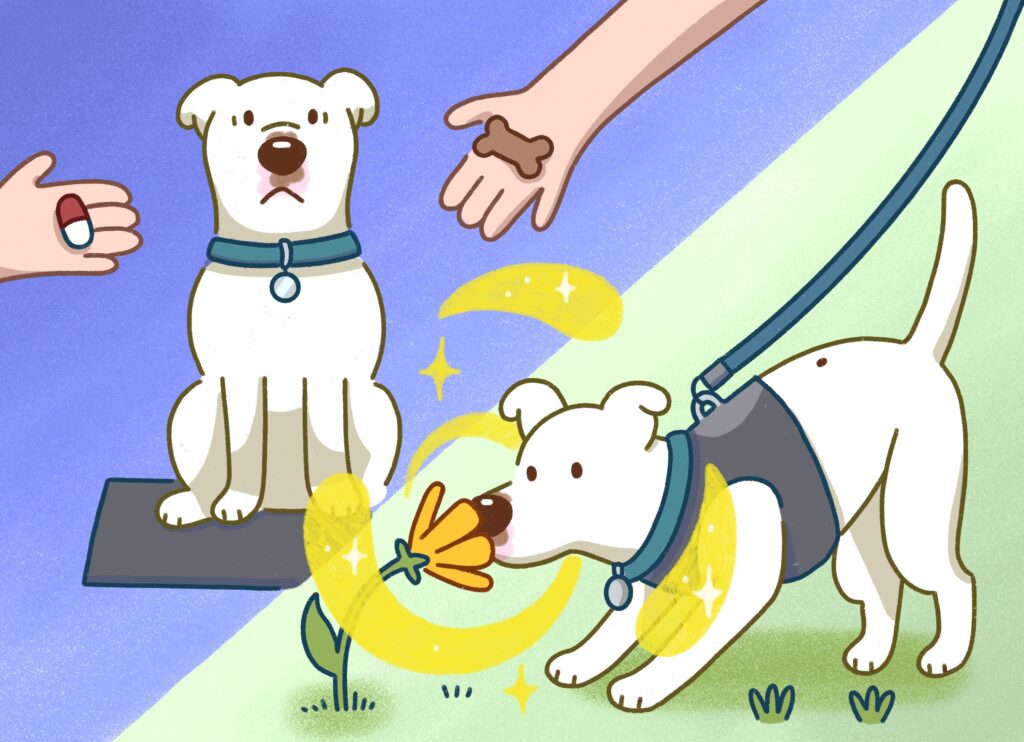
Months later, something happened that I thought would never be possible: Arnold accompanied me on my walks. He walked calmly through the shops. He stopped to smell the rugs, the plants, and the flowers in the garden. What’s more, for the first time in his life, he chose a toy. To anyone, these might seem like everyday scenes in the lives of pets and their owners. For me, however, they were evidence that my dog was no longer trying to survive every walk but was starting to enjoy it. Seeing him perform a new command no longer excited me. Instead, I was thrilled to see him experience the world with curiosity for the first time.
Our journey did not end there. Arnold is still a reactive dog with anxiety. We continue to face difficult days, and there is still much to learn. However, the difference is that I no longer see his actions as disobedience but as forms of communication. I learned that behind his bark can be fear, behind a reaction can be pain, and behind a dog labeled as “problematic” may be an animal that never had the opportunity to feel safe.
Canine literacy didn’t just change Arnold’s life. It transformed how I understood it. He taught me that living with a dog goes beyond teaching it behaviors; it means developing the ability to observe, interpret, and respond more appropriately to its needs. In the end, that was the meaning for us: to stop trying to change Arnold and to start, at last, to understand him.
Translation by Daniel Wetta