
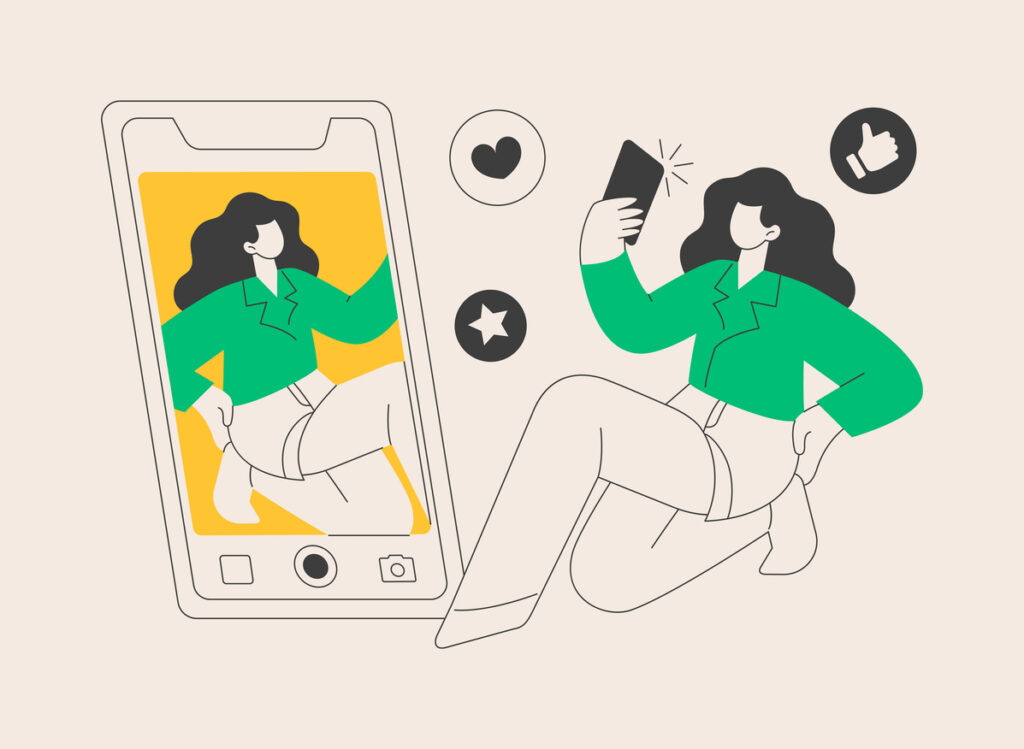
If you asked me what, in my opinion, was the prime thing shaping the course of today’s virtual life, I would say, without hesitation, the selfie boom. Even more than social media, videoconferencing platforms, or transparency scandals like WikiLeaks and the Epstein case; even more than marketers like Amazon, that omnipresent practice of sharing one’s self-image served as the “Start-your-engines!” flag for the modalities of human interaction in the new century.
It’s no small thing. Personal computers, the Internet, and digital telephony had provided the technological tools (just as artificial intelligence is now making clear its scope); however, the selfie is how, in this realm of hyper-technology and remote communications, human beings (and, above all, women, who were, without a doubt, key in all this) showed their determination to continue occupying the central position of that new world. Once again, it was people—ordinary people (the “inventors of the everyday,” as Michel de Certeau would call them)—not technology or entrepreneurs—who set the tone for the new era.
The practice left its mark, in my view, irreversible, and, with the same spontaneity with which it had arrived, it gradually disappeared. Nothing more was needed. It had emerged as an unexpected metamorphosis of the very concept of “person” and had spread to all spaces where people, real people, still existed. Selfies, for example, accompanied millennials as they quietly concluded that paid work doesn’t have to be the center of human life and that other things matter. Phenomena like this — which surprise everyone — came from that personal autonomy and empowerment that were also shown in selfies; these did not arise — as so many detractors believed — from fragile beings who depended on others’ admiration, but from sensitive people determined to share themselves and, as I say, to be present.
I owe my view to what the writer John Higgs states in the last chapter of his excellent book Alternative History of the 20th Century (the chapter corresponding to the turn of the new millennium, titled ‘The Network’): “The previous generation may consider the selfie trend a manifestation of narcissism. However, these self-portraits are not mere attempts to reinforce a personal concept of the individual self; they exist to be seen and, in this way, to strengthen the relationships that occur through the network. It may give the impression that selfie culture relates to 20th-century individualism, but only when viewed through 20th-century eyes. These photos only make sense when shared.”
Thus, those of us who, being members of another generation, at the time judged selfies as evidence of great personal insecurity, did not want to understand that the world was changing and that, for all the people who took and shared them, it was as simple and everyday as leaving home, heading to the global virtual street and being present in the planetary environment.
Very few of us deprived ourselves of the joy of making ourselves known in that way. I confess I am among them. I never really wanted to expose myself in selfies. I was raised with a sense of humility, I don’t know if false or authentic, that still forces me to maintain a certain modesty about myself; modesty (or is it shame, or even guilt?) largely supported by a saying that was a kind of motto at home: The names of fools are written everywhere. Extending this idea to the world of images and to the face itself (the faces of fools), I shied away from looking like everyone else and avoided showing off, believing this “modest” attitude made me less foolish. But today, I often think there is nothing better than daring to be just one more of them!
Intellectuals and social critics like me have always disparaged people who show off, seeing it as an act of alienating one’s self-worth and as basing self-esteem on others’ judgment. However, I am beginning to think, as I said above, that this contempt is just another form of intellectualization—in this case, a way to repress one’s natural desire to receive external input.
Selfies arrived when society expected every personal presentation to begin by displaying some outstanding trait: economic status, one’s own fame, an academic degree…. In this context, these self-portraits asserted themselves as the opposite: what mattered was presence, a kind of “Juan was here,” “María was here,” which used to be inscribed on walls, doors, benches, and tree trunks, but now they roam the world in photographs, with a certain degree of anonymity, making it clear that the human person, even without a name, is the message.
As a reaction to the social chaos that overshadowed individuals (which is the same as saying that, on the streets, at least in the big cities, no one looked at you as a fellow human anymore), selfies were ways to be present, to be seen: dressing up, showing off, posing, smiling… just as one did before, when going out to the streets, parks, markets, cinemas, and churches. The first social networks, like Facebook, became the old street where you ran into half the world and interacted with other members of your community and strangers (“accepting friendship” then was like sharing social spaces with friends and strangers you met, as always).
Except now, the new street—the new space people traversed—was the global highway. Selfies became, more than any other virtual resource, the web’s characteristic function—the one it was actually created for: connecting all points on the planet and overcoming any obstacle that threatened that connection. (Technically, that is the Internet’s innovation: fragmenting messages into small blocks that can be distributed more quickly across a network to be reunited at their destination, which can be anywhere in the world). In selfies, the person portrayed themselves as aware —almost with a clear physical sensation—that their image, from that precise place, could end up anywhere on the planet (even going viral, in many cases).
It was a completely spontaneous global movement that transcended communication styles, recovering the old sense (never lost, by the way) of sharing oneself with one’s peers. If “life is a reality to be experienced,” as Kierkegaard stated, this communicating bears witness to it, as well as opening oneself to the testimony of the other, which, in the new virtual world, means sharing the simplest experiences of everyday life, starting with what one is about to eat for breakfast and ending with the starry sky one is contemplating before sleeping.
A selfie was not capturing oneself as an object from the outside but creating a true self-portrait—an image of the self, of our complete being. That’s why selfies flooded virtual space and made it no longer just another alternative for communication, but a truly new world. Thanks to these, people — led by young people — began to see that the newly discovered planet was habitable, and they could populate it with increasing confidence (just as, a century and a half earlier, we had learned to inhabit the world of photography and, five centuries earlier, that of books).
Today, selfies, as such, are disappearing, most likely as a natural defense mechanism against the onslaught of artificial intelligence, capable of simulating the real existence of fictional people. But their spirit of in-person presence still drives the prevailing style of current communication. It is present, for example, in its successors, the TikToks and all types of short videos, which have become the boldest and most effective form of communication at the moment, imposing a new style (which is actually the human style underlying all eras): one where the person sharing the information never disappears, emphasizing that every message has a sender and that, no matter how hard anyone tries, they cannot be hidden. Gone is the idea that, when it comes to information and knowledge, people (the subjects, with all their subjectivity) will let themselves be sidelined.
Human beings will always find a way to be present. Technology, as a servant of the exalted and powerful, is often accused of taking us over and subduing our spirit. But that is not the case. Always, by any means necessary, our self—that piece of the world that is us—will prevail.
Since the selfie phenomenon was nothing more than ordinary people appropriating technology, as they always have, we should simply call it the human phenomenon.
Translation by Daniel Wetta