
In the early fifteenth century, the Italian artist Filippo Brunelleschi devised the technique to recreate the illusion of perspective in painting. His innovation, so familiar today, challenged his contemporaries. When he presented his first paintings, no one understood what they showed: what was that jumble of blurry, overlapping splotches that looked like windows, doors, and pieces of sky but didn’t form a real image? Was Mr. Brunelleschi pulling their leg by insisting that it represented the exterior of a temple, seen from afar?
Brunelleschi could have failed as an innovative painter and resigned himself to painting landscapes with the old technique of showing everything on the same plane; however, he did what every good art master did: he looked for a way to teach people to appreciate innovation, to understand what they were viewing, and to open themselves to new ways of considering and feeling the world around them.
He battled centuries of tradition, art that represented not visible reality but a symbolic one. Until then, painted objects on canvases and walls did not represent real space but illustrated an ideal; their size, for example, corresponded not to their distance from the viewer but to their importance, greater or less, on a scale of symbols accepted by everyone. It was a collective art, and the spectators recognized in it the foundations of their community.
That is why, when Brunelleschi demonstrated to a group of people in a plaza, using an ingenious device, that what he was showing them was not a chaotic mess of splotches but an exact representation – albeit in perspective – of the temple in front of them (the Baptistery of San Giovanni, in Florence), they were dumbfounded; they were fascinated to be able to decipher what moments before had looked like nonsense.
Perspective drawing was part of a huge revolution in every aspect of the world: it implied that the reality depicted in a painting was no longer the same for everyone (based on community symbolism), but could be observed by a single person from their particular viewpoint. This meant the audience for these new works was no longer the entire collective, but the individual Renaissance spectator, for whom collective beliefs were no longer enough to explain the world. Only a few years later, Copernicus proved that the Earth was not the center of the universe but moved through space; thus, anyone who wanted to survive these upsetting ideas had to force themselves to view reality using new criteria. Science needed individual minds willing to delve deeply into the universe. The new art was destined to exalt, or rather, save, anyone willing to endure the vertigo of using their own perspective.
Six centuries have passed since then and, as we know, that dizzying feeling that accompanies individuality and one’s own viewpoint, separate from the community, has become an ordinary habit; now we are about to crash to the ground without realizing it.
None of this began recently: by the second third of the twentieth century, egocentrism had already reached atrocious levels; the valuation of the individual had succumbed to the glorification of authoritarianism. In the arts, personal sensitivity was exacerbated to the point of anxiety, leading to exaggerated individual consumption: everyone had their own tastes and preferences, which mass reproduction only intensified. Radio and the new “records” meant that music could be heard anywhere. Photography had also mass-produced painting, and the Mona Lisa exhibited her “enigmatic smile” even on matchboxes.
In response, many artists began to explore silence, and, as in the Renaissance, art underwent a revolution. Its audience was the human being: not the isolated, noisy individual of capitalism, but a being dwelling deep within each of us, hidden beneath the great commercial din. Artists wanted to go beyond the much-devalued individual consciousness to the sleeping being, the subconscious self. In a way, it meant returning to the communal through what some call the collective unconscious, vast and magical.
In music, jazz turned listeners into silent devotees; even the great symphony orchestras, once so sonorous, taught audiences to listen to murmurs, long pauses, sounds that faded into something ghostly. In painting, the new art also sought to delve deep, looking for the original and primitive, the forgotten and childish. An example is Picasso’s Guernica, which many have judged as “a work that a child could paint,” as if, so to speak, they reduced its value to something banal. They did not realize that, in fact, the artist might have wanted to paint it just as a Basque child would have, sitting next to the corpses of his parents and neighbors, in that miserable little Spanish village.
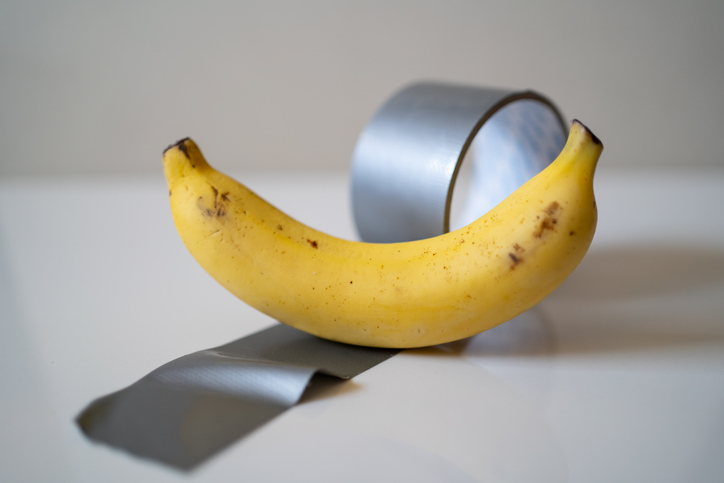
Now, let’s fast-forward to our century and look around for our own kind of art. Amid the chaos of our days, we yearn for something to console us and bring order to our lives, at least by reflecting its unique beauty. But all we see is more of the same: warmed-over paintings and music like always. Nothing of ours. And when someone talks about “contemporary art,” they show us a shoebox or a pile of fallen plates. Can anything be more absurd? Then comes the question that hits us with immense bitterness: how low have we sunk that the experts show us what they call a masterpiece: not something extraordinary like those of other centuries, but something as ridiculous as a banana stuck to the wall with silver duct tape? Is this really today’s thing? Are they really asking us to recognize ourselves there? It’s just another big joke in a world that’s going mad! The unmistakable mark of that so-called “innovative spirit,” which creates things in a state of decay and…
But hold on… wait a minute! We need to pause. Aren’t we making the same mistake as Brunelleschi’s and Picasso’s contemporaries? We’re sure we aren’t; this isn’t the case. Now we are right… But we should at least question ourselves, so no one says we are like those stupid critics. Besides, who is to say that, in one corner of our soul, there isn’t still a little blank wall where we can stick a banana?
So, I start by trying not to prejudge the work and, to my surprise, I soon come up with an interesting, or at least amusing, interpretation. I imagine that during the assembly of an exhibition of contemporary art from around the world, one of the hard-working technicians – who has been working non-stop for hours – is about to eat the last banana she managed to rescue from the remains of the communal snack (the one that everyone has already raided, except her). Sitting amid cardboard boxes and paint cans, she is about to peel the fruit when she is told her boss, the head curator, is looking for her. There is no time to lose… However, she can’t show up with a banana in her hand. But she also doesn’t want it to be taken, so she looks left and right for a place to hide it. Keeping it in the boxes is risky, since they are moved all the time. If she leaves it on the fixed table, within reach, some opportunist will immediately snatch it and put it in their mouth. At that moment, in a stroke of genius, the woman grabs a piece of the silver duct tape she’s been using all day and sticks her banana to the wall, where there is still no work of art. She looks at it, triumphantly. The message is clear and definitive: “Don’t touch this: it belongs to someone!” Everyone who sees it laughs, celebrating the sacrilege. Then she exits with a disgruntled look and rushes to answer her boss’s call.
Now comes the best part: one of the artists exhibiting at the event walks by. He is fed up with making sure everything goes smoothly as he sets up his work. He is tired and bored of dealing with people who are tired and bored too, working these late hours only so they don’t lose their jobs. At that hour, it saddens him to know he earns more than them. Everything feels bitter. Then he sees the banana. Immediately, its presence stands out and dazzles him. He bursts out laughing; he still doesn’t know why, but a millisecond later he understands the message of the person who put it there. He laughs more. Is it another work of art in the exhibition? Yes. No. He is not sure. The disruptive splash of yellow life and metallic fiber has made him happy. That strange thing conveys ingenuity, humor, daring, vigilance, tool use, labor, a certain animality, survival. It evokes a female monkey’s action: using what she has at hand to preserve her food. In a way, it summarizes the long journey from our origins as banana-eating apes to the present day, showing that, no matter how sophisticated we think we are in our contemporary art exhibitions, we will always be hungry beings, forced to remain alert for a morsel.
When the museum technician returns, she clarifies that the banana, or whatever it is, is hers, but the pegged banana, bewitching the artist’s gaze, has become a work of art. As an epilogue to my story, the artist immediately orders a bunch of bananas and everything else the museographer wants for dinner.
Thus ends my interpretation.
Once I put the final period to the above, I feel a tremendous urge to contemplate the work again, because I devised all of the above—I confess—after only glancing at its photo. Then I go to the internet and…
What I find leaves me speechless! (https://share.google/a3h9G6YlI5o2xwhgg) The original piece has nothing to do with what I believed before imagining my story. To begin with, the title appears at the top of the piece in large, clearly visible letters, almost like a marquee or a book chapter. That indicates that it is part of the work. It’s called Comedian. Knowing this (because I didn’t before) moves me. Resonances of the Commedia dell’Arte characters come to mind: that ancient theatrical movement that arose in Italy and moved Europe for centuries (and still does), and which I studied with special affection in my years as a teenage actor. In those plays, the main protagonists were poor servants and rogues living on the streets, always hungry and looking for food and a way to hide it from other rascals who wanted to steal it. Now, instead of the idea of the museographer, I can think of a comic character like Mr. Bean, who, fleeing from other hungry homeless people, accidentally ends up at the opening of a contemporary art exhibition, where the wealthy guests also want to steal his food (we all know that we go to the openings for the snacks). So, our hero sticks his banana to the wall and passes it off as one of the artworks to protect it from others’ temptation. Then he steps to one side and, with his finger on his nose, pretends he finds it “very interesting.”
Yes, we are all hungry.
As an Italian, the author, Maurizio Catellan, reaffirms my idea about the Commedia dell’Arte. I don’t think any Italian artist isn’t proud of it, as it is one of their great national treasures (in Italy, to talk about comedy is to talk about La Commedia). Then I notice a coincidence with what I have been saying. Given that we are talking about artistic magic, perhaps it is not trivial: not only was Brunelleschi Italian, but, historically, the Commedia emerged precisely at the dawn of modernity, full of incipient individualism, science, international trade, the new world, competition, the birth of the bourgeoisie, the rise of fashion, the ostentation of personal styles and a nascent enjoyment of the delights of consumerism. All this soon led to an unprecedented phenomenon: rudimentary advertising. In places of production and sale, certain comedic sketches extolled the virtues of what could be bought there (and which, no doubt, was better than in other establishments). Thus, in front of the workshop of a famous carpenter, a couple of semi-civilized, hungry kids would demonstrate how sturdy two chairs and a table can be, climbing on them and throwing them around, while arguing over a piece of cake, which initially they were supposed to share peacefully (by the way, there were no bananas in Italy yet). Over time, these two characters became known as Pierrot and Harlequin and became the wonderful protagonists of the Commedia dell’Arte.
As if by magic, the author’s title and nationality have revealed to me part of the Comedian’s intimate beauty. Furthermore, in this one, the banana sits at the center of a large white wall that, at least in my version, is not just the panel where the piece is exhibited but the wall where the comedian stuck her morsel. The warm, careful light; the fruit’s iconic proportions and the ribbon; its simplicity in the large space—all emit an aura that makes me feel more than good. With the same sparsity of elements as the two comics of the carpentry shop, five centuries of artistic life are there, present, in Catellan’s work (by the way, the photographic reproductions I had seen completely distorted its relevance, by showing only a close-up of the banana and not the whole piece).
So… forgive me if I now proclaim that, yes, Comedian is beautiful (to the point that I fantasize about paying millions of dollars for it).
In our times of self-exploitation, safeguarding what is most precious, our intimate sustenance, brings us face to face with millennia of human need, framed in a gesture of painful, theatrical tenderness (that of a hungry rogue, besieged by other rogues who are also hungry). The archetypes of the collective unconscious have become visible in the figure of a banana stuck to the wall with silver duct tape. Art no longer comprises only surreal dreams or the strokes of a man who puts himself in a child’s shoes, but the whole of humanity struggling for food.
That is the current truth, the one we will see if we are brave enough.
Why can’t we all eat in peace and always have something to put in our mouths? Seeing contemporary art, and perhaps teaching others to see it, begins by stripping bare that ancestral question, which sometimes hides beneath what, at first glance, appears absurd.
As absurd as the sad fact that we have to defend our food.
Translation by Daniel Wetta