
As education began to change with the advent of Information and Communication Technologies (ICT), significant efforts were made to ensure that technology use was beneficial (UNESCO, 2023). At first, the implementation of ICT was very technical (e.g., classes on turning on a PC and using Word), but it evolved as new methodological frameworks emerged in education.
Notably, teaching has never been static. Today, educational technology has been adapted to students’ changing needs and societal demands, posing significant challenges, such as digital literacy and teacher training in technology.
To understand one effective integration of technology into teaching, we will review the TPACK model, its components, and new variants springing from the emergence of artificial intelligence (AI) and inclusive education. Note that there are other models for integrating technology into teaching, such as the SAMR model (see the article on this in the Observatory), the technology integration matrix (TIM), and the RAT model (replacement, amplification, and transformation), but we focus on the TPACK model due to its relevance and complexity.
The TPACK model
Designed by Punya Mishra and Matthew J. Koehler in 2006 to guide the integration of technology into education (Karataş & Aksu, 2025; Mu, 2025), the TPACK (Technology, Pedagogy, Content, Knowledge) model is composed of three primary dimensions and four intersections, as shown below:
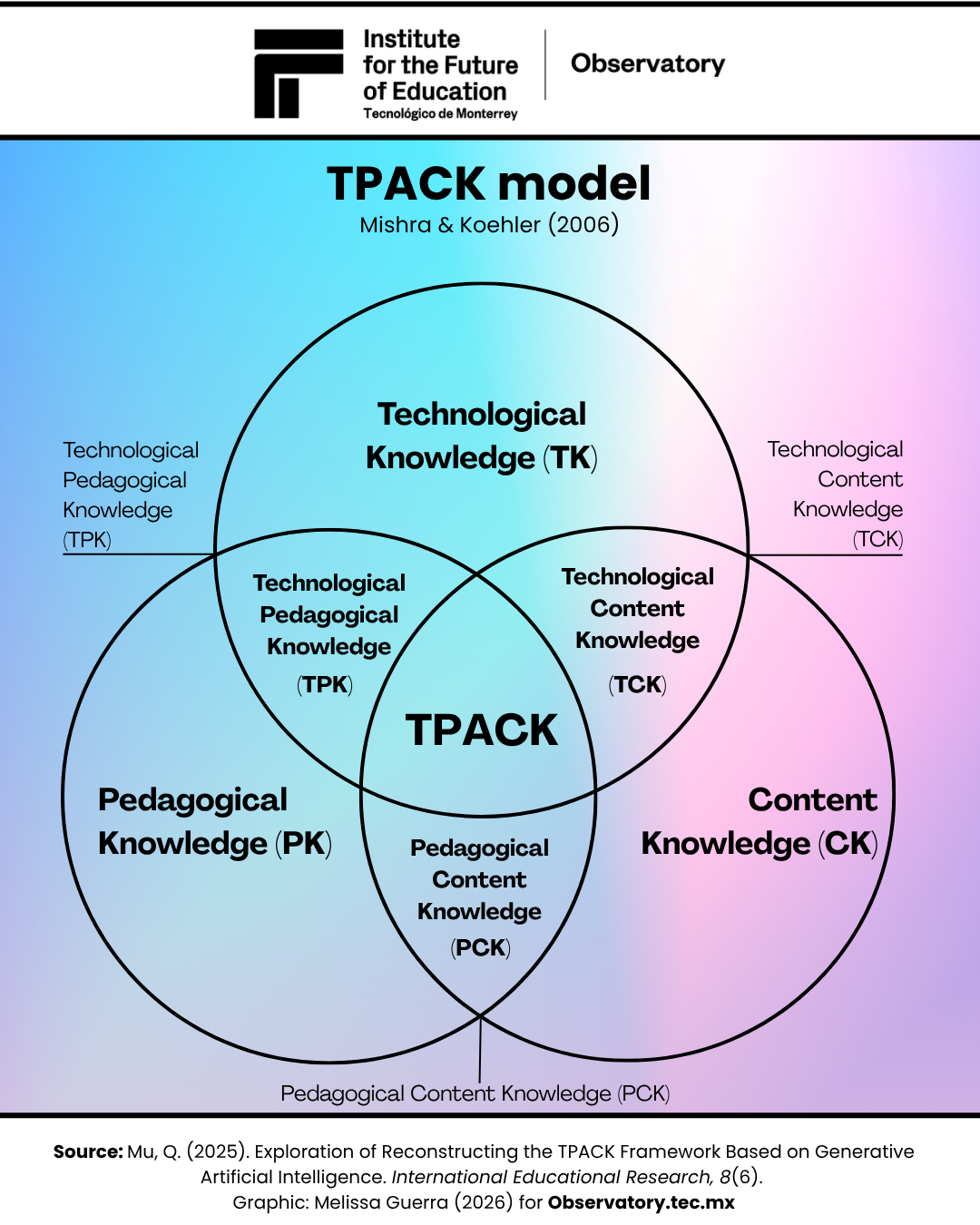
The model’s components are concisely broken down as follows (Moreno et al., 2019; Paidicán & Arredondo, 2023; Vijayatheepan, 2025):
Primary dimensions:
- Technological Knowledge (TK): the teacher must have literacy and digital skills to use technology (platforms, software, tools, etc.) in teaching practice. Thus, teachers must not only learn but also adapt to emerging technologies.
- Pedagogical Knowledge (PK): the teacher must master strategies, techniques, and methods for teaching and learning. These include classroom management, planning, and evaluation, among others.
- Content Knowledge (CK): the teacher must possess knowledge and skills related to the content taught and be able to devise appropriate strategies and approaches to transmit the content effectively.
Intersections:
- Pedagogical Technology Knowledge (PTK) is the knowledge of pedagogical strategies that can be implemented through technology, particularly in education (e.g., selecting appropriate classroom tools).
- Content Technology Knowledge (CTK): this is knowledge about presenting content using technology and understanding how its use affects the classroom.
- Pedagogical Content Knowledge (PCK): is the didactic knowledge of a content area; it involves knowing effective methods and strategies for successful teaching-learning processes.
TPACK model with artificial intelligence (AI)
The advent of AI has transformed education. Many teaching and learning processes, both in and out of the classroom, have been affected by generative AI. This has transformed the classic TPACK model into the AI-TPACK model, powered by AI.
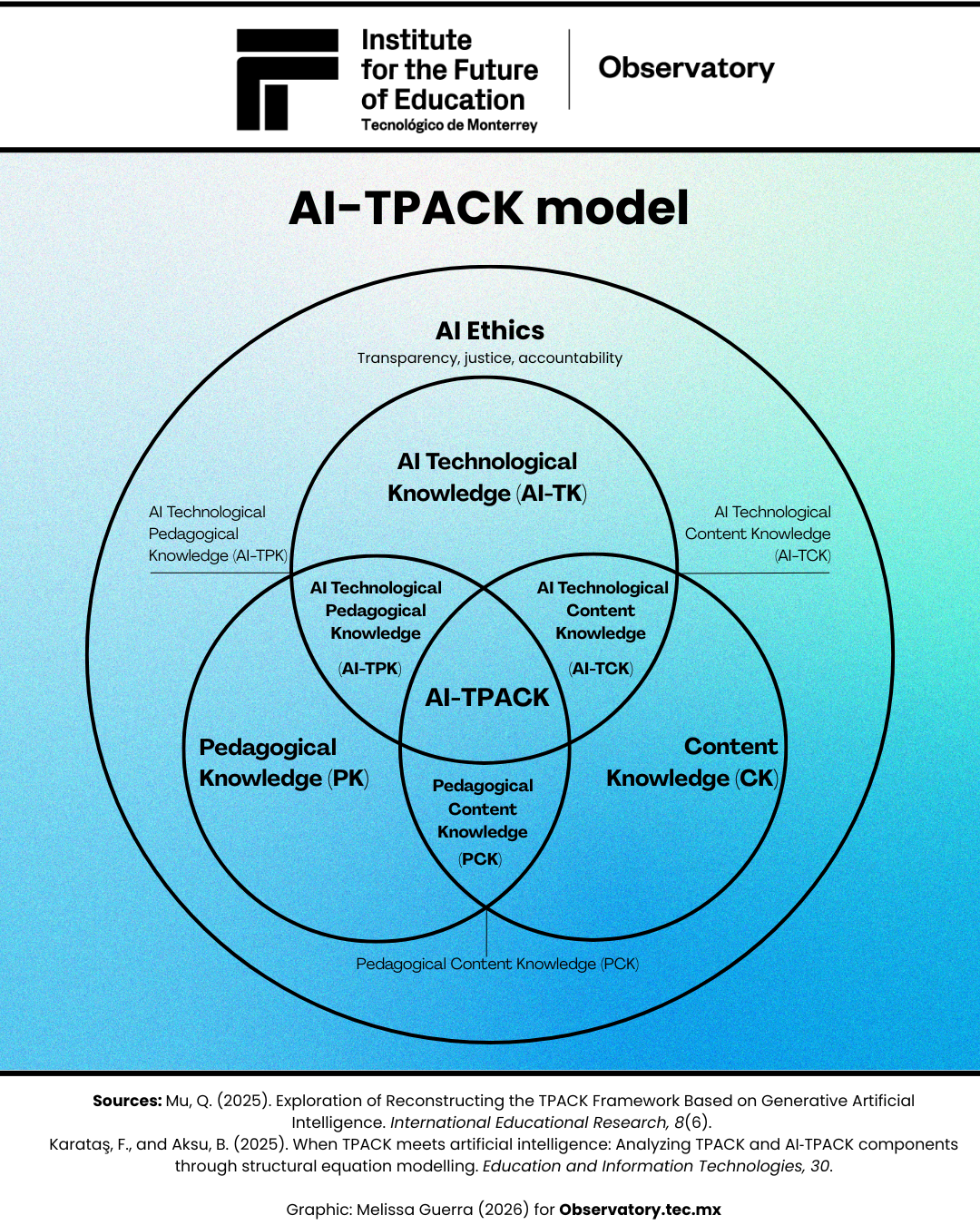
The elements of this AI-TPACK model are as follows (Karataş and Aksu, 2025; Mu, 2025):
- Technological Knowledge + AI (AI-TK): This refers to the technical and operational skills and knowledge required to manage and apply AI in a critical and responsible manner.
- Pedagogical technology knowledge + AI (AI-PTK): This is knowing how to recognize and reflect on the benefits and risks of AI in teaching and learning processes; it requires knowing which tools to use and how to use them. It has three dimensions: teaching strategy, classroom management, and learning assessment. The first transforms the fixed teaching process into managing generative AI for analysis and decision-making to create learning paths; the second involves using data efficiently to manage the classroom; and the third is AI-assisted assessment based on learning analytics to improve these processes.
- Content Technology Knowledge + AI (AI-CTK): This refers to knowing the implications of AI in specific areas and assessing its impact. AI is integrated across three dimensions: technical tools, content, and learning experience, and dynamic, multimodal, and immersive learning processes produced by the first two.
- AI Ethics: Emphasizes the need to employ generative AI ethically and pedagogically. AI ethics implies proper and responsible use with transparency, inclusiveness, fairness, and accountability. It also highlights the need to integrate ethical knowledge to guide the use of AI in education.
Thus, successfully integrating the TPACK model with intelligent systems requires AI literacy: understanding what AI is and how it works, how to interact with it appropriately, and the risks and benefits of its use.
Other TPACK variants
UNESCO (2023) notes that many discussions have focused on technology rather than education, leaving aside important issues such as equity and inclusion, educational quality, and efficiency. Consequently, a variant of the TPACK model seeks to address the areas of opportunity identified by the AI model: tool agency, epistemic challenges, ethical complexity, and dynamic collaboration. This is how HCAP (Human-Centric AI Pedagogy) emerged, which integrates literacy and AI skills as fundamental pillars (Chiu, 2026).
This variant adds two new variables: Human Collaboration Knowledge + AI (HCAI-K) and Ethical Knowledge (ethics-K). The first emphasizes AI as a collaborator that can assume different roles (tutor, co-creator, etc.) to increase human intelligence and avoid its replacement. Autonomy and originality should be promoted by integrating AI contributions while preserving critical thinking and creativity. The second involves understanding the ethical risks of AI in education, including bias, copyright violations, and misinformation. Under this model, which includes ethical knowledge, the teacher with AI literacy can audit tools to detect bias, use a protocol for data provision, and teach how to use AI ethically.
Finally, there is a TPACK model for inclusive online learning, called I-TPACK, which seeks to ensure equitable access to education and meaningful learning experiences for all students. In this model, the variant is Knowledge of Inclusion and Equity. It has six guidelines: develop awareness and practice self-reflection; know and adapt to students’ needs; diversify pedagogical practices and guarantee access; diversify content; create an inclusive digital learning environment; and foster collaboration at all levels (Saenen, 2024).
This last model is based on universal design for learning (UDL), a framework for intentionally and proactively planning, considering the significant diversity of students’ needs and preferences, and promoting proactive, meaningful learning. (If you want to know more about UDL, check out the article in the Observatory on this subject).
When designing learning experiences, it is always good to consider the available resources and analyze and reflect on what works for certain groups or subjects and what will not be very useful. Therefore, when employing technology in the classroom, the teacher must understand not only which tools will be used but also how they will be used and whether they serve a real purpose. Sometimes, innovation isn’t about using more AI but about knowing when and where to use it; this requires the teacher to be AI-literate and to decide how to implement it responsibly and ethically.
Moreover, the frameworks and models for implementing technology in the classroom must be flexible guides that account for the real needs of the teaching task. In the end, the teacher must establish rules for the use of AI in class, for example, how the tools will be used, whether they are allowed for certain tasks, and what percentage is acceptable (or not); i.e., they must manage the depth of interaction with artificial intelligence.
Translation by Daniel Wetta