
Yesterday I saw two videos that left me perplexed. In the first, an elderly Catholic monk spoke about guilt and forgiveness. His presence and voice were moving, and what he said convinced me. From his follower count, I knew he was a true influencer. Digging a little deeper into him, I came across a video by another Catholic influencer who explained something that ended up shaking me: that the old monk is a character created with artificial intelligence.
This second influencer makes a series of critical observations about the supposed “sage,” pointing out some challenges that artificial intelligence (AI) presents, saying, “First, we have to learn to discern what is real from what is not, and not to take for granted everything we see and hear is true.” He then adds: “In addition, characters like this do not clarify that they are AI, so they promote misinformation and, in addition, falsify identity.” Both observations seem apparent and yet, together they are not so clear; rather, they show the degree of contradiction – and anguish – behind this whole issue of “real” characters created with AI: on the one hand, we have to be cautious about things that seem real but may not be; on the other, our caution may be of no use in today’s environment, plagued by misinformation and misrepresentation.
To get out of the mess, the real influencer does what we all try to do in such a pressing and, at the same time, contradictory situation: he appeals to the authority of the one he considers can best resolve things – in his case, the supreme leader of his faith, Pope Leo XIV.
Leo XIV, participating in an event on communication at the beginning of the year, gave his position on the falsified reproduction of the human figure: “The face and voice are unique, distinctive features of each person; they manifest unreproducible identity and are the constitutive element of every encounter. The face and voice are sacred.”
The Pope’s viewpoint on the subject is significant because, in addition to being the religious leader he is, he is one of the few currently active international mediators (humble but firm, as he himself says).
A few weeks ago, the pontiff released an encyclical, that is, a letter addressed to the world, entitled Magnificat Humanitas (Magnificent Humanity), in which he explains the mission and position of the Catholic Church “in the time of artificial intelligence,” which he means as our current time. This text has its antecedents in that lecture he gave at the beginning of the year at the communication event, in which he presented his ideas about the production of the falsified human figure, as quoted above.
Although his starting point – the one I described about the face and the voice, which is the one used by the second influencer – is posed in theological terms, it parallels non-dogmatic philosophies, such as that of the German Ludwig Wittgenstein, who says that “the human body is the best image of the human soul.” (After I came across this phrase, I decided that the best example is the famous Vitruvian Man, by Leonardo da Vinci, the one who appears with arms and legs open, and legs closed at the same time; for me, the drawing reflects, better than anything in the world, the human spirit).
In fact, inside a body, we are all accustomed to perceiving a soul. Therefore, it is completely justified for the whole world to be scandalized by the possibility that artificial intelligence is creating false souls. However, we must stop and reflect on some things.
To begin with, the problem is not current. The theme of the representation of the body and its repercussions for a possible supernatural world likely lies in the origins of human culture. I say this because the issue is present everywhere: in cave art (according to some interpretations), in religions that prohibit this representation or restrict it (the issue was central to Protestantism’s opposition to Catholicism); in ancient myths (such as that of the sculptor Pygmalion, who fell in love with one of his sculptures and thus evoked divine intervention); in contemporary myths (that of Dorian Gray, whose portrait ages while he remains young), or in the refusal of indigenous people to be photographed because they see in it a kind of theft of the soul.
Perhaps the most significant, and most recent (at least for us Westerners) controversy over the specific issue of “soul-building” occurred in the Renaissance. Once again, I was perplexed to discover that, at that time, realistic portraits of people provoked controversy, much like the current one. At that time, those portraits were the major pictorial innovation, along with the discovery of perspective. A relevant example is that of Pedro Aretino —the brilliant writer—, who accused his friend Titian —the brilliant painter— of “deceiving nature” by creating figures that seemed to “breathe and speak,” and could cause an effect of idolatry in the viewer, by allowing him to confuse the image with reality.
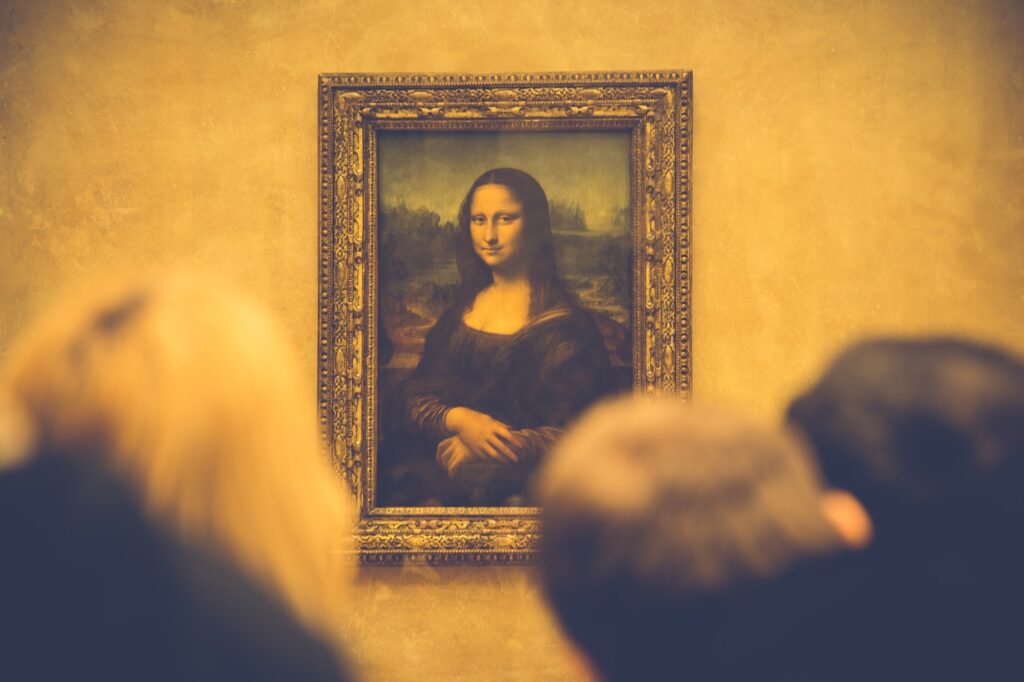
Seeing it this way, what would be the difference between the monk of artificial wisdom and Leonardo’s Mona Lisa, which continues to captivate us to the extent that some are uncomfortable in her presence when her portrait hangs in a room, feeling that her gaze follows them everywhere? Should we consider Leonardo’s realistic works, and those of many others, also as false souls? What would the pope have said at that time? (It is said that towards the middle of the seventeenth century, Pope Innocent III questioned the portrait that the great Spanish painter Diego Velázquez had made of him, with the words “Troppo vero!” (“Too true!”).
It will be said, with perfect logic, that there is a great difference between those paintings and the current AI characters, because, while back then no one was hidden and those were painted portraits, the influencer monk is being passed off as real. But we must consider that the logic that now allows us to think this way did not exist in earlier times, at least not in general. Back then, the existence of the supernatural permeated all thought, and only very timidly, very cautiously, did some doubts begin to insinuate themselves. A realistic portrait could certainly pass for an object with a soul and, therefore, as a being created in another dimension, even if its earthly concreteness had passed through the hands of a painter, who would have functioned only as a vehicle. (If this could happen with any portrait, imagine what it would be like with those of the saints, that they would be venerated as if they were there, present). The reproach, therefore, would have been very similar to that of today: the creation of images that pass for real fosters false links that replace true connections (then with transcendent reality, and today with real people).
Believe it or not, it took two or three centuries for critics to become convinced that realistic paintings had not captured the soul of the person portrayed, but were the expression of the painter’s soul. For this, it was necessary for philosophy to separate from theology and to propagate faith in personal “ingenuity.” Alongside this, in intellectual circles, the scientific proposal that nothing earthly comes from a transcendent reality triumphed, and that emotional phenomena, such as art, are the work of the psyche, in this case that of the painter. The belief in “inspiration” as a spiritual phenomenon would be replaced by that of the so-called “genius” and, finally, by that of “creativity,” much more individual, physical, and cerebral aptitudes.
Opposed to the aesthetics of the Renaissance (eager to capture the soul of everything), painters of later times set out to end the mirage and began to stylize the human figure. Moving away from realism, they wanted to show that a more personal, more subjective spirituality was expressed in their works. And when this spiritual trait finally gave way to science, the idea of faith was transformed first into that of imagination, then into that of personal point of view, and ultimately into the propagation of a critical and materialistic realism (no longer spiritual, as in the Renaissance).
But art can never detach itself from the psychic, that is, from the soul (anima/soul); and so, after that last disenchanted vision, after that ruthless realism (we are talking about the end of the nineteenth century), the soul turned again to the spiritual, although along a narrower, less “inspired” path: that of symbolism.
Now the transcendent (which was no longer “supernatural,” that is, it was not above the natural but at its base) was seen in reality through universal symbols (the forms of nature, artistic icons, language, mathematics…). Human beings were once again vehicles of that unfathomable something, becoming intermediaries. “Myths dialogue with each other without our knowledge,” said Claude Lévi-Strauss, the brilliant anthropologist who created structuralism. “Words think of us,” wrote a poet.
With the rise of physical science (which one day, without even knowing how, without itself knowing how, discovered the power that statistics has in shaping the universe), symbols – which still retained the warmth of wood… I mean, matter (sorry, but both words grow from the same root) – with that rise of physics, I mean, symbols became signs, then data, and finally information. It began to be thought that the latter was even in the appearance of the human, who turned out to be a kind of processor of the existent. Levi Strauss himself, in an interview he gave on the radio in 1977, described his experience as a materialist scientist, in this regard: “I do not have the feeling that it is I who writes my texts but that they are written through me; and once I’m transferred, I feel empty, as if there’s nothing left. I seem to be the place where things happen, but there is no self.”
Note that this description could well have referred to inspiration, so Greek and also so Renaissance.
And so, we come to the present day, where there is no real self either, but one that dissolves into information. However, this dissolution, in which “nothing remains,” is a parallel with mysticism, like its Renaissance counterpart, I repeat.
Let’s explain this by starting with the key question: if everything is information, who informs? Scientists, radicalized today as never before, believe that everything is physical and that the material universe either arose from nothing or has always existed. The other answer (equally unfounded) is theological: “God informs” (even if it seems like a newscast).
About the first, someone said, “If you believe that the universe could have come out of nothing, then you have more faith than I do.” And, as for the eternity of matter, Einstein certainly believed in it, but, sensitive to mystery, he allowed himself to be amazed, let’s say, mystically, by the universe, and accepted that there was something in it that would always be inexplicable (“In this sense, I am religious,” he added).
I, who think that something cannot arise from nothing, without being created, and I cannot believe that matter has always existed (just there, floating, meaninglessly, in the universe), am more inclined to the second option, that “God informs” (the German Karl Jaspers summarizes religious experience in a single sentence: God exists).
But beyond my personal belief, from either of the two mysticisms – the Einsteinian, of matter, and that of creation – it is possible to think that information could one day become beings who possess a soul. (If God created human beings in His image and likeness, why wouldn’t He want us to do the same?)
I dream – just as Spielberg did in his film Artificial Intelligence – of the appearance of mystical robots capable of populating the universe; although, unlike the filmmaker’s, mine would not leave humans behind, but, together with us, would make the journey.
If great artificially intelligent monk were the predecessor of those robots in which divine light and electronic light merge, I would gladly accept the deception, understanding that – perhaps, deep down – this is nothing more than how a soul begins to emerge, and which (even if it takes centuries or millennia to be born) must be cared for with the same devotion with which we care for our own and that of our fellow human beings.
But, beyond my personal belief, I can say that, from either of the two mysticisms – the Einsteinian or the theistic – it is possible to think of the existence of a profound mystery that informs the already informed human psyche, so that it can elaborate works called “art”; this mystery is still present, ready to permeate other psyches, present or future.
In his film Artificial Intelligence, Spielberg imagined mystical robots that populate the cosmos. I don’t believe that matter can develop a soul, but I do fantasize that, one day, humans, inspired by that ineffable mystery, will be able to spiritualize the world. Sometimes I think that this is our mission in the universe. Imbued with that fiction – or with that hope – I think that, if the monk of great artificial wisdom with whom I began this dissertation, were the predecessor of works in which divine light and electronic light unite (through our intermediation), I would gladly accept it, understanding the deception as part of the experiment and recognizing that, in matters of artificial intelligence, we are still in the dark, just a little more advanced than people were during the Renaissance.
Translation by Daniel Wetta