
In memory of José Alfredo Jiménez*, Mexican composer.
Years ago, I participated in an educational project for the prevention and treatment of serious addictions, such as opioid use. Thanks to that experience, I can say, with certainty, that one of the main problems of those who suffer from substance use disorders is the way we treat them. The studies clearly detail the mistreatment that these people receive in their environment, especially from the police authorities and health personnel. The studies, on the other hand, record very little of the affective ties that occur between people with an addiction, who often create communities that they consider their families: in them, they protect each other from external violence and from dying in cases of overdose, and they share all kinds of experiences. It is easy to discount these forms of relationships, reducing them to mere survival, to pure individual convenience… It is easy, I say, until one of the experts on the subject tells you, off the record, what he has experienced with those people up close, what he has seen them suffer, how they love each other, and all the pain he has shared with them over the loss of a colleague. (Let this serve as a small tribute to Dr. Clara Fleiz, an expert at the National Institute of Psychiatry in the Mexican Ministry of Health, who has favored me, telling me her experiences.)
One is even more moved by this pain when one thinks that the treatment we give to these people – belittling them and underestimating their identity – is nothing more than the exacerbation of the treatment that we human beings usually give to each other in our daily lives; that is, it is nothing more than an exaggeration of the same difficulty we have in recognizing the people around us as our fellow human beings.
In general, if we do not treat other people as we would like them to treat us (an ancient moral precept, and key to the majority religion in our countries) it is because we cannot conceive that these “others” are, in fact, similar to us; that is, we believe that, while we act of our own free will, with full awareness – yes, with pressures, but, in the end, freely, they do so in response to mere external stimuli, to unjustified impulses, without a clear purpose, or, at most, to imposed interests. While we, when we are in our car, make illegal turns or double-park for reasons that are clear to us (even if we admit that we are doing something wrong), “they” do the same, letting themselves be carried away by unconscious reactions. That’s why, precisely for that reason, it feels acceptable to shout nonsense at them: so that they realize it. Obviously (irony reaches its maximum!), it is not the same if someone shouts the same insult at us as if we did not know what we are doing!
Faced with that state of general anesthesia toward the other (a state we could call disability), alcohol and drugs affect our ability to perceive other people as our fellow human beings. Let’s take alcohol as an example. When I am drunk, I experience things as if, magically, the world is populated with beings similar to me, my brothers and sisters, whom I can approach.
“I love you very much!”
If it is said that “infants and drunks tell the truth,” it is because both live in a reality in which others can be trusted. The great misfortune is that those “others” who can be trusted, sooner or later, disappear: in the case of childhood, with age, and in the case of drunks, as soon as the water level drops and the hangover comes (in Mexico, when they return to the harsh reality). Finally, misfortune turns into tragedy when this sudden disappearance of our fellow human beings is too painful, and we must consume new doses for them to reappear.
It is difficult to accept that alcohol and drugs facilitate sensitive approaches, opening us to empathy and to the authenticity of the other, even if it is ephemeral. Some substances even induce spiritual experiences in which we recognize ourselves and others as part of the Whole. This sensation of ecstasy, although it can be achieved through a process of personal growth, is much easier to achieve through the drug of the same name. (Countless testimonies allow us to infer that opioids such as heroin and fentanyl induce states of peace that, at times, are close to the mystical experience.)
The fact of being induced does not diminish the reality of the experience. The problem is that the fullness lived, although genuine, is provisional and temporary, and once it ends, we return to the previous state of solitude: Consumption did not leave any lasting trace inside us. On the contrary, the absence is now greater, and its increase requires progressively higher doses (technically, this adaptation mechanism is called tolerance).
Over time, the coming and going from the sea and the undertow (which addicts to hard drugs call malilla), that magical appearance and disappearance of beings we can trust, that painful transformation of our fellow human beings into strangers, sap our strength for seeking and establishing lasting relationships and continuing to grow. The great José Alfredo Jiménez, (a Mexican composer who, as they say, needs no introduction) describes it, in many songs, with as much simplicity as depth: After the drunkenness, already in the hangover, in the disenchanted world of the hangover, the person with an addiction is sad because he knows that one day, when he gets drunk again (perhaps tomorrow), he will have to suffer again the brotherhood – and the loss – of beings as adorable as they are ephemeral.
The years have taught me nothing,
I always fall into the same mistakes:
Once again to toast with strangers…
and to cry over the same pains.
We live fleeing from our fellow men, which is nothing less than running away from ourselves.
*
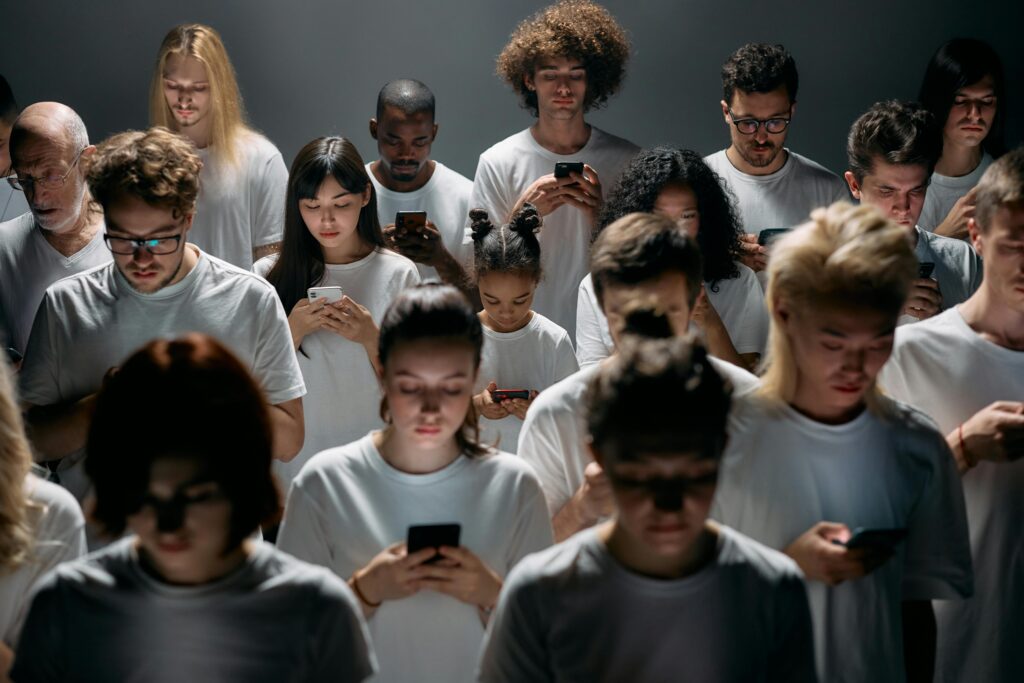
All of the above lead us to discuss the use of electronic devices. It has been shown that the abuse of social networks and virtual games – the latter already officially classified as a psychiatric disorder – produces in the human body the same rewarding substances as drug-induced experiences.
Undoubtedly, as with any addiction, the addiction to virtual content harms us, but we must be clear, once again, that the problem is not the intrusion of technology, but the growing depersonalization of our relationships and the increasingly widespread belief that we should not identify with “strangers.”
This devastating dehumanization should, in fact, be the central theme in our discussions about the current technological age, which, if it has done anything important, has opened up new opportunities for relationships for all of us.
Humans born in the last century find it difficult to realize that, since the first decade of this century, the advent of social networks has opened another world for all of us; much like how printed books once opened Wonderland to many people, virtual platforms now give us access to an extraordinary reality. This Virtual Galaxy is the successor to the Gutenberg Galaxy.
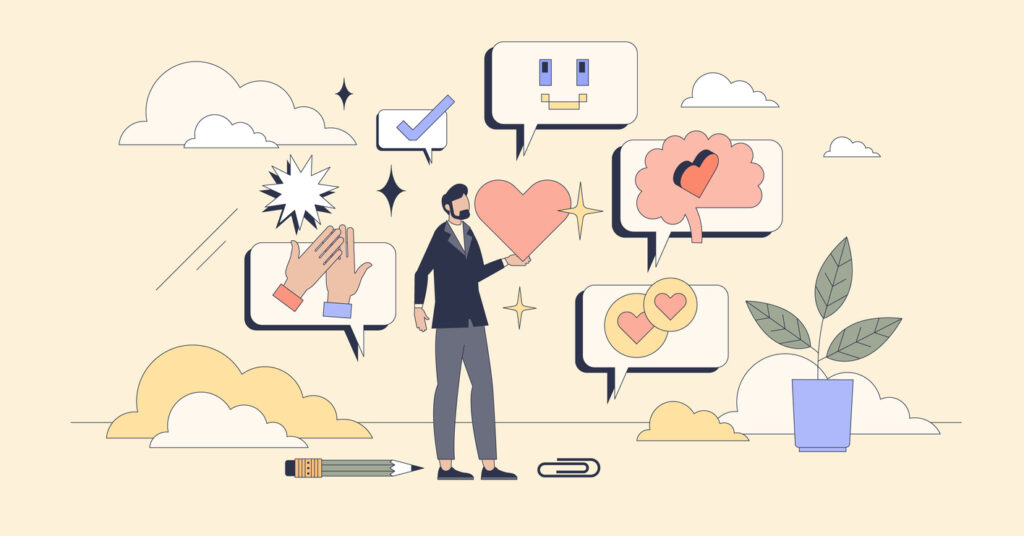
In this new space, recently discovered and barely explored, human beings (yes, everyone, not just young people) achieve true interrelationships through writings and images; we express emotions and intentions in small icons. We translate our presence and our feelings of approval, rejection, anger, or fascination into likes, hearts, and angry faces. We witness daily that digital communication is being refined, incorporating virtual gestures, mannerisms, and attitudes that increasingly align with real ones.
A new threshold has been opened. First, they were windows and then real portals. Is this a truly different space – perhaps a successor to the city, as we know it – in which distances are traveled at the speed of light? Before, the soul “flew” through letters and handwritten messages; now, it travels to the other and touches his soul, and even his body, with luminous words, images, and sounds (the encounters are less carnal, in fact, with all the disadvantages and advantages that this brings: ah, the joyful flesh, the hindering flesh!).
However, as we have said, and as is obvious, these new relationships run the same risk as all others: that of entering into the dynamics of addiction, that is, that of temporary approaches that can only be sustained by compulsive repetition. Being human, the virtual world has no reason to lack depersonalization or the worst vices.
It is a fact that, abusing our vulnerability, the owners of virtual platforms – as well as drug producers and distributors – induce us to remain on them, for their benefit. However, if we dig a little deeper, we will see that these platforms become addictive by appealing to our natural propensities, that is, exacerbating our needs, although, of course, always satisfying them according to what suits their owners, such as certain products on the market or particular political affiliations (we are talking not only about gambling platforms and virtual casinos, but also well-known social networks).
The most common mechanism of induction is well utilized. With an infinite number of variants and nuances, its primary objective is to provoke suspense (“leaving us hungry,” which, as we well know, is a very effective seduction). That is, they design intensely emotional experiences and leave us suspended at their highest point, putting us on the edge of our chairs, our eyes glued to the screen. It is even possible (and this would be a novel conclusion) that they do not break our willpower, as is often claimed, but rather leverage it and promote it in their favor, appealing to it so that it remains vigilant.
Suspenseful experiences (as long as they remain tolerable) fascinate us all. (Consider not only thrillers and detective novels, but also the expectation of the likes in our posts and the response to our messages). Unfortunately, in the absence of a family, school, and social reality that provide us with other, better, or at least comparable satisfactions, these experiences tend to provoke pathological attachment, able to continue beyond what is healthy.
This induction strategy is clear and transparent. There is nothing extraordinary or hidden in it. Experts use their creativity to devise plots or designs that hook people and allow the greatest number of pauses to advertise and increase anxiety and addiction. However, perhaps to deny the responsibility of those who become addicted, such an explanation is usually replaced by another that is quite imaginary and paranoid, a prevailing one: Thus, most of us, when we talk about “manipulation,” think of monstrous people who invent inhuman content of unprecedented perversion, which, quickly and without us realizing it, takes over our minds, bodies and will, like electronic vampires.
These fantastic versions are not only found in popular imagination but are also expressed in scientific terms, with explanations that, after detailing very specific neurological processes and reactions, affirm that the design of the platforms enables a true construction and reconstruction of our personality. The web “forms” the “Self,” it is explicitly said (as if we already knew for sure what the Self is, and, worse, as if it were already well located in brain functions!).
Thus, what we are saying now aligns with what we said at the beginning. A person with a “Self ” formed externally, a “Self ” reconstructed with induced information and obsessions, is just like those people we were talking about: people who, without the slightest awareness, park their cars in forbidden zones and act unjustifiably; who are incapable of making free decisions, forcing us to shout at them to come to their senses.
However, if we are willing to attribute to others—even drug addicts, or whatever—a “Self” like ours; if we are willing to consider them our fellow men, we will realize that all we have believed is a mistaken fantasy; that no human being in the world is altogether foreign or unknown to us; that no one is, really, unconscious; that no one ever escapes consciousness or the real world; that no one is empty, or absent, or out of his mind, or lives on the peripheries of his personality; that “each person is a center,” as Françoise Dolto says.
Our Self is not an entity that is formed. It is our essence, something that simply is. Nothing and no one can build us or rebuild us. We are beings in a perpetual state of self-knowledge and, of course, in the process, we allow ourselves to be influenced by external factors. Thus, in search of greater well-being, we often fall into nets that make us think that we are better inside them than outside. Inside, we experience a kind of drunkenness, an intoxicating fluidity of our relationships with others and with ourselves, which leads us to run the risk of addiction.
But within this panorama, many of us remain alert, trying to preserve our authenticity and create lasting bonds with virtual comp@nions, establishing commitments with them, and holding ourselves accountable; caring for them, trying to know and respect them, and making them feel that they count on us.
Thus, facing life’s risks and opportunities, we leverage all the value that digital spaces offer us, accepting them as our new world.
I, for my part, on a personal level, join José Alfredo Jiménez to serenade my wife under her virtual window.
(*Note: José Alfredo Jiménez is a famous Mexican singer-songwriter of ranchera music.)
Translation by Daniel Wetta