


Academic integrity is a key issue in education, as it fosters the development of ethical values and behaviors, both personally and professionally. As a teacher, one of the many tasks in the classroom is to promote integrity, ethics, and values. However, there are many challenges to ensuring educational quality because academic dishonesty is just a prompt and click away.
Although generative artificial intelligence (AIgen) has emerged as a tool to support teaching and learning processes, it has also become an obstacle to education. In Mexico, not only are there no approved guidelines for education, but there is also no current regulatory framework governing it (only legislative initiatives have materialized). This means that many AI models and systems do not comply with safeguarding data privacy or user security, or that they simply apply ethics washing, that is, practices, in this case, ethical, that are carried out to improve the perception of a person or organization, but without implementing changes.
Although there are many consequences of the misuse of AI in education (cognitive dependence, cognitive debt, academic laziness, etc.), this paper focuses on the integrity of education in the age of artificial intelligence.
What is academic integrity?
According to the Cambridge Dictionary, the word integrity means “the quality of being honest and having strong moral principles that you refuse to change”. However, there is no consensus definition of what academic integrity encompasses; the term is usually associated with academic conduct, virtues (trust, justice, character, integrity), and values (honesty, fairness, respect, responsibility, etc.) (Mejía and Garcés, 2025).
Other authors, such as Șercan and Voicu (2022), define academic integrity as respect for intellectual property, moral and ethical standards, and rules of conduct (as cited in Balalle and Pannilage (2025). For their part, Sbaffi and Zhao (2022), as cited in Balalle and Pannilage (2025), describe it as commitment, honesty, and moral behavior in the academic work of students and teachers.
Within academic practice, academic integrity seeks to prevent plagiarism, fraud, cheating (whether analog or digital), the illegal sale or reproduction of materials (such as exams), bribery to obtain better grades, and, more recently, ghostwriting and AI writing (Balalle and Pannilage, 2025).
The impact of generative AI on academic integrity
A study by Ruskulis et al. (2026), titled: An Academic Text: The Balance Between Academic Integrity and Artificial Intelligence,” found that 76% of respondents (higher-education students) consistently use AI for academic tasks, with ChatGPT (65%) preferred over other tools. That study also revealed that students themselves perceive over-reliance on AI as a violation of academic integrity. This suggests that a more ethical and responsible approach is needed; efforts are required to foster AI literacy and to create and implement transparent, well-defined institutional policies that preserve academic quality and integrity.
As mentioned in other Observatory articles, copyright (author’s rights) when using AI tools remains a major topic of debate. In this case, many students use LLMs such as ChatGPT, Claude, and Gemini to produce text instantly, thanks to the development of prompts and specialized agents (bots) for text-generation tasks.
When using these, the student’s only “cognitive” effort is to create the command, since the AI does all the work of searching, analyzing, and synthesizing the answer. In this scenario, the student makes errors of omission and commission; that is, when they accept the information as valid and incorporate it into their work (omission) and, secondly, when they are not able to identify that there is a critical problem with said information, either because they did not have the initiative to review it or because the AI did not indicate it to them (Watts, 2025). This also leads to the deterioration of cognitive processes (cognitive debt), i.e., underlying critical thinking, decision-making, and other essential skills suffer a cumulative loss of function. In addition, this work habit increases cognitive dependence.
Many experts argue that AI lacks the understanding, critical thinking, and intuition to produce authentic work, raising concerns about academic integrity, as these capabilities do not reflect the author’s ideas and essence and, in turn, diminish originality and ethical behavior (Currie et al., 2023; Balalle and Pannilage, 2025; Bittle & El-Gayar, 2025). Likewise, authors such as Currie et al. (2023) point out that the use of generative AI to commit academic fraud directly affects institutional quality indicators.
Consequently, the risks of AI to academic integrity are reflected in increased academic dishonesty, such as fraud or cheating (especially in unschooled programs), as well as the creation of sophisticated, undetectable ghostwriting texts. It is also important to remember that these systems can yield biased results, violate privacy, be used improperly, and lead to academic laziness and cognitive dependence when not properly managed (Bittle and El-Gayar, 2025).
Moreover, some authors point out that not only is there a problem of academic dishonesty caused by AI, but that these systems also generate an unfair advantage over students who do not have access, leading to an inequitable assessment of knowledge (Cotton et al., 2023; Sullivan et al., 2023, as cited in Ruskulis et al., 2026).
Challenges and implications of AI on academic integrity
Gulumbe et al. (2025) present some challenges and possible implications of AI’s effect on academic integrity:
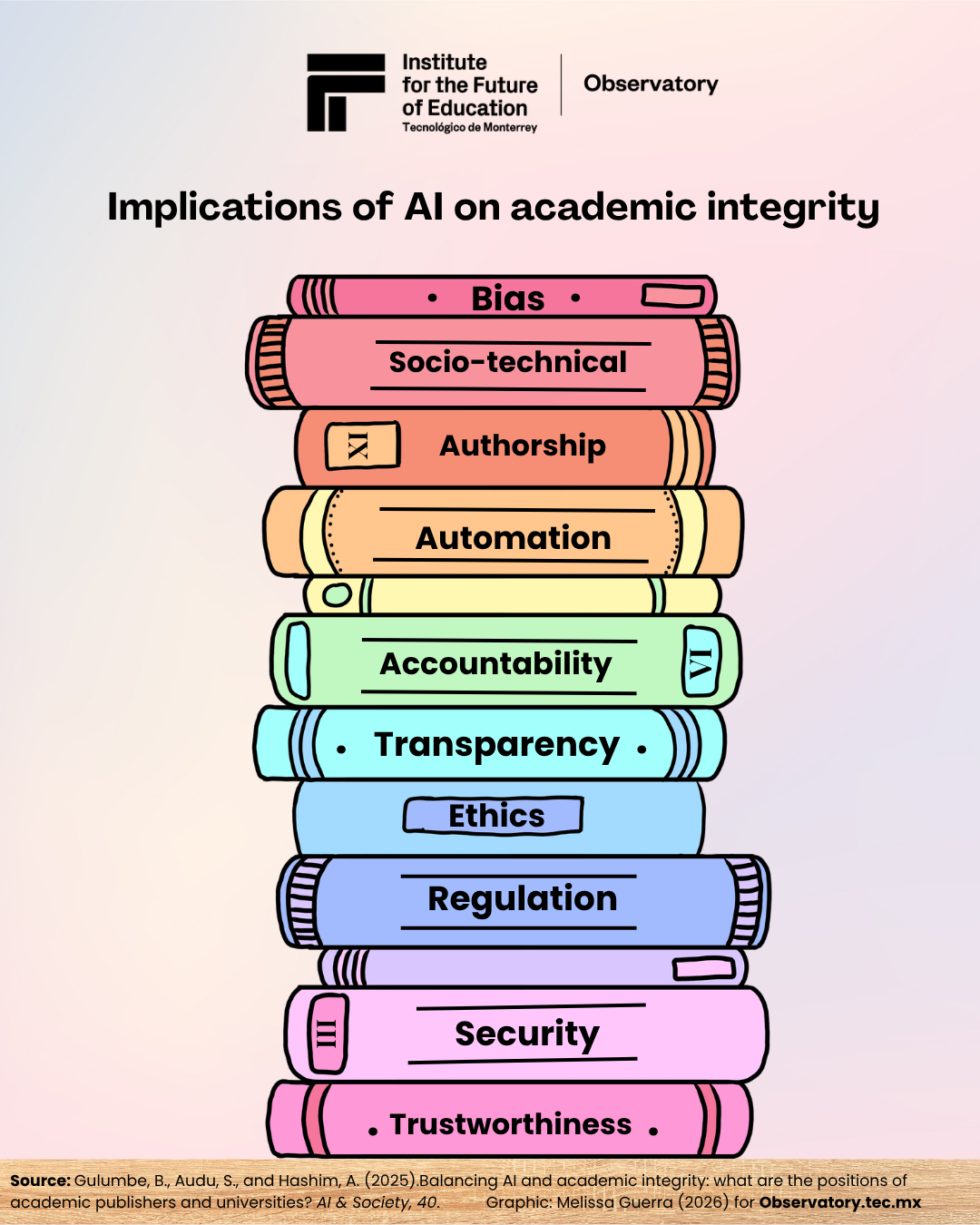
The socio-technical implications refer to the potential disruption of AI in the interaction that humans have with technology; bias due to the predictability of these systems; authorship, since the use of content generated by LLM is a risk to integrity and copyright; regulation, since there are no approved regulations (as in Mexico, where there is no law that regulates AI) that prevent AI from being created for unethical purposes; automation, since it reinforces the culture of convenience and reduces intellectual contribution.
Aspects such as safety, reliability, accountability, and transparency constitute the ethical frameworks these systems must comply with to ensure ethical development and implementation. In the case of academic integrity, security refers to the potential use of AI to commit academic fraud and data breaches; trustworthiness refers to the loss of trust in these systems, i.e., when there is a lack of transparency (when AI decision-making cannot be trusted because algorithms are not understandable or visible); and accountability refers to ensuring the accountability of AI in an academic environment, as well as the proper use of systems.
Actions to ensure academic integrity
Here are some actions to strengthen academic integrity within academic processes (Bittle & El-Gayar, 2025):
- Develop and validate AI detection applications or systems.
- Create guidelines and regulatory frameworks for the use of AI in education.
- Reevaluate and design evaluation methods that promote critical thinking.
- Investigate the impact of generative AI on diverse student demographics to ensure inclusion.
Ensuring academic integrity in the age of AI is complicated, as it is not only a matter of upholding ethics and values, for example, in the completion of assignments, but also across all teaching-learning processes. To teach in this new era, the teachers must have AI literacy, access to quality tools, as well as an institutional (and faculty-level) framework or guidance on what does or does not apply when using AI; for example, what percentage of AI can be used to complete assignments, and what is not acceptable?
Moreover, when planning, teachers must realize that students will likely use AI to perform tasks, so it is necessary to modify activities so that, rather than copying and pasting, the students must corroborate the information they receive from these systems and (for example) discuss ideas in class so that they employ more complex cognitive processes (evaluating, analyzing) and not just remembering or understanding.
Other modifications can include carrying out analogous (unplugged) activities, oral activities, debates, or other tasks that promote critical thinking, decision-making, and other critical skills. It’s a good time to rethink education and the role AI should play in the classroom. Although it is a useful tool, like everything else, it must serve a purpose and not just fill a space or create the perception of “innovation”. Education should not conform to AI; AI should conform to education.
Translation by Daniel Wetta