


Previously, in the article The Environmental Cost of AI, we explored the environmental impact of artificial intelligence, particularly its energy consumption, carbon footprint, and the types of emissions it generates. In this article, we investigate the water footprint of AI and its repercussions for the environment and the communities where the data center complexes are located.
According to UNESCO’s 2025 report, Mountains and Glaciers: Water Towers, the agricultural sector currently dominates freshwater withdrawals (72%), followed by industry (15%) and domestic use (13%). In addition, it states that withdrawals have increased in cities with high economic growth (14%), highlighting that, in higher-income countries, water is mostly used in the industrial sector. In contrast, in lower-income countries, it is used in agriculture (UNESCO, 2025, as cited in Kashiwase and Fujs, 2023).
However, when discussing AI, we do not immediately think about water consumption but rather about energy – specifically, the excessive amount of electricity required to train AI models, which need data storage in large data centers, the energy demanded for their operations, and the resources (often non-renewable) required to generate the electricity. However, investigations often overlook the amount of water required for their operation.
To put it in context, in 2024 alone, Google consumed 31 million cubic meters of water, equivalent to irrigating 54 golf courses in a year. However, this consumption occurred in regions with abundant water resources, that is, with a low risk of water depletion or scarcity.
Google reported that, as the company continued to grow, water demand increased by 28% between 2023 and 2024. For its part, Microsoft reported in its 2025 Environmental Sustainability Report: Accelerating progress to 2030 that its water consumption and extraction have also increased due to growth. In 2024 alone, more than 5 million m³ were consumed, and more than 10 million m³ of water were extracted.
What is a water footprint?
The concept of the water footprint emerged in 2002 with Professor Arjen Hoekstra, who later, in 2008, founded the Water Footprint Network to address the water crisis and make it visible. It is defined as “the total volume of fresh water used to produce goods and services consumed by individuals or communities and/or produced by companies” (Chapagain, 2017). Therefore, it is an indicator of water consumption and pollution, tagged by its geographical location.
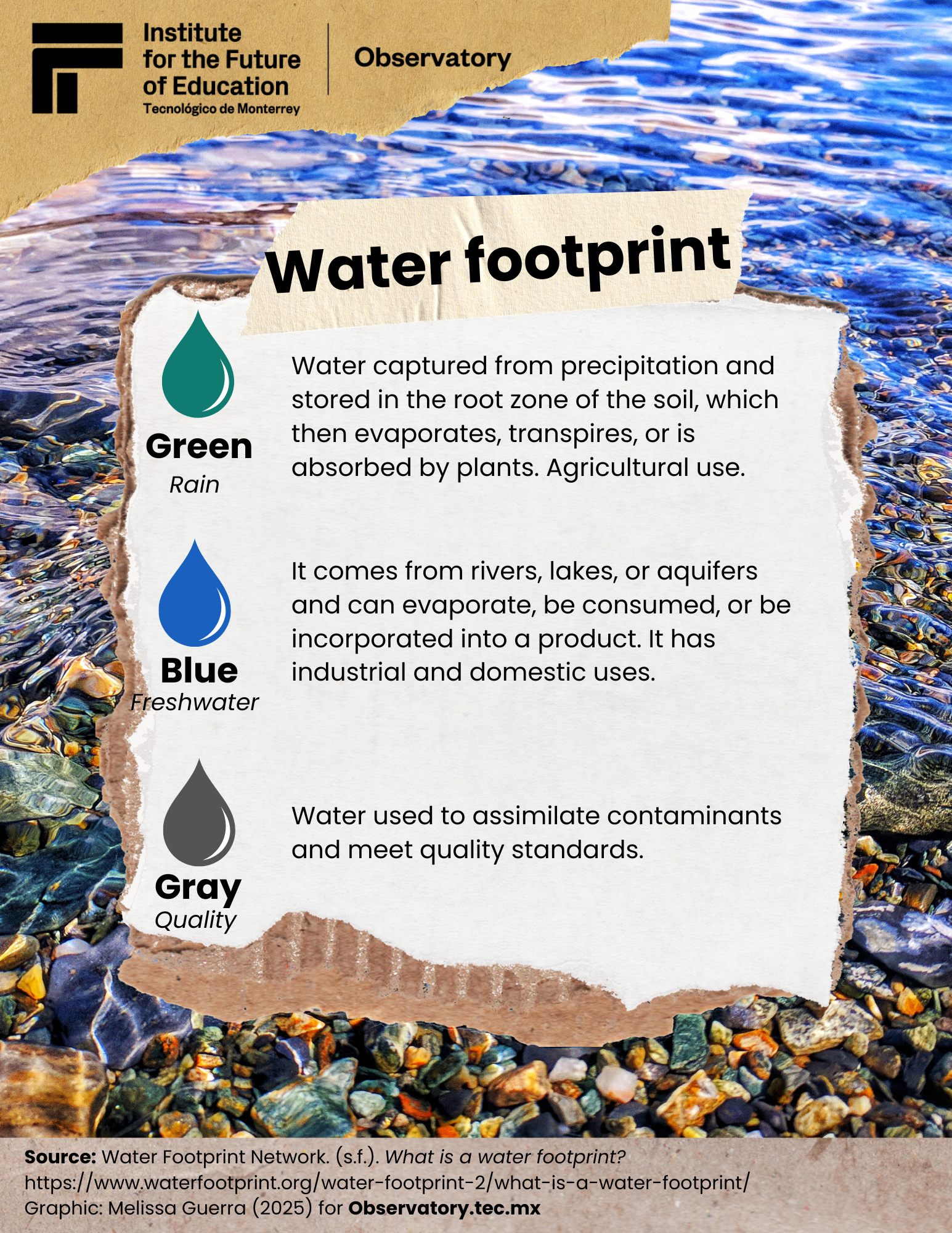
According to the Water Footprint Network, there are three types of water footprint, depending on the water’s origin:
AI and water consumption
Data centers and AI require much more than just electrical power to operate. Therefore, to measure the water efficiency of data centers, the Water Usage Effectiveness (WUE) must be calculated, using an equation that divides the total water consumption for cooling and humidification systems by the annual energy consumption (Vries-Gao, 2026):

In this consideration, data center water consumption falls into three categories: cooling (direct use), energy (indirect use), and supply chain (Li et al., 2025; Barnett-Itzhaki, 2026, as cited in Yáñez-Barbanuevo, 2025).
Cooling systems
All data centers require cooling systems to prevent overheating-related interruptions, as they generate large amounts of heat when operating 24/7.
Therefore, to cool the servers, it is necessary to transfer the heat to a specialized installation or to a heat exchanger by air or liquid cooling. Liquid cooling is required to cool AI servers due to their high power density (Li et al., 2025).
The operations require heat to dissipate to the outside of the data center. Cooling towers that use air-assisted cooling and water evaporation are used for these processes. The cooling towers require a continuous supply of fresh water; they prevent the accumulation of minerals, salts, and bacteria, and compensate for water that evaporates or is discharged. Evaporative-assisted cooling, on the other hand, uses water in the outside air. When the air is very hot, they must “drink” water to compensate and control the humidity. With this method, the water demand can be increased when the outside air is very hot and dry (Li et al., 2025).
Electricity generation
Many data centers use thermoelectric energy, generated by water vapor that produces pressure and drives turbines. This implies considerable water consumption to generate this type of energy, which can be up to 4 times that of cooling systems.
For example, Meta (Facebook) consumed 3.7 l/kWh* in 2023.
*Liters per kilowatt-hour, i.e., the amount of water needed to generate electricity or dissipate heat.
Supply chain
The supply chain involves the manufacture of AI materials and servers, which requires ultrapure water to be free of impurities that could damage the manufacturing process. However, obtaining 3.7 liters of ultrapure water requires 5.6 liters of water.
However, water is used in the supply chain both to manufacture chips and to cool semiconductor plants. To give an idea of the immense amount of water required for chip manufacturing, more than 37 million liters of ultrapure water are needed per day on average.
The supply chain water footprint also considers water contaminated by chemical substances or hazardous waste. Apple reports that water consumption in its supply chain accounts for 99% of its water footprint.
Training and inference
According to Barnett-Itzhaki (2026), artificial intelligence workloads, i.e., the training and inference processes of these systems, also intensify water demands.
Recall that AI models require electrical power to train and operate. Currently, increasing energy demands correspond to the scale of parameters, that is, the configurations or values that models utilize during their training, which are adjusted when modifying how they process information and generate responses, as well as to adapt their behaviors. It is predicted that by 2028, AI electricity consumption will exceed 150 trillion watt-hours (TWh) in the United States alone.
Likewise, AI requires water for training. A significant example is the GPT-3 model, which has 175 billion parameters and consumes 5.4 million liters of water during its training (which involves cooling the servers and the data center, as well as producing the necessary electrical energy, etc.). Similarly, the end users of AI consume water when using it; this is called inference.
The environmental and social impact of AI
Studies such as Gour et al. (2026) note that data centers pose health risks due to air pollution, excessive water use, noise pollution, and soil alteration, which affect ecosystems and communities. Here we briefly examine some of them.
Water
The International Energy Agency (IEA) estimated that in 2023 the AI sector consumed 560 billion liters of water (373 billion in indirect consumption, 140 billion in direct consumption, and 47 billion in supply chain consumption).
Meanwhile, a more recent study on AI and its environmental impact found that the technology consumed about 765 billion liters of water in 2025, surpassing global bottled water consumption. Another specific example is that, on average, a hyperscale data center can consume between 11 and 26 million liters of water per day in cooling systems alone (Tao & Gao, 2025).
An important factor in water consumption is geographical location, since many data centers are located in areas with high water stress or in arid areas, where water is less accessible. For example, in the municipality of Colón, in the state of Querétaro, Mexico, Microsoft established a hyperscale data center amid a severe drought that was forcing its inhabitants to rely on tanker trucks to survive, while water was diverted to Microsoft facilities.
Li et al. (2025) point out that although the water footprint of agriculture is larger, it is mainly green, whereas that of AI companies is blue (including wastewater discharge from cooling systems, which degrades water quality), representing significant water stress for many communities, such as that of Colón.
Noise pollution
A major problem for ecosystems and communities is the noise pollution from AI and data centers, mainly from diesel generators and heating, ventilation, and air conditioning systems, which emit continuous noise.
The noise levels generated by data centers can exceed 90 dB (decibels), and within the racks where servers are housed, they are even higher. To put it in perspective, the WHO recommends keeping noise levels below 30 dB(A) at night to avoid affecting sleep quality. In addition, this body notes that persistent noise impairs cognitive performance, diminishes well-being, and can affect blood pressure. Other effects include decreased productivity, tinnitus, permanent hearing loss, endocrine disorders, and stress, among others.
Recently, multiple communities in the United States, such as Dowagiac, Michigan, have reported that the noise generated by these centers is unbearable, to the point that residents do not want to open their windows. In addition, the area reportedly experiences frequent power cuts and high electricity bills.
Another example is Elon Musk’s recent project, Colossus, in Memphis, an AI supercomputer to train Grok. According to The Times, this project will consume 1 million gallons of water per day and 1.1 gigawatts of electricity to operate. In addition, Colossus uses 30 (apparently temporary) gas turbines that generate excessive noise and environmental pollution.
Infrasound
Apart from noise, data centers also generate infrasound. This frequency is below 20 Hz, so it is imperceptible to the human ear; however, these vibrations can have significant harmful effects, including dizziness, nausea, headaches, sleep problems, and anxiety. Thus, infrasound can affect people’s mental and cognitive states.
Other impacts
In addition to the aforementioned effects, data center emissions pose a public health problem. According to a study by the University of Riverside, Caltech and Rochester Institute of Technology (RIT) entitled The Unpaid Toll: Quantifying and Addressing the Public Health, data centers (due to the manufacture of chips and their operation) “contribute substantially to the degradation of air quality, which results in high costs for public health.” This includes PM2.5 particles, which can cause serious health problems (Han et al., 2025).
An example of these effects was studied at the Vantage Data Center in Virginia, which uses gas turbines to operate. The studies estimated that there will be “between $53 million and $99 million in annual health damage from associated air pollution, which is one of the largest estimates of health damage assessed to date for a single facility.”
What measures are being taken to mitigate the water footprint?
Although large companies such as Google, OpenAI, Microsoft, and Amazon, among others, indicate in their sustainability reports that they are pursuing strategies and measures to mitigate environmental damage (air pollution, water footprint, carbon footprint, etc.), many are not 100% transparent about their environmental impact. (Others do not even disclose this information.) Thus, one area of opportunity is for them to provide clear accounts of the resources they use and how they use them.
Among the strategies proposed by these organizations are the following:
- Improve cooling systems using direct-to-chip liquid cooling technology to mitigate water consumption. This system does not rely on evaporation and recycles water, so it dissipates heat without requiring additional water.
- Replace more water than is consumed.
- Improve data center efficiency to reduce water consumption (water positive).
Other measures that seek to alleviate water stress, such as immersion cooling, in which servers are immersed in a liquid synthetic that conducts heat (but not electricity), are not widely used due to their high costs. China, for example, is considering submerging data centers in the ocean to avoid water consumption by using the ocean’s cooling and reducing electricity consumption by 30%. However, this solution could cause other problems in the future, especially for local ecosystems (flora and fauna).
Various studies, such as that by Pimenow et al. (2024), indicate that AI and machine learning can improve energy efficiency and mitigate environmental impacts. However, they also highlight the duality of these tools, as training AI requires significant expenditure of economic and natural resources, which is at odds with the premise of mitigating environmental impact.
For their part, Wright et al. (2025) note that improving system efficiency should not be the sole focus, as it cannot, on its own, improve environmental sustainability.
There are more than 5,000 active data centers in North America, representing 48% of the world’s data centers. In the United States alone, there are more than 4,000, of which 54% are hyperscalable, located mainly in Virginia (665), Texas (413), and California (321).
On the other hand,Mexico has 79 active data centers and, according to the Mexican Association of Data Centers (MEXDC), this number is expected to increase. These infrastructures are (or will be) mainly in Querétaro, Monterrey, Guadalajara, Mexico City, and the State of Mexico.
Undeniably, generative AI improves efficiency and automation (among other benefits), but it also poses serious problems for the environment and public health. While the government bombards us with campaigns to save water, the CEOs of big tech companies slowly take control over everything in their path, without facing any consequences.
Although it is difficult to measure these negative impacts fully, we must be more aware and responsible in our use, since a problem does not seem to be a problem until it is ours.
Translation by Daniel Wetta