
Service-Learning (SL), a pedagogical methodology that integrates learning with social commitment, makes it possible to serve the community while studying curricular content. Through service projects, students learn while participating in altruistic, solidarity-based programs that meet real community needs.
Nieves Tapia, Director of the Latin American Center for Solidarity Learning and Service (CLAYSS in Spanish), explains this concept simply: planting a tree in a place that needs reforesting is an act of solidarity, while analyzing the causes of forest degradation is a learning activity. However, getting involved in reforestation and applying the acquired knowledge makes this experience an example of Service-Learning.
The literature defines SL as an approach that uses experiential learning because it contributes to a person’s holistic development, empowered through their own development and that of their community.
This methodology has spread worldwide since 1960, originating from the civic concerns of the philosopher John Dewey and the premise of the pedagogue Paulo Freire that the world can be transformed through reflection and action. Although it was systematized in the United States at that time, it began to spread throughout Spain around 2004, resulting in the creation of the Spanish Network of Service Learning.
However, it is difficult to find a common definition for this methodology. In the last two decades, the most cited is that of Robert Bringle and Julie A. Hatcher (1999): “A credit-recognized, course-integrated educational experience in which students participate in an organized service activity that responds to identified community needs; they reflect on their activity to deepen their understanding of course content, gain a broader perspective of the academic discipline, and strengthen their sense of civic responsibility.”
According to psychologist David Kolb’s (1984) experiential learning cycle, students understand better when they go through four phases of learning: specific experience, reflective observation, abstract conceptualization, and active experimentation.
In a Service-Learning environment, students apply their skills and knowledge to do something meaningful, adding value to their learning process. That is why, when evaluating this method, one must consider the learner’s level of interest and the impact on the educational institution and/or the community. This can be done using tools such as questionnaires, interviews, or reflective diaries.
In addition, Tapia created a five-step model used in Europe, specifically Italy, to develop an SL project.
- Motivation: Invitations for an active role should explain that the project is not constructed with a vertical hierarchy but is built collaboratively based on personal needs and the community.
- Diagnosis: Community needs are studied to select the focus problem, considering its causes and consequences. Local stakeholders are involved in this phase to consider the community.
- Planning: Solidarity-based actions are carried out collaboratively with the surrounding community, establishing service and learning objectives.
- Execution: The operational phase, where the activities are carried out as agreed upon.
- Closing and celebration: A final reflection and project evaluation are conducted. Results are disseminated, and participants are thanked.
When following these steps, it is essential to consider reflection as a transversal process that transforms a challenging experience into something meaningful and influential in learning, connecting theory with practice.
Moreover, Mark Warschauer and Janice Cook agree that reciprocity and reflection are key principles of SL. All parties collaborate and benefit, and students strengthen their sense of belonging and responsibility toward others.
Thus, the students’ protagonism means they engage in real experiences, actively participating in tasks related to their future profession, fostering an early connection to their vocation and to the situations and challenges they may face in the workplace.
Digital SL
Digital technology has mediated projects to completion and supported their progress. Thus, the mechanisms of Service-Learning take on new meaning.
Anna Escofet from the University of Barcelona, Spain, points out that some authors (Malvey, Hamby, & Fottler, 2006; Dailey-Hebert, Donnelli-Sallee, & DiPadova-Stocks, 2008) have referred to this methodology as e-Service Learning, calling it an “integrative pedagogy that engages learners through technology in civic inquiry, service, reflection, and action.” Escofet argues that calling it Service-Learning Mediated by Digital Technologies would be more precise.
Integrating digital technologies into these projects lets students experience solidarity, responsibility, service to others, the satisfaction of achieving goals, and conscious citizenship.
Service-Learning in virtual environments offers great potential, as distance education and this methodology can complement each other and expand both the number of participating students and the community contexts of intervention. Furthermore, it is particularly suitable for subjects related to management, program evaluation, and political analysis, as it promotes the achievement of their learning objectives. This modality can also benefit non-traditional students, such as those who work or have family responsibilities, by facilitating their participation in projects linked to their communities. Therefore, Service-Learning Mediated by Digital Technologies should not be understood as merely experimental, but as a modality with a relevant role in the future of Service-Learning.
During the pandemic, purely in-person Service-Learning projects were affected and forced to redesign themselves to offer an online service orientation. This event accelerated the adoption of this pedagogy in digital format. Waldner et al. (2010) define Electronic or Virtual Service-Learning (V-SL) as a resource that can include online or hybrid models, as some require personal contact. An educational model like this, but fully online, is known as Extreme Service-Learning (XE-SL).
However, according to Faulconer (2021), this methodology lacks an established conceptual framework and instead draws on the fundamentals of traditional SL. Therefore, more research is needed on using immersive platforms and internet-based activities.
With this tool, spatial-temporal boundaries and curricular limits dissolve, enabling horizontal, participatory knowledge production. In virtual classrooms, emerging technology helps students, teachers, and the community collaborate. Participants develop digital skills while working directly with people in vulnerable communities. Access to various sources and media in the digital field allows students to analyze and understand complex environmental problems. Thus, students go from being uncritical consumers to “prosumers” (Mayor Paredes, 2021).
On the other hand, challenges to confront include the complexity of working remotely, managing participation and teamwork, and the lack of digital skills and even human contact.
Therefore, proposals to incorporate digital technologies must always put them at the project’s service. They should function as tools that help achieve educational objectives. Therefore, when selecting technologies, a dual criterion is essential: pedagogy, considering where one wishes to arrive and what needs one wishes to address; and a deeper understanding of the technology itself, recognizing its benefits as well as its limitations.
Strait and Sauer highlight that when starting an initiative, it is necessary to train students how to use digital technologies and, while they learn, to continue teaching in service spaces, as well as to anticipate unexpected results. In this scenario, transmissive teaching becomes technology-mediated active learning.
Below, Strait and Nordyke illustrate a series of digital technological applications for a Service-Learning project:
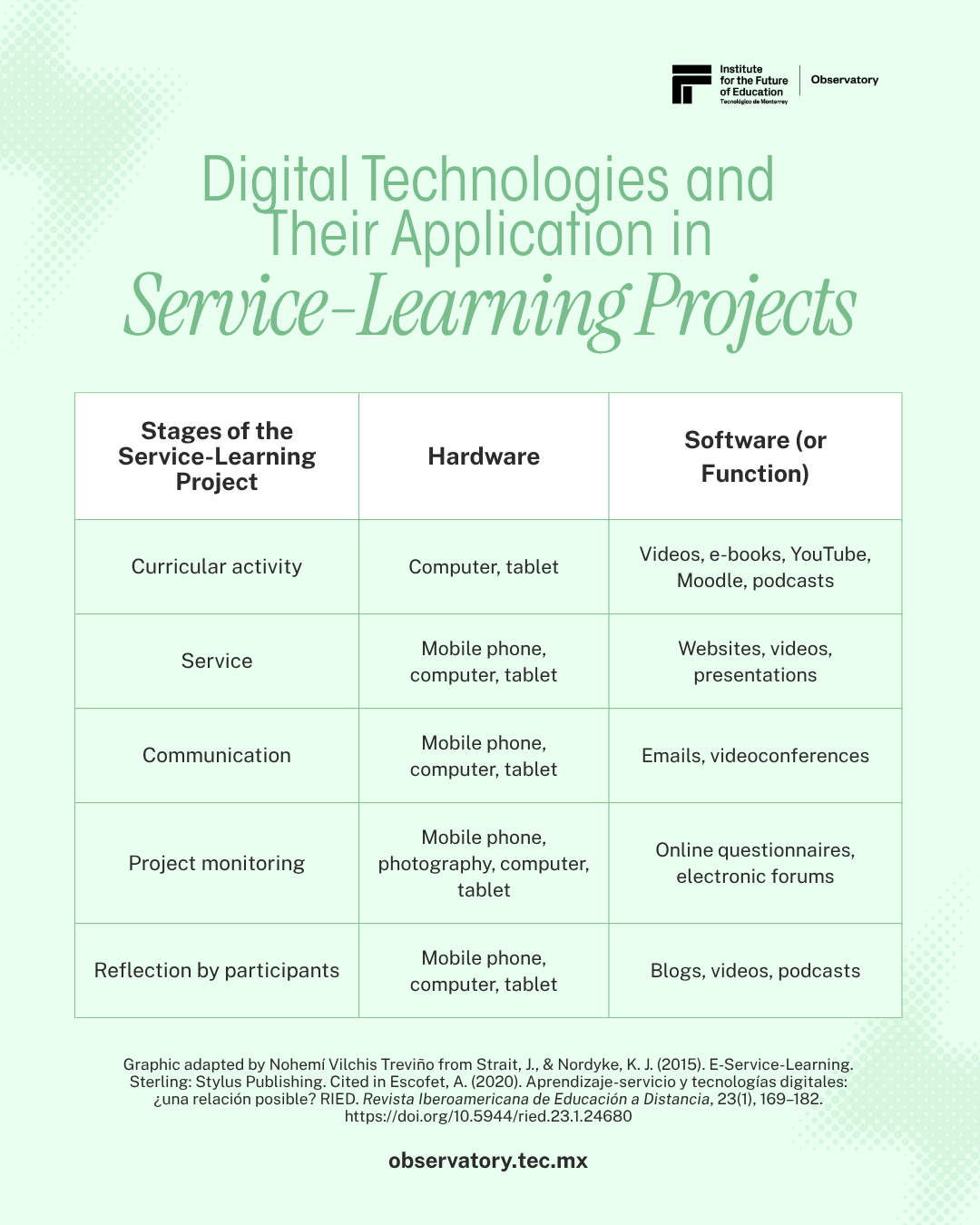
Although hybrid models exist that combine in-person with virtual service, and others that are purely in-person or online, the decision on how to combine them or the final choice depends on the expected results of the project. Digital technologies can be included in various ways.
Irene Culcasi, Claudia Russo, and Maria Cinque propose four types of technological interactions in such deployments:
- Instrumental technological interaction: Understands technology as a means to carry out SL projects, without students needing specific technological knowledge. For example, they may use a computer to support or train vulnerable groups.
- Integrated technological interaction: Considers technology as an essential component of the SL project. Its development requires digital skills, since students must use technological tools to create and share educational resources, such as distance-learning materials through social networks.
- Instrumental-objective technological interaction: Identifies technology as the objective of the SL project. Students learn to use existing digital tools they will use in their future profession, applying them in community service. For example, communication students use digital tools to design and develop strategic campaigns for a non-profit organization.
- Integrated objective technological interaction: Considers technology as the central objective of the SL project, including the creation of new technological tools. For example, sustainable engineering students can develop software to design virtual sustainable housing models.
Technology enables solidarity and social action among young people. It helps develop human skills, which are key to their professional future. Specifically, studies have shown that it can have positive effects on social competencies (communication, collaboration, conflict management, and negotiations), personal (leadership, self-evaluation, adaptability, and flexibility), methodological (learning to learn, analytical skills, creativity and innovation, and problem solving), and digital (communication and creation of digital content).
Research led by Culcassi, Russo, and Cinque involved 46 university students aged 21 to 34, from psychology, education, and communication marketing courses. These students participated in hybrid projects due to the pandemic, combining in-person instruction with virtual service. After nine months of reflection and service activities, participants reported increased leadership skills and improved self-assessment. In the end, participants attributed the most importance to communication skills and digital content creation for their professional careers.
Another analysis concludes that seven essential experiences foster learning and reflection among learners in Service-Learning projects: understanding recipients’ real needs, autonomously designing and planning projects, solving real problems, collaborating with diverse individuals, taking on responsibilities, managing uncomfortable emotions, and reflecting on one’s own interests and abilities. Finally, these experiences extend learning beyond the SL project by connecting it to academic subjects and new activities both on and off campus.
Digital technologies within Service-Learning projects facilitate communication between students and communities, but they can also drive collaborative reflection. Synchronous and asynchronous interaction resources enable students to share ideas, respond to others’ contributions, and expand their knowledge through others’ reflections. This approach includes participation from anyone, regardless of location, while creating more accessible spaces for exchanging experiences and collectively constructing learning.
Translation by Daniel Wetta