
By itself, the experience of pursuing a university degree is marked by emotional ups and downs, stressful situations, and moments that can be overwhelming, which requires a constant ability to adapt. Despite this, the experience of a person with a chronic condition adds another layer of complexity: it is challenging to manage an unpredictable condition.
Let’s start by conceptualizing chronic diseases. Although this term encompasses various conditions, it is relevant to define it as a long-term health condition, mainly because it lasts more than three months and has a fluctuating nature. Although symptoms vary, they share discomfort accompanied by chronic fatigue, pain, and impaired cognitive function, which can cause sudden emotional changes and even impair speech, making it difficult to concentrate, or causing brain fog.
Chronic conditions include asthma, Crohn’s disease, epilepsy, multiple sclerosis, lupus, rheumatoid arthritis, cardiovascular diseases, gastrointestinal disorders, ulcerative colitis, chronic depression, diabetes, chronic migraine, cancer, HIV/AIDS, skin conditions, Parkinson’s disease, endometriosis, adenomyosis, and fibromyalgia, among many others.
Such conditions require long-term management; unfortunately, many are also invisible. That is, they do not necessarily manifest themselves palpably to other people, which can lead to misunderstandings, frustration, isolation, sadness, or anger. The inconspicuous nature of these conditions makes it difficult for those who have not experienced them directly or lived closely with someone who suffers from them to understand their impact on daily life fully.
Many chronic illnesses carry stigma, so those living with them may bear uncomfortable social interactions, social rejection, or stereotypes about their physical, mental, or emotional abilities. Even people with more visible conditions or social recognition often face prejudice in environments where a high level of productivity is expected. Consider fibromyalgia, a condition that is not yet understood in all its complexity, even within the medical community. This lack of knowledge is conducive to stigmas: those living with persistent fatigue and generalized pain can be labeled as “hypochondriacs” and the legitimacy of their symptoms called into question. However, fibromyalgia is an invisible, profoundly disabling, and exhausting disease.
The challenges faced by a person with varying daily physical discomforts and medication side effects are overwhelming enough. In addition, in college it is necessary to comply with a schedule that does not fit these symptoms. Moreover, time must be carved out for medical appointments or treatments that may or may not work, as well as for monitoring and maintenance of the condition.
Students may be affected by fatigue, nausea, or other symptoms that limit their academic performance for a few hours or days. Similar to more traditional or noticeable disabilities, which require specific support devices such as wheelchairs, chronic diseases require flexible support and accommodation.
Notably, people with chronic conditions may have “flare-ups” or episodes that can last for days, during which the discomfort worsens, daily functions are carried out with greater difficulty, and they are especially painful. Also, going back to school after treatment is often an exhausting readjustment.
Although everyone approaches their condition as they know and prefer, I can say, based on my university experience, that compassion for oneself and achieving as much flexibility as possible are key to having a university experience like your peers. [I had an autoimmune disease; I found out later that I was living with four chronic conditions during this period.] The more you get to know yourself and learn to read and listen to your body, the more you can deal with the curricular subjects and, later, your professional life, and you can decide what to communicate to the world about your impairment. In my case, I have been very fortunate to have empathetic personal and professional environments, so making my conditions visible has been more a matter of awareness than a battlefield.
Sometimes it is useful to listen to the testimony of others, to learn about realities very different from ours, and not to feel so alone in the process. Therefore, if you normally experience pain simply sitting in the classroom, listening to the teacher, but having difficulty concentrating with so much noise inside you, unable to take notes because today the joints of your hand do not respond, and even getting to the classroom was an odyssey of walking, I accompany your experience with respect and admiration.
There will be small and big battles won over time, but remember that the most realistic thing is that balancing life like on a scale would be dedicating 50% to your health and 50% to studying. However, days with chronic illness are very variable, so balance means looking at one day at a time and identifying how much energy you have and how to distribute it for your greater good.
Effort measured in teaspoons (Spoon Theory)
If you’re not yet familiar with this term or know someone with a chronic condition who uses it, but don’t know what it is or how it works, I’ll explain it simply. American writer Christine Miserandino coined this theory in a 2003 essay to simplify measuring the day’s energy using spoons. Yes, you project that today you have a certain number of spoons to use wisely to manage your daily activities, which could include going out for coffee and chatting with a friend, or brushing your teeth. Each activity is equivalent to a specific number of spoons based on the energy required.
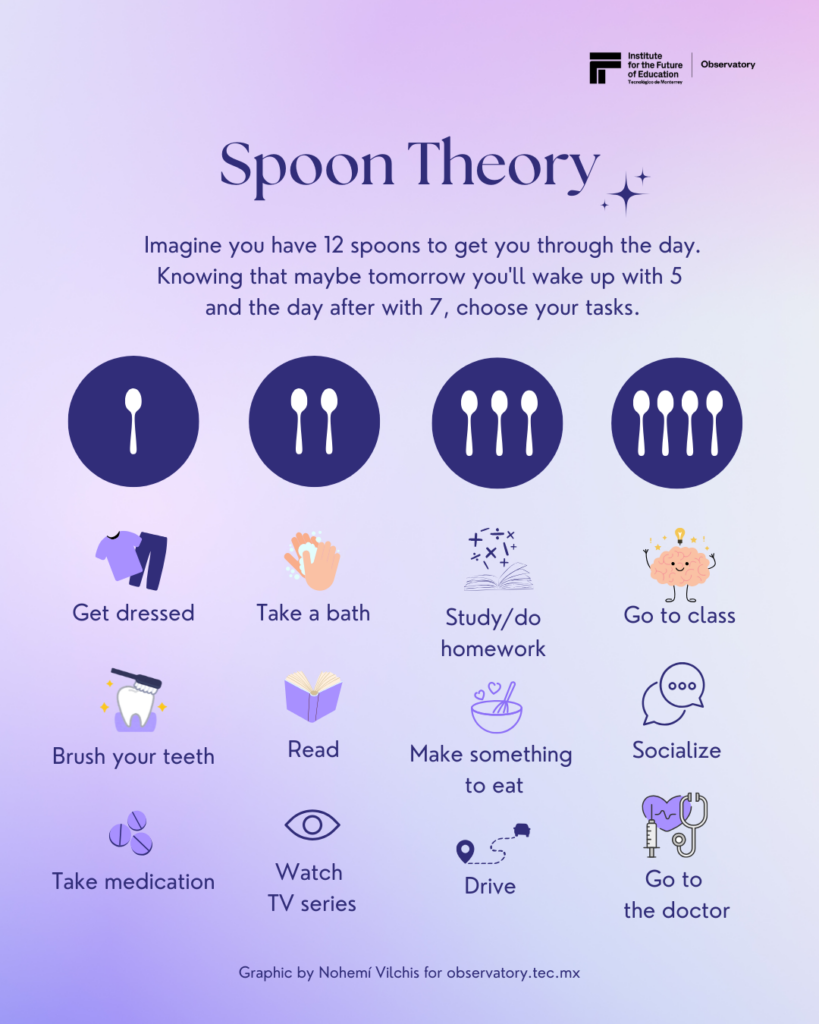
Consider that each individual evaluates how many spoons they give to a task. Imagine waking up and analyzing your energy level: today, you only have four spoons to manage the day. So, maybe a consideration is bathing (1 spoon), and hopefully, someone can take you to classes, so you don’t have to drive. You arrive, but you must move around the institution, sit down, participate, and pay attention (2 spoons). Your friends invite you out in the afternoon. Only one spoon remains. You can go, but then how do you study for tomorrow’s exam without energy? These are your own decisions, perhaps you need to reconnect with people to feel like a functional person, so you accompany them (1 spoon) with the logic that: I will return home early and prioritize my rest. Maybe tomorrow you’ll wake up with seven spoons. Now, with time before the exam, you study with more concentration (3 spoons).
Everything is very relative and depends on the case, but the spoon theory helps you make decisions that contribute to your well-being.
Specific tips
There may be no magic formula for dealing with a chronic illness, but those who have already walked that path and faced the challenges have developed useful strategies. Below are some recommendations that students, based on their own experience, have identified as most effective.
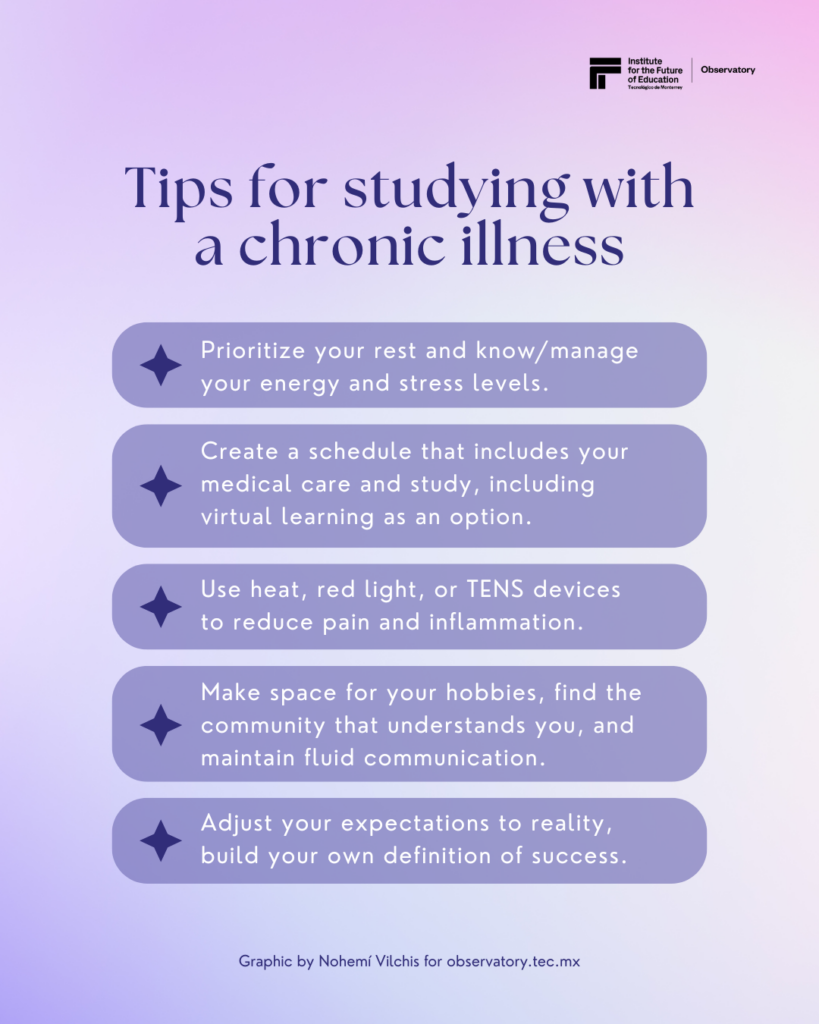
First, as already mentioned, it is essential to manage your energy levels. Therefore, you must mainly evaluate how much you can do, even if you would like to do everything and strive to be like your classmates. Dosing energy helps you accomplish more in the time you allotted yourself. Distribute tasks into manageable sections to avoid overload.
Other students point out that staying too busy can take its toll, so organization is key to avoiding collapse. Similarly, they highlight the importance of being aware of one’s own needs, such as spending time meditating, exercising, or doing restorative activities like yoga or mental exercises.
Creating a comprehensive schedule can help you establish a specific routine that supports your health, medical appointments, personal care, and academics. Once those are allotted, you can adjust your university subject schedule accordingly. For example, if you find the afternoons difficult because of concentration problems or pain, try to choose classes in the morning. If you can select online courses, virtual learning is a great option that allows flexibility without requiring as much physical effort.
Taking breaks during the day is extremely important, as well as taking time to eat and recharge. Prioritizing rest will help avoid overexertion that leads to a flare-up of the disease, since a small decrease in the quantity or quality of sleep can affect your performance. Even if you sleep, it does not mean that the body has rested or repaired itself. However, if you start your day with 15 to 30 minutes of sunlight, you can contribute to a good night’s rest because sunlight helps regulate your circadian rhythm and stabilize melatonin levels.
Stress management has a profound effect on your health. Anticipate and take into account what is important to you; eliminate what does not matter to attenuate the noise inside you. Preparing yourself with everything you need to take a class, such as medication, a heat pack, or a snack to keep you focused, can help reduce unnecessary stress. Consider packing light so your backpack is not heavy, but do carry the essentials.
Pain-relieving devices can increase your productivity. These include compresses or devices that emit heat for muscles or joints, a TENS (Transcutaneous Electrical Nerve Stimulation) unit that, through electrical currents and neuromodulation, mitigates acute pain. Red light therapy (photobiomodulation) also reduces inflammation and speeds muscle recovery. Even lidocaine patches may give you a break. Wearing comfortable clothes can also make your day-to-day life easier, although it is revitalizing to dress up from time to time.
Other comforting aspects are hobbies and finding your community. Although free time is limited while you are in college and depends on your spoons, finding spaces for hobbies that you enjoy fuels your well-being. Also, although this is usually a lonely journey, meeting people who understand what you are going through helps you relate and find safe spaces and support networks. There are online groups where you can find people, clubs, or interactive places with your peers; It is motivating to discover that many human beings are very empathetic and ready to be a great support to help you navigate your condition.
Communication is critical for others to understand you. I know that sometimes it can be difficult to share your vulnerability; it really is your decision. The whole class may not have to hear about it, but talking to your teacher, program director, or administration can make your experience more bearable. Some institutions offer programs with support for people with health conditions. Also, teachers may be able to offer you different deadlines or accommodations. The information they have about you can be valuable to your practice. Asking for help is not a sign of weakness; it can help you become stronger, so you don’t waste all your energy, and your body can repair what is necessary.
To access more specific tips, here are some tricks for studying, from preparing your study environment to how to exercise your attention span with a chronic illness.
While all these recommendations help lighten the process, it’s crucial to have realistic expectations. On the one hand, there is the optimism of healing; on the other, you bear the great weight of symptoms, exhaustion, and limitations. So, juggling these two aspects requires you to move away from the toxic optimism of “it’s all in the mind,” that through mental power alone, you can deal with the day. While the mind can be powerful, the body often recognizes better which path to follow.
To thrive in college, building a new definition of the word “success” for you is paramount. Sometimes you may not take as many classes as your peers, or perhaps you will graduate in a different timeframe, but that does not mean you are behind or failing in some way. Your path will always be different, but that does not make you any less strong or less meaningful. You can opt for a reduced academic load if your situation allows it, because you might need medical leave or you may change your major, as can happen with other of your classmates. Decisions should be based on your health, which is the primary consideration.
Most of all, celebrate your accomplishments: some may seem small by society’s standards, but attaining them every day while dealing with so much on your plate is a huge effort that deserves a lot of recognition; it is a true feat. You are your own advocate, not only medically, but also as you fight for a life that only you know how difficult it has been to face. Always appreciate your courage.
How to be an ally?
If you are a teacher and you are looking to create a learning place for your chronic-condition students in harmony with their health, the Free University of Amsterdam proposes six suggestions:
- Provide a structured and predictable education.
- Be flexible with attendance and participation.
- Create a learning environment with few stimuli.
- Provide flexibility in assignments and assessments.
- Support in the planning and orientation of studying.
- Build an inclusive and supportive environment.
But how to achieve these adaptations promptly? For example, if a student has difficulty taking notes due to lack of concentration or rigidity in their hands, allow the use of technology, such as a computer or voice recorder.
For students who not only have brain fog but also physical limitations or reasons why they must miss classes frequently, a great help is to provide a tutor, a note taker, or a lab assistant when needed. Above all, be flexible, allowing extra time for these students to turn in assignments or projects and to take exams. It also helps their concentration by allowing exams to be taken in quiet places with few distractions.
Some chronic-condition students have physical symptoms or frequent needs during class. Offering breaks to rest, hydrate, go to the bathroom, or move, without judgment, creates a safe space. The important thing is to personalize support based on their abilities, symptoms, and specific needs. In this way, such students will develop their full potential. Teaching and supporting them in the practice of self-awareness and self-regulation gives them tools that serve both student life and life in general.
Do you know someone with a chronic illness? Avoid being the person who makes them deal with negative attitudes. Bullick invites you to consider a series of steps to reflect on before approaching students with heavy complexities.
- See the person beyond their illness.
- Focus on their capabilities, not their limitations.
- Listen and learn from their experience to better understand their condition.
- Educate yourself before making judgments or assumptions. The Internet has a lot of information, although not enough about many of these diseases. Don’t assume it is your only source.
- Practice patience and empathy in the face of the challenges you encounter when providing support.
- Support initiatives and organizations that promote the inclusion and well-being of people with chronic illnesses.
Finally, as a person with a chronic condition, I offer that if it seems evident that you can do it all, that does not mean that you should do it. Dealing with the disease is complex and burdensome enough. Sometimes its many challenges and new experiences can be simply overwhelming. Find balance for yourself, prioritize what your body communicates to you, and compassionately permit yourself to rest, fall apart, or rebuild when you need it.
Translation by Daniel Wetta