
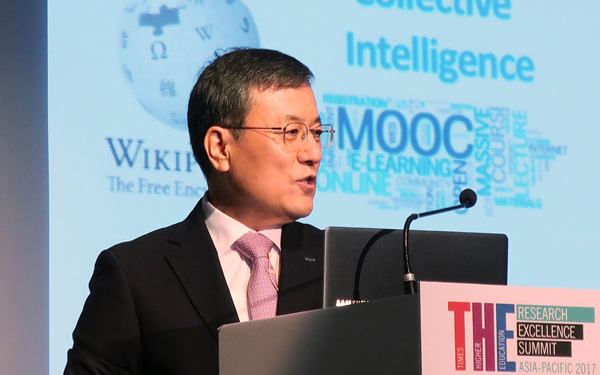
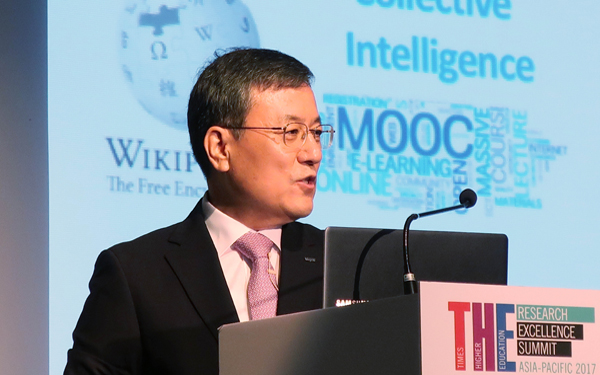
KAIST President Sung-Chul Shin during his keynote speech at the Times Higher Education Research Excellence Summit.
Universities should play a central role in developing the fourth industrial revolution but in order to achieve it, universities must embrace cross-disciplinary education and research.
This was the message Sung-Chul Shin, president of the Korea Advanced Institute of Science and Technology (KAIST), gave in his keynote speech at the Times Higher Education Research Excellence Summit held in Taichung, Taiwan.
“Especially, in addressing pressing global issues and big science, international collaboration will be very effective and crucial,” Professor Shin said at the summit.
He also pointed out three components that will drive the fourth industrial revolution:
- Hyperconnectivity
- Superintelligence
- The convergence of science and technology
Professor Shin also presented a Non-Departmental Education Track, which KAIST plans to implement next semester. The track is designed to prepare students for the new industrial era and will focus on whole brain education, entrepreneurship, and leadership education.
“It is imperative to foster creative young talents fluent in convergence, collaboration, and communication skills in the new era. To this end, we need to focus on whole brain education by enhancing basic education in science and engineering plus humanities and social studies,” he stressed.
The fourth industrial revolution “is predicted to change the way we live, work and relate to each other,” writes Holly Else in Times Higher Education. That is why Professor Shin believes that “an education in the humanities and social sciences, in addition to a strong training in basic science and engineering,” will be vital to prepare students for the digital revolution.
Students must develop a set of values such as thoughtfulness, wisdom, and emotion in order to deal with the advent of artificial intelligence. “Those traits add undeniable educational value that we should continue to pursue even in the era of Robo Sapiens,” he added.